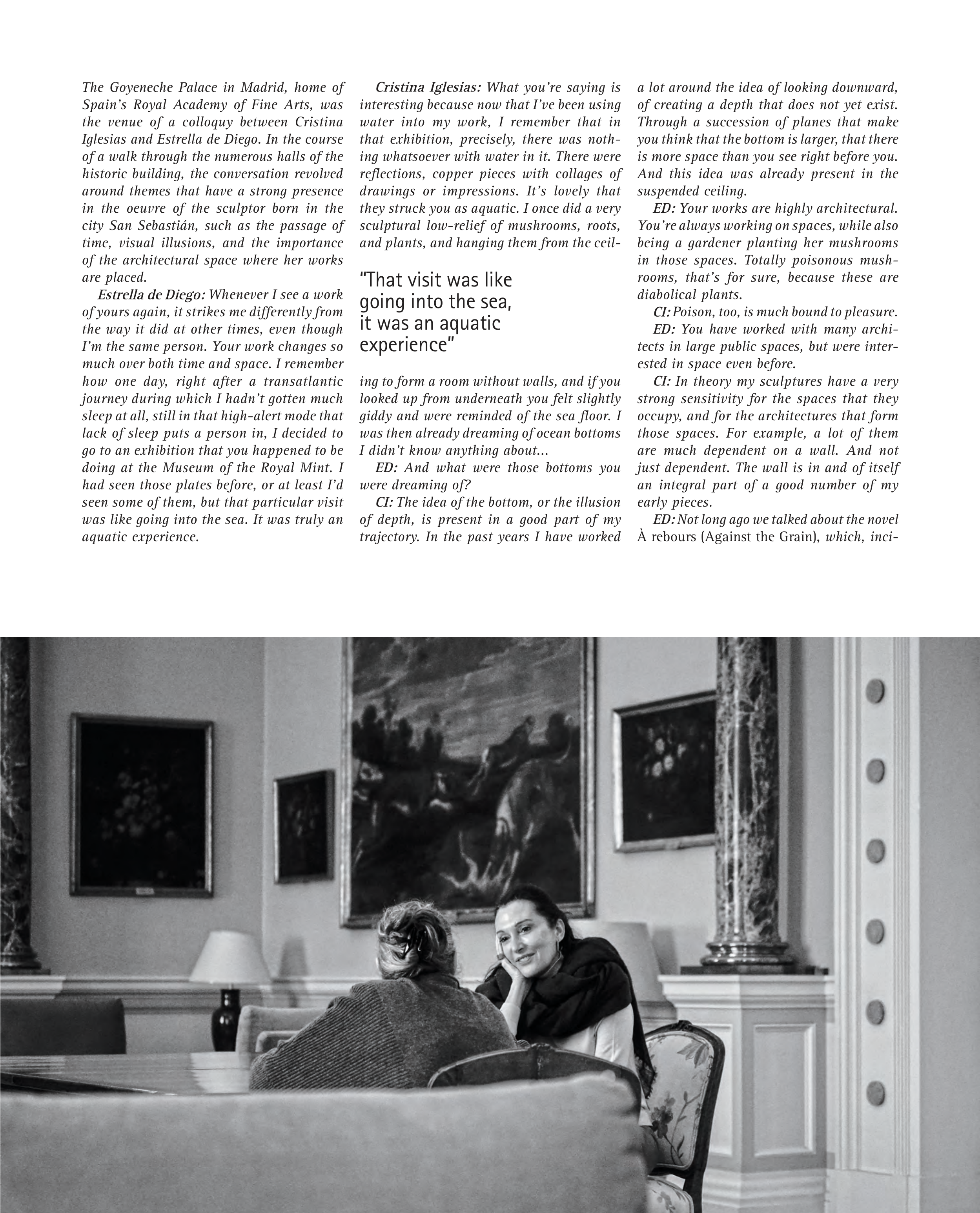
The Goyeneche Palace in Madrid, home of
Spain’s Royal Academy of Fine Arts, was
the venue of a colloquy between Cristina
Iglesias and Estrella de Diego. In the course
of a walk through the numerous halls of the
historic building, the conversation revolved
around themes that have a strong presence
in the oeuvre of the sculptor born in the
city San Sebastián, such as the passage of
time, visual illusions, and the importance
of the architectural space where her works
are placed.
Estrella de Diego: Whenever I see a work
of yours again, it strikes me differently from
the way it did at other times, even though
I’m the same person. Your work changes so
much over both time and space. I remember
how one day, right after a transatlantic
journey during which I hadn’t gotten much
sleep at all, still in that high-alert mode that
lack of sleep puts a person in, I decided to
go to an exhibition that you happened to be
doing at the Museum of the Royal Mint. I
had seen those plates before, or at least I’d
seen some of them, but that particular visit
was like going into the sea. It was truly an
aquatic experience.
Cristina Iglesias: What you’re saying is
interesting because now that I’ve been using
water into my work, I remember that in
that exhibition, precisely, there was noth-
ing whatsoever with water in it. There were
reflections, copper pieces with collages of
drawings or impressions. It’s lovely that
they struck you as aquatic. I once did a very
sculptural low-relief of mushrooms, roots,
and plants, and hanging them from the ceil-
ing to form a room without walls, and if you
looked up from underneath you felt slightly
giddy and were reminded of the sea floor. I
was then already dreaming of ocean bottoms
I didn’t know anything about...
ED: And what were those bottoms you
were dreaming of?
CI: The idea of the bottom, or the illusion
of depth, is present in a good part of my
trajectory. In the past years I have worked
a lot around the idea of looking downward,
of creating a depth that does not yet exist.
Through a succession of planes that make
you think that the bottom is larger, that there
is more space than you see right before you.
And this idea was already present in the
suspended ceiling.
ED: Your works are highly architectural.
You’re always working on spaces, while also
being a gardener planting her mushrooms
in those spaces. Totally poisonous mush-
rooms, that’s for sure, because these are
diabolical plants.
CI: Poison, too, is much bound to pleasure.
ED: You have worked with many archi-
tects in large public spaces, but were inter-
ested in space even before.
CI: In theory my sculptures have a very
strong sensitivity for the spaces that they
occupy, and for the architectures that form
those spaces. For example, a lot of them
are much dependent on a wall. And not
just dependent. The wall is in and of itself
an integral part of a good number of my
early pieces.
ED: Not long ago we talked about the novel
À rebours (Against the Grain), which, inci-
“That visit was like
going into the sea,
it was an aquatic
experience”