C 20 59
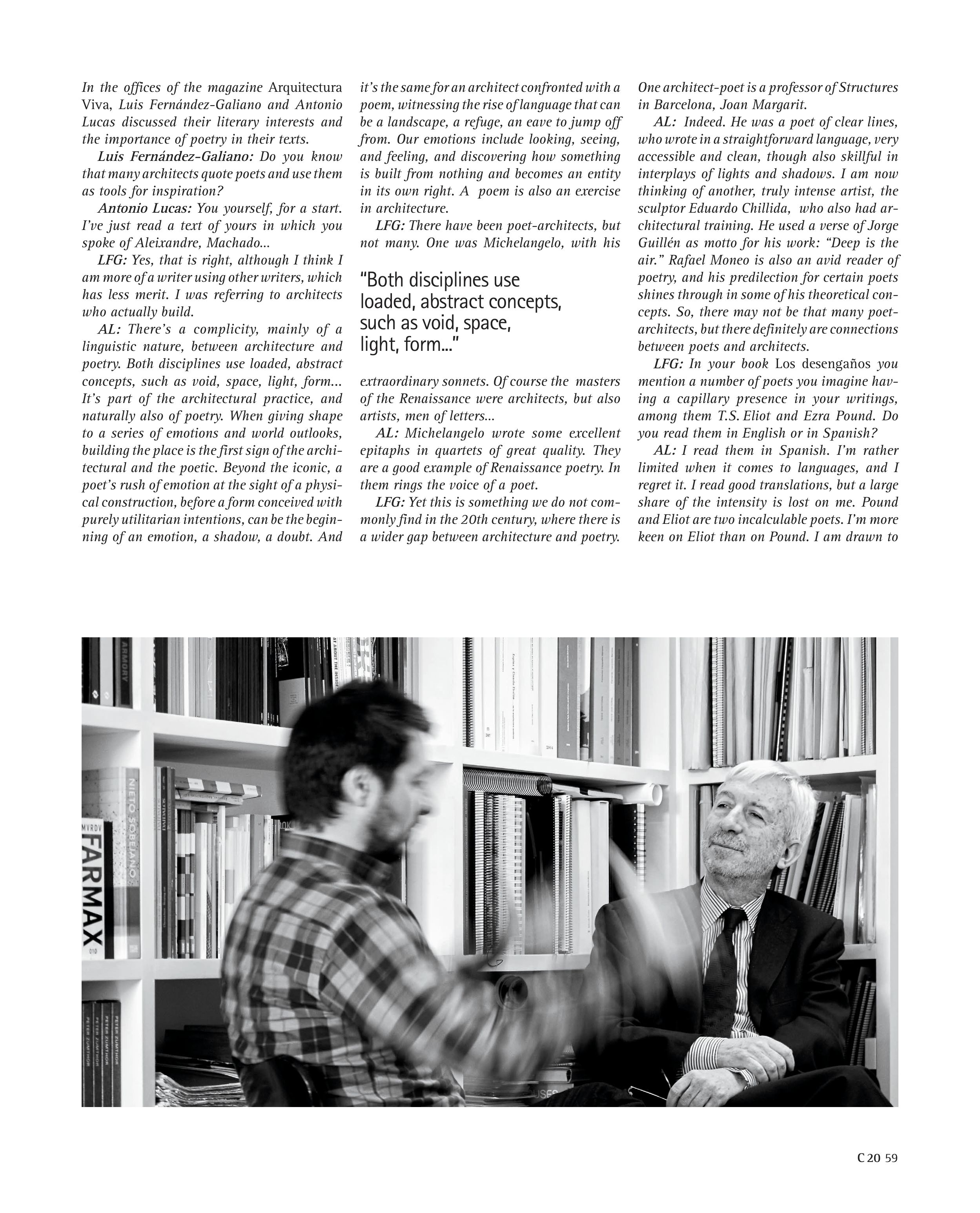
In the offices of the magazine Arquitectura
Viva, Luis Fernández-Galiano and Antonio
Lucas discussed their literary interests and
the importance of poetry in their texts.
Luis Fernández-Galiano: Do you know
that many architects quote poets and use them
as tools for inspiration?
Antonio Lucas: You yourself, for a start.
I’ve just read a text of yours in which you
spoke of Aleixandre, Machado…
LFG: Yes, that is right, although I think I
am more of a writer using other writers, which
has less merit. I was referring to architects
who actually build.
AL: There’s a complicity, mainly of a
linguistic nature, between architecture and
poetry. Both disciplines use loaded, abstract
concepts, such as void, space, light, form...
It’s part of the architectural practice, and
naturally also of poetry. When giving shape
to a series of emotions and world outlooks,
building the place is the first sign of the archi-
tectural and the poetic. Beyond the iconic, a
poet’s rush of emotion at the sight of a physi-
cal construction, before a form conceived with
purely utilitarian intentions, can be the begin-
ning of an emotion, a shadow, a doubt. And
it’s the same for an architect confronted with a
poem, witnessing the rise of language that can
be a landscape, a refuge, an eave to jump off
from. Our emotions include looking, seeing,
and feeling, and discovering how something
is built from nothing and becomes an entity
in its own right. A poem is also an exercise
in architecture.
LFG: There have been poet-architects, but
not many. One was Michelangelo, with his
extraordinary sonnets. Of course the masters
of the Renaissance were architects, but also
artists, men of letters…
AL: Michelangelo wrote some excellent
epitaphs in quartets of great quality. They
are a good example of Renaissance poetry. In
them rings the voice of a poet.
LFG: Yet this is something we do not com-
monly find in the 20th century, where there is
a wider gap between architecture and poetry.
One architect-poet is a professor of Structures
in Barcelona, Joan Margarit.
AL: Indeed. He was a poet of clear lines,
who wrote in a straightforward language, very
accessible and clean, though also skillful in
interplays of lights and shadows. I am now
thinking of another, truly intense artist, the
sculptor Eduardo Chillida, who also had ar-
chitectural training. He used a verse of Jorge
Guillén as motto for his work: “Deep is the
air.” Rafael Moneo is also an avid reader of
poetry, and his predilection for certain poets
shines through in some of his theoretical con-
cepts. So, there may not be that many poet-
architects, but there definitely are connections
between poets and architects.
LFG: In your book Los desengaños you
mention a number of poets you imagine hav-
ing a capillary presence in your writings,
among them T.S. Eliot and Ezra Pound. Do
you read them in English or in Spanish?
AL: I read them in Spanish. I’m rather
limited when it comes to languages, and I
regret it. I read good translations, but a large
share of the intensity is lost on me. Pound
and Eliot are two incalculable poets. I’m more
keen on Eliot than on Pound. I am drawn to
“Both disciplines use
loaded, abstract concepts,
such as void, space,
light, form...”