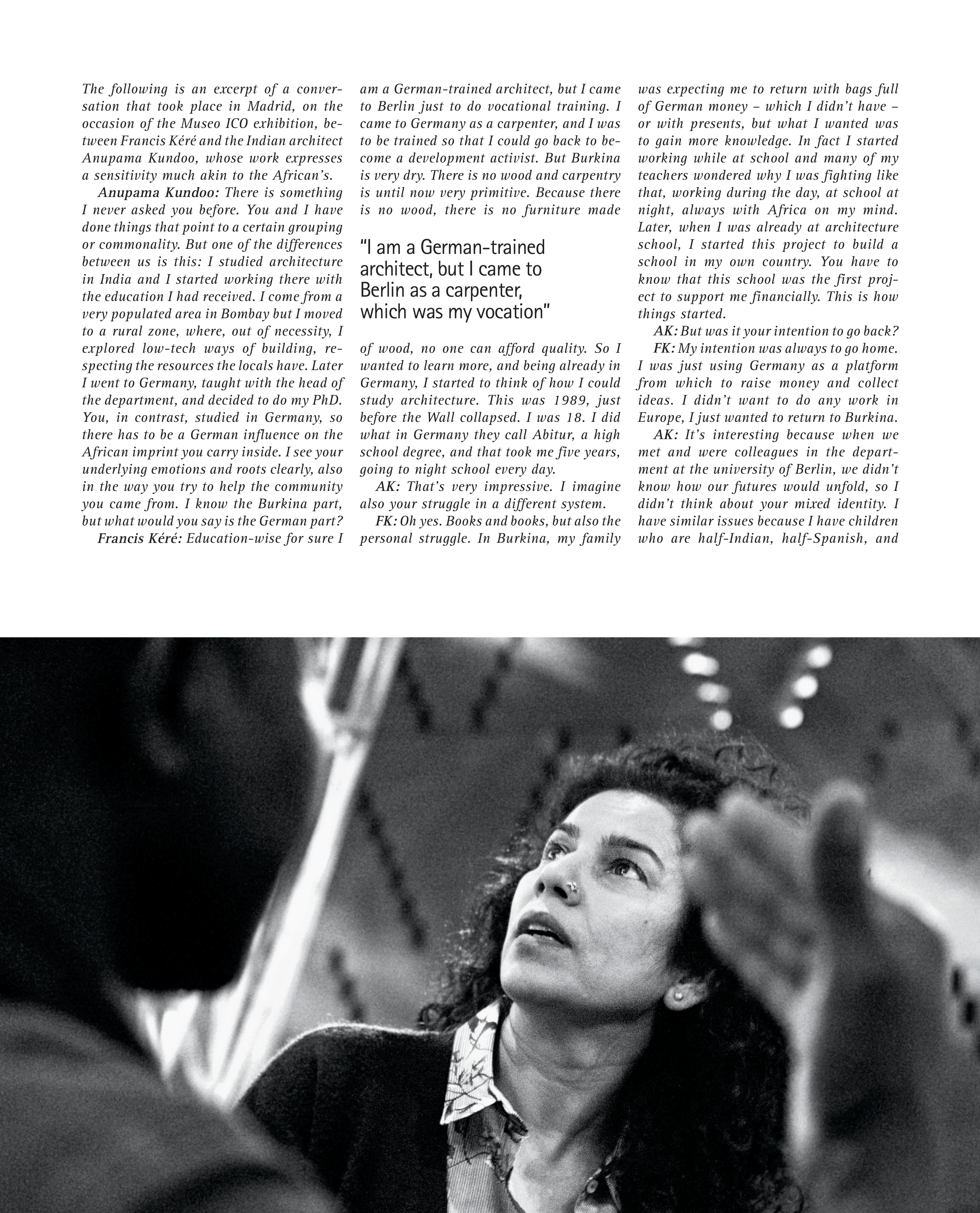
The following is an excerpt of a conver-
sation that took place in Madrid, on the
occasion of the Museo ICO exhibition, be-
tween Francis Kéré and the Indian architect
Anupama Kundoo, whose work expresses
a sensitivity much akin to the African’s.
Anupama Kundoo: There is something
I never asked you before. You and I have
done things that point to a certain grouping
or commonality. But one of the differences
between us is this: I studied architecture
in India and I started working there with
the education I had received. I come from a
very populated area in Bombay but I moved
to a rural zone, where, out of necessity, I
explored low-tech ways of building, re-
specting the resources the locals have. Later
I went to Germany, taught with the head of
the department, and decided to do my PhD.
You, in contrast, studied in Germany, so
there has to be a German influence on the
African imprint you carry inside. I see your
underlying emotions and roots clearly, also
in the way you try to help the community
you came from. I know the Burkina part,
but what would you say is the German part?
Francis Kéré: Education-wise for sure I
am a German-trained architect, but I came
to Berlin just to do vocational training. I
came to Germany as a carpenter, and I was
to be trained so that I could go back to be-
come a development activist. But Burkina
is very dry. There is no wood and carpentry
is until now very primitive. Because there
is no wood, there is no furniture made
of wood, no one can afford quality. So I
wanted to learn more, and being already in
Germany, I started to think of how I could
study architecture. This was 1989, just
before the Wall collapsed. I was 18. I did
what in Germany they call Abitur, a high
school degree, and that took me five years,
going to night school every day.
AK: That’s very impressive. I imagine
also your struggle in a different system.
FK: Oh yes. Books and books, but also the
personal struggle. In Burkina, my family
was expecting me to return with bags full
of German money – which I didn’t have –
or with presents, but what I wanted was
to gain more knowledge. In fact I started
working while at school and many of my
teachers wondered why I was fighting like
that, working during the day, at school at
night, always with Africa on my mind.
Later, when I was already at architecture
school, I started this project to build a
school in my own country. You have to
know that this school was the first proj-
ect to support me financially. This is how
things started.
AK: But was it your intention to go back?
FK: My intention was always to go home.
I was just using Germany as a platform
from which to raise money and collect
ideas. I didn’t want to do any work in
Europe, I just wanted to return to Burkina.
AK: It’s interesting because when we
met and were colleagues in the depart-
ment at the university of Berlin, we didn’t
know how our futures would unfold, so I
didn’t think about your mixed identity. I
have similar issues because I have children
who are half-Indian, half-Spanish, and
“I am a German-trained
architect, but I came to
Berlin as a carpenter,
which was my vocation”