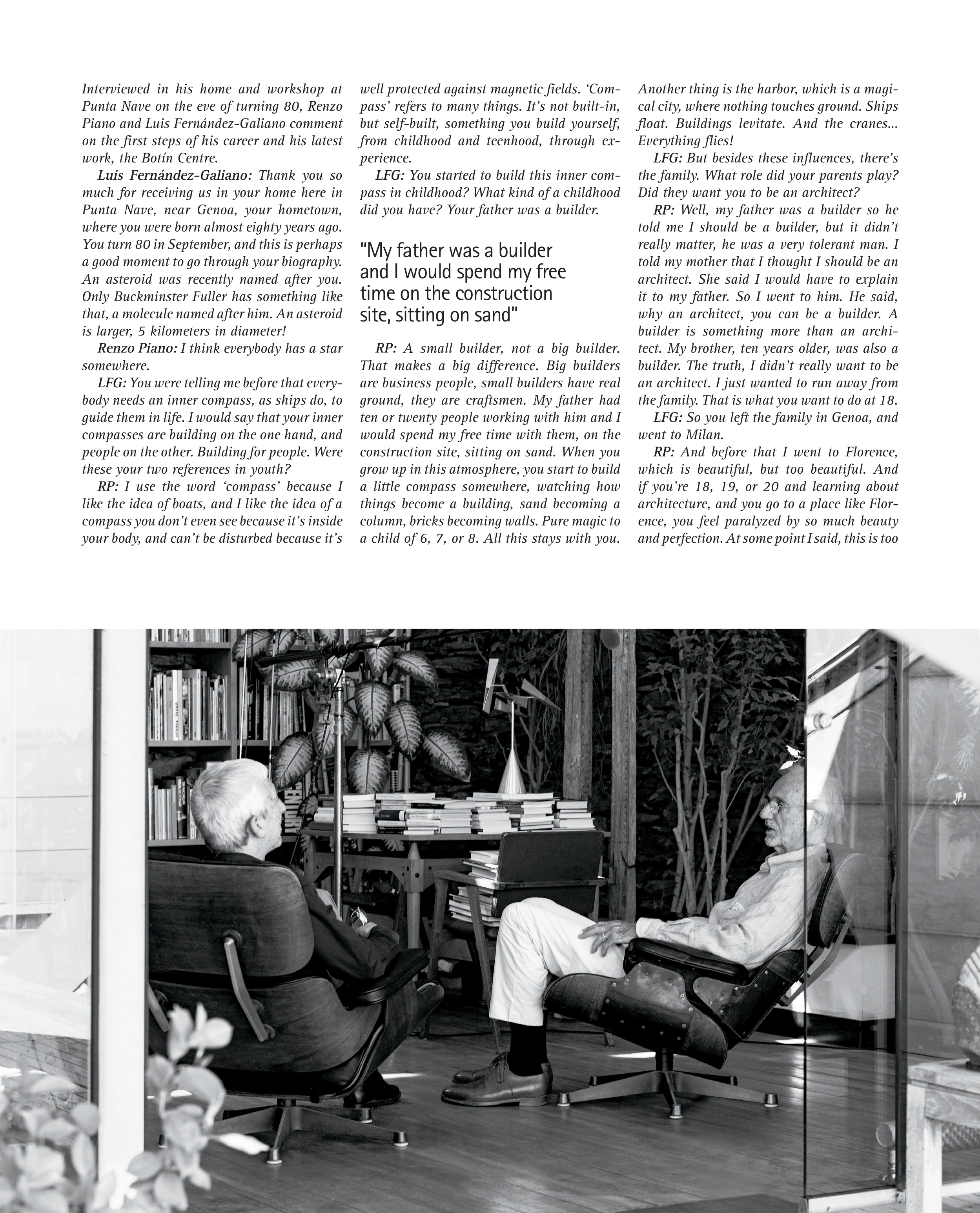
Interviewed in his home and workshop at
Punta Nave on the eve of turning 80, Renzo
Piano and Luis Fernández-Galiano comment
on the first steps of his career and his latest
work, the Botín Centre.
Luis Fernández-Galiano: Thank you so
much for receiving us in your home here in
Punta Nave, near Genoa, your hometown,
where you were born almost eighty years ago.
You turn 80 in September, and this is perhaps
a good moment to go through your biography.
An asteroid was recently named after you.
Only Buckminster Fuller has something like
that, a molecule named after him. An asteroid
is larger, 5 kilometers in diameter!
Renzo Piano: I think everybody has a star
somewhere.
LFG: You were telling me before that every-
body needs an inner compass, as ships do, to
guide them in life. I would say that your inner
compasses are building on the one hand, and
people on the other. Building for people. Were
these your two references in youth?
RP: I use the word ‘compass’ because I
like the idea of boats, and I like the idea of a
compass you don’t even see because it’s inside
your body, and can’t be disturbed because it’s
well protected against magnetic fields. ‘Com-
pass’ refers to many things. It’s not built-in,
but self-built, something you build yourself,
from childhood and teenhood, through ex-
perience.
LFG: You started to build this inner com-
pass in childhood? What kind of a childhood
did you have? Your father was a builder.
RP: A small builder, not a big builder.
That makes a big difference. Big builders
are business people, small builders have real
ground, they are craftsmen. My father had
ten or twenty people working with him and I
would spend my free time with them, on the
construction site, sitting on sand. When you
grow up in this atmosphere, you start to build
a little compass somewhere, watching how
things become a building, sand becoming a
column, bricks becoming walls. Pure magic to
a child of 6, 7, or 8. All this stays with you.
Another thing is the harbor, which is a magi-
cal city, where nothing touches ground. Ships
float. Buildings levitate. And the cranes…
Everything flies!
LFG: But besides these influences, there’s
the family. What role did your parents play?
Did they want you to be an architect?
RP: Well, my father was a builder so he
told me I should be a builder, but it didn’t
really matter, he was a very tolerant man. I
told my mother that I thought I should be an
architect. She said I would have to explain
it to my father. So I went to him. He said,
why an architect, you can be a builder. A
builder is something more than an archi-
tect. My brother, ten years older, was also a
builder. The truth, I didn’t really want to be
an architect. I just wanted to run away from
the family. That is what you want to do at 18.
LFG: So you left the family in Genoa, and
went to Milan.
RP: And before that I went to Florence,
which is beautiful, but too beautiful. And
if you’re 18, 19, or 20 and learning about
architecture, and you go to a place like Flor-
ence, you feel paralyzed by so much beauty
and perfection. At some point I said, this is too
“My father was a builder
and I would spend my free
time on the construction
site, sitting on sand”