C 09 59
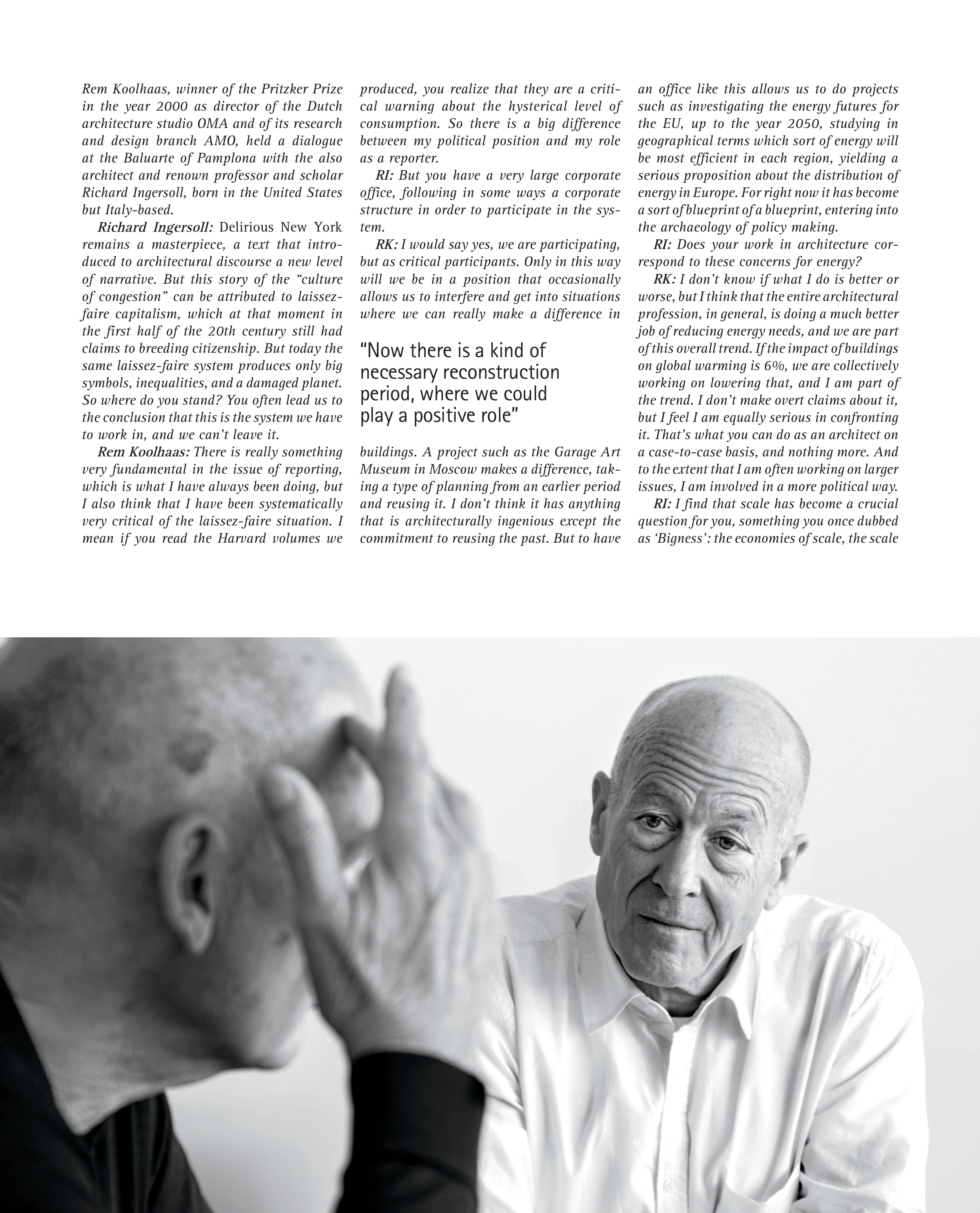
Rem Koolhaas, winner of the Pritzker Prize
in the year 2000 as director of the Dutch
architecture studio OMA and of its research
and design branch AMO, held a dialogue
at the Baluarte of Pamplona with the also
architect and renown professor and scholar
Richard Ingersoll, born in the United States
but Italy-based.
Richard Ingersoll: Delirious New York
remains a masterpiece, a text that intro-
duced to architectural discourse a new level
of narrative. But this story of the “culture
of congestion” can be attributed to laissez-
faire capitalism, which at that moment in
the first half of the 20th century still had
claims to breeding citizenship. But today the
same laissez-faire system produces only big
symbols, inequalities, and a damaged planet.
So where do you stand? You often lead us to
the conclusion that this is the system we have
to work in, and we can’t leave it.
Rem Koolhaas: There is really something
very fundamental in the issue of reporting,
which is what I have always been doing, but
I also think that I have been systematically
very critical of the laissez-faire situation. I
mean if you read the Harvard volumes we
produced, you realize that they are a criti-
cal warning about the hysterical level of
consumption. So there is a big difference
between my political position and my role
as a reporter.
RI: But you have a very large corporate
office, following in some ways a corporate
structure in order to participate in the sys-
tem.
RK: I would say yes, we are participating,
but as critical participants. Only in this way
will we be in a position that occasionally
allows us to interfere and get into situations
where we can really make a difference in
buildings. A project such as the Garage Art
Museum in Moscow makes a difference, tak-
ing a type of planning from an earlier period
and reusing it. I don’t think it has anything
that is architecturally ingenious except the
commitment to reusing the past. But to have
an office like this allows us to do projects
such as investigating the energy futures for
the EU, up to the year 2050, studying in
geographical terms which sort of energy will
be most efficient in each region, yielding a
serious proposition about the distribution of
energy in Europe. For right now it has become
a sort of blueprint of a blueprint, entering into
the archaeology of policy making.
RI: Does your work in architecture cor-
respond to these concerns for energy?
RK: I don’t know if what I do is better or
worse, but I think that the entire architectural
profession, in general, is doing a much better
job of reducing energy needs, and we are part
of this overall trend. If the impact of buildings
on global warming is 6%, we are collectively
working on lowering that, and I am part of
the trend. I don’t make overt claims about it,
but I feel I am equally serious in confronting
it. That’s what you can do as an architect on
a case-to-case basis, and nothing more. And
to the extent that I am often working on larger
issues, I am involved in a more political way.
RI: I find that scale has become a crucial
question for you, something you once dubbed
as ‘Bigness’: the economies of scale, the scale
“Now there is a kind of
necessary reconstruction
period, where we could
play a positive role”