C 09 33
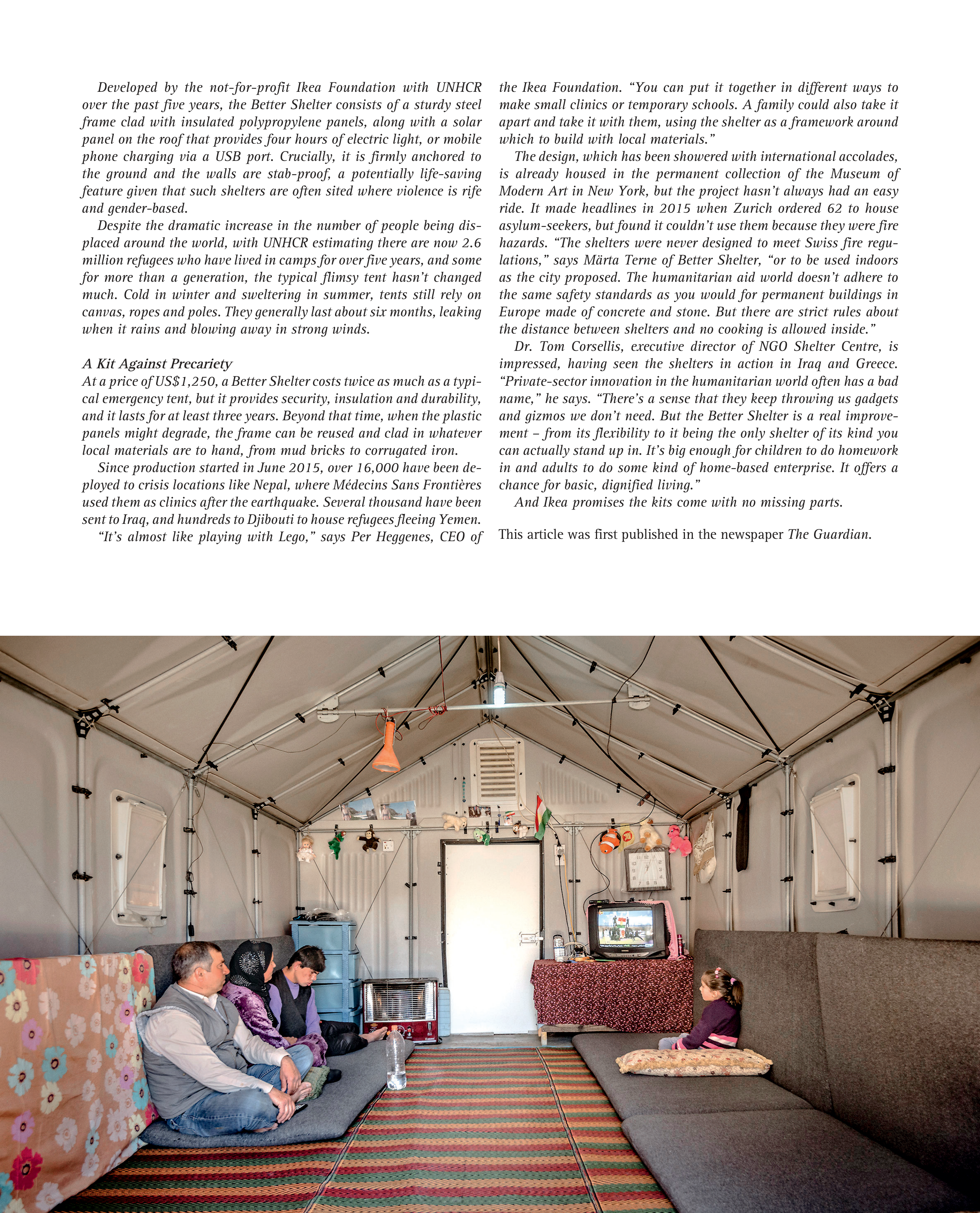
Developed by the not-for-profit Ikea Foundation with UNHCR
over the past five years, the Better Shelter consists of a sturdy steel
frame clad with insulated polypropylene panels, along with a solar
panel on the roof that provides four hours of electric light, or mobile
phone charging via a USB port. Crucially, it is firmly anchored to
the ground and the walls are stab-proof, a potentially life-saving
feature given that such shelters are often sited where violence is rife
and gender-based.
Despite the dramatic increase in the number of people being dis-
placed around the world, with UNHCR estimating there are now 2.6
million refugees who have lived in camps for over five years, and some
for more than a generation, the typical flimsy tent hasn’t changed
much. Cold in winter and sweltering in summer, tents still rely on
canvas, ropes and poles. They generally last about six months, leaking
when it rains and blowing away in strong winds.
A Kit Against Precariety
At a price of US$1,250, a Better Shelter costs twice as much as a typi-
cal emergency tent, but it provides security, insulation and durability,
and it lasts for at least three years. Beyond that time, when the plastic
panels might degrade, the frame can be reused and clad in whatever
local materials are to hand, from mud bricks to corrugated iron.
Since production started in June 2015, over 16,000 have been de-
ployed to crisis locations like Nepal, where Médecins Sans Frontières
used them as clinics after the earthquake. Several thousand have been
sent to Iraq, and hundreds to Djibouti to house refugees fleeing Yemen.
“It’s almost like playing with Lego,” says Per Heggenes, CEO of
the Ikea Foundation. “You can put it together in different ways to
make small clinics or temporary schools. A family could also take it
apart and take it with them, using the shelter as a framework around
which to build with local materials.”
The design, which has been showered with international accolades,
is already housed in the permanent collection of the Museum of
Modern Art in New York, but the project hasn’t always had an easy
ride. It made headlines in 2015 when Zurich ordered 62 to house
asylum-seekers, but found it couldn’t use them because they were fire
hazards. “The shelters were never designed to meet Swiss fire regu-
lations,” says Märta Terne of Better Shelter, “or to be used indoors
as the city proposed. The humanitarian aid world doesn’t adhere to
the same safety standards as you would for permanent buildings in
Europe made of concrete and stone. But there are strict rules about
the distance between shelters and no cooking is allowed inside.”
Dr. Tom Corsellis, executive director of NGO Shelter Centre, is
impressed, having seen the shelters in action in Iraq and Greece.
“Private-sector innovation in the humanitarian world often has a bad
name,” he says. “There’s a sense that they keep throwing us gadgets
and gizmos we don’t need. But the Better Shelter is a real improve-
ment – from its flexibility to it being the only shelter of its kind you
can actually stand up in. It’s big enough for children to do homework
in and adults to do some kind of home-based enterprise. It offers a
chance for basic, dignified living.”
And Ikea promises the kits come with no missing parts.
This article was first published in the newspaper The Guardian.