C 05 51
National Science Foundation, and the National Aeronautics and
Space Administration (NASA), Khoshnevis is experimenting with a
3D printing process called “contour crafting” to print buildings. He
has created a form-free composite-fiber concrete that can be extruded
and that is strong enough to allow a printed wall to support itself
during construction.
Khoshnevis is not alone. The MIT research lab is using 3D printing
to explore ways to create the frame of a house in one day with virtually
no human labor. That same frame would take an entire construction
crew a month to put up.
Dini and Foster + Partners, one of the world’s largest architectural
firms, have teamed up with the European Space Agency to explore
the possibility of using 3D printing to construct a permanent base
on the moon. The buildings would be printed using lunar soil as the
feedstock. The goal is to construct lunar habitats with locally sustain-
able materials found on the moon in order to avoid the logistical cost
of shipping in materials from Earth.
While the 3D printing of buildings is in the very early stages of
development, it is projected to grow exponentially in the coming two
decades as the production process becomes increasingly efficient and
cheaper. Unlike conventional construction techniques, where the cost
of designing architectural blueprints is high, construction materials
are expensive, labor costs are steep, and the time necessary to erect
the structures is lengthy, 3D printing is not affected by these factors.
Whether on the moon or here on Earth, human beings will need
transport to get around. The first 3D-printed automobile, the Urbee,
is already being field tested. The Urbee was developed by KOR Eco-
Logic, a company based in Winnipeg, Canada. The automobile is a
two-passenger hybrid-electric vehicle, which is designed to run on
solar and wind power that can be harvested in a one-car garage each
day. The car can reach speeds of 40 miles per hour. If long driving
distances are necessary, the user can switch over to the car’s ethanol-
powered backup engine. Granted, the Urbee is just the first working
prototype of the new TIR-era automobile, but like the introduction of
Henry Ford’s first mass-produced, gas-powered internal-combustion
engine automobile, the nature of the vehicle’s construction and power
source is highly suggestive of the kind of future it portends for the
economy and society.
A 3D-printed automobile is produced with a very different logic. The
automobile can be made from nearly free feedstock available locally,
eliminating the high cost of rare materials and the costs of shipping
them to the factory and storing them on-site. Most of the parts in the
car are made with 3D-printed plastic, with the exception of the base
chassis and engine. The rest of the car is produced in layers, which
are “added” one onto another in a continuous flow rather than being
assembled together from individual parts, meaning less material, less
time, and less labor are used. A six-foot-high 3D printer poured out
Urbee’s shell in only ten pieces, with no wasted material.
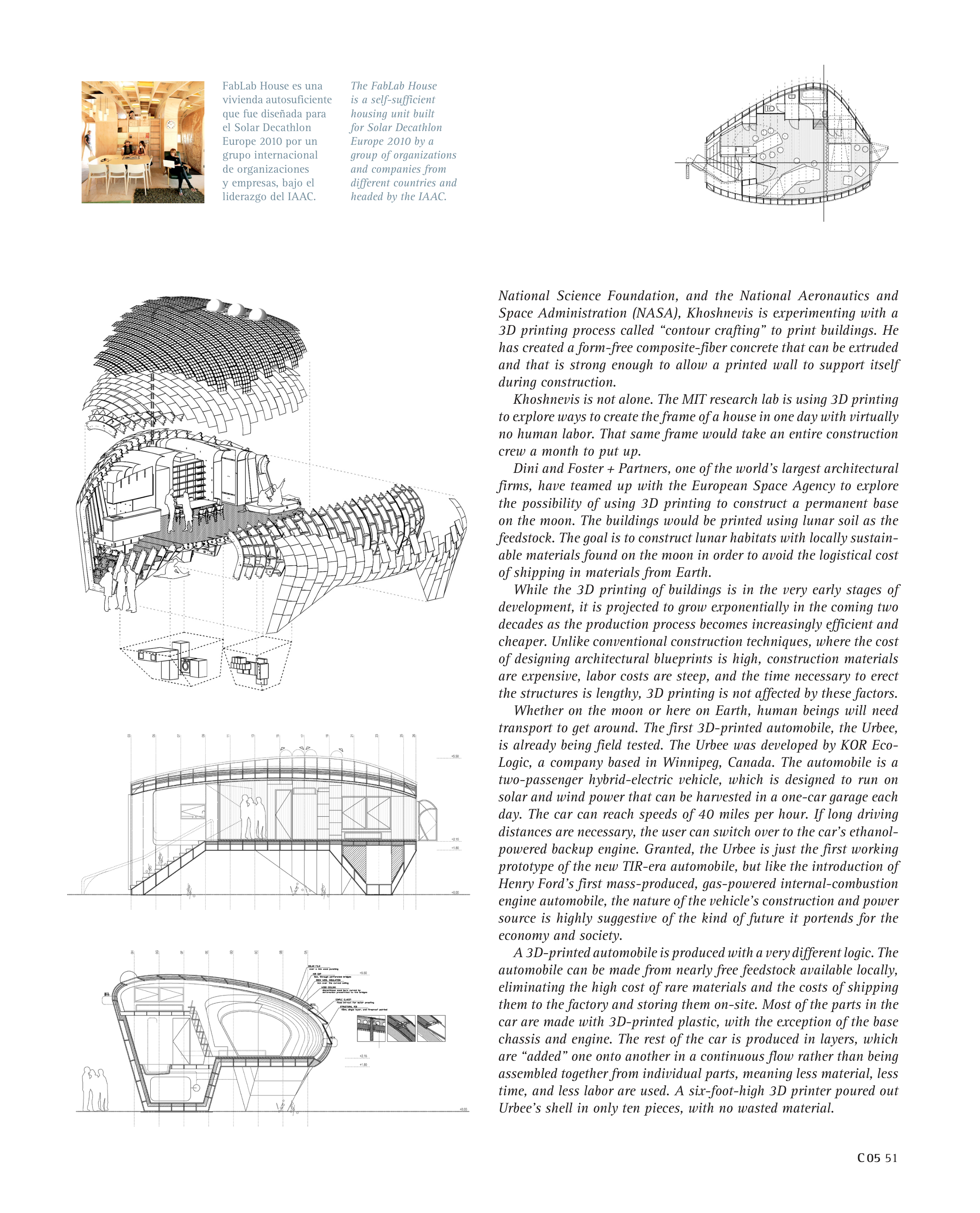
FabLab House es una
vivienda autosuficiente
que fue diseñada para
el Solar Decathlon
Europe 2010 por un
grupo internacional
de organizaciones
y empresas, bajo el
liderazgo del IAAC.
The FabLab House
is a self-sufficient
housing unit built
for Solar Decathlon
Europe 2010 by a
group of organizations
and companies from
different countries and
headed by the IAAC.