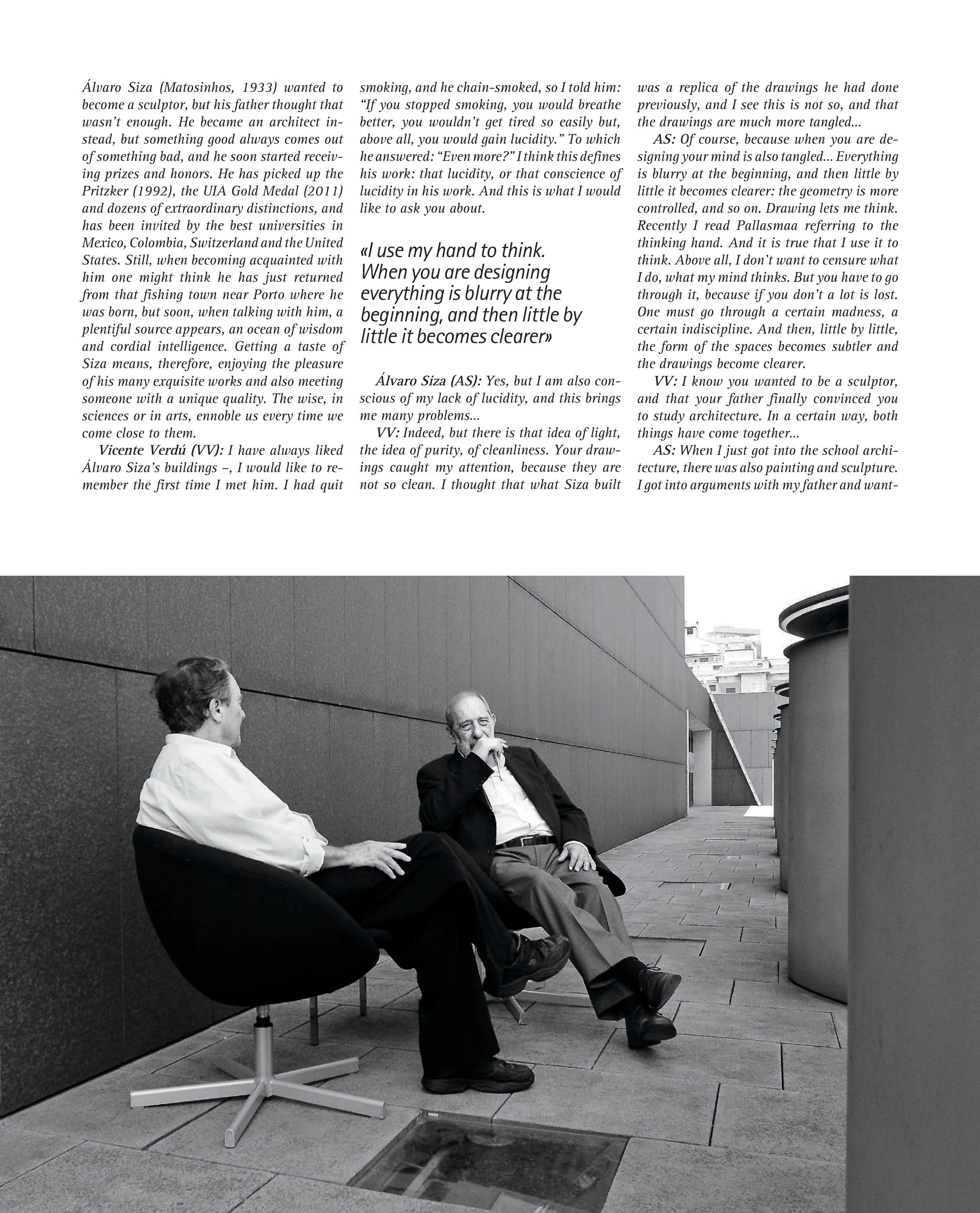
Álvaro Siza (Matosinhos, 1933) wanted to
become a sculptor, but his father thought that
wasn’t enough. He became an architect in-
stead, but something good always comes out
of something bad, and he soon started receiv-
ing prizes and honors. He has picked up the
Pritzker (1992), the UIA Gold Medal (2011)
and dozens of extraordinary distinctions, and
has been invited by the best universities in
Mexico, Colombia, Switzerland and the United
States. Still, when becoming acquainted with
him one might think he has just returned
from that fishing town near Porto where he
was born, but soon, when talking with him, a
plentiful source appears, an ocean of wisdom
and cordial intelligence. Getting a taste of
Siza means, therefore, enjoying the pleasure
of his many exquisite works and also meeting
someone with a unique quality. The wise, in
sciences or in arts, ennoble us every time we
come close to them.
Vicente Verdú (VV): I have always liked
Álvaro Siza’s buildings –, I would like to re-
member the first time I met him. I had quit
smoking, and he chain-smoked, so I told him:
“If you stopped smoking, you would breathe
better, you wouldn’t get tired so easily but,
above all, you would gain lucidity.” To which
he answered: “Even more?” I think this defines
his work: that lucidity, or that conscience of
lucidity in his work. And this is what I would
like to ask you about.
was a replica of the drawings he had done
previously, and I see this is not so, and that
the drawings are much more tangled…
AS: Of course, because when you are de-
signing your mind is also tangled… Everything
is blurry at the beginning, and then little by
little it becomes clearer: the geometry is more
controlled, and so on. Drawing lets me think.
Recently I read Pallasmaa referring to the
thinking hand. And it is true that I use it to
think. Above all, I don’t want to censure what
I do, what my mind thinks. But you have to go
through it, because if you don’t a lot is lost.
One must go through a certain madness, a
certain indiscipline. And then, little by little,
the form of the spaces becomes subtler and
the drawings become clearer.
VV: I know you wanted to be a sculptor,
and that your father finally convinced you
to study architecture. In a certain way, both
things have come together…
AS: When I just got into the school archi-
tecture, there was also painting and sculpture.
I got into arguments with my father and want-
Álvaro Siza (AS): Yes, but I am also con-
scious of my lack of lucidity, and this brings
me many problems…
VV: Indeed, but there is that idea of light,
the idea of purity, of cleanliness. Your draw-
ings caught my attention, because they are
not so clean. I thought that what Siza built
«I use my hand to think.
When you are designing
everything is blurry at the
beginning, and then little by
little it becomes clearer»