C 03 65
tionwide network of high-speed motorways.
The mobility offered by these newly connected
ribbons of asphalt encouraged a boom in
suburban housing – a new American dream
only made possible by the mass production
of affordable automobiles.
Mobility was more than fast trips coast-
to-coast, now made possible for the first
time. The new generation of land cruisers
even symbolised movement when they were
at rest. Stylists sculpted them with tail fins
derived from the most advanced jet fighters
of the day. They exuded power, speed, ex-
cess and confidence, with generous dressings
of chrome and multi-toned paint jobs. The
automobile was more than just a mover of
people – it had now become a signifier of
social standing in a society that was more
and more economically mobile. It was an
expression of achievement.
Within the league of the big three manufac-
turers one’s status and comparative wealth
could be charted by the badge names. Moving
up the ladder of aspirations the offerings of
General Motor started with Chevrolet, rising
through Pontiac, Oldsmobile and Buick to the
pinnacle of Cadillac. The sequence of Chrys-
ler products began with Plymouth, moved
onto De Soto and Chrysler to Chrysler Impe-
rial. The Ford Motor company had its own
hierarchy starting with Ford, going through
Mercury and ending with Lincoln. For more
independent spirits there were niche marques
to satisfy exotic expressions of taste, even
extending to European imports.
The personal ambitions that were embod-
ied in these various name tags are reflected
in the advertising and marketing brochures
of the time. The image of the automobile was
invariably coupled to an architectural frame-
work of the most desirable residences or a
luxury first seems on the surface. The external
bodywork, aside from its bumpy patina of
layered paint, may be reassuringly familiar.
However the plumes of black smoke give clues
to the endless recycling that has taken place
within the shell by cannibalising imports
from Russia and Eastern bloc countries. Often
the growl of an original V8 has been replaced
by the clunky knocking of a communist era
diesel engine. Notwithstanding this pattern
of surgical implants, the American classic
car has survived remarkably intact and like
good vintage wine they have aged well, with
lines that delight the eye even more with the
passage of time.
This book is a testimony to the ingenuity
that keeps this vast fleet of antique autos
moving, largely in the service of the com-
munity but there is another kind of Cuban
automobile that exists in a parallel world
– those of aficionados who have a love affair
with original examples and painstakingly
restore them to pristine condition, reaching a
point where they are newer than new. There
are clubs of enthusiasts who come together as
groups to display their treasures and compare
notes with each other.
Sometimes in a street you might see one of
these immaculate vehicles appearing as if it
had just been delivered from the showroom.
The paintwork would be perfect and without
a blemish; matched by chrome polished to a
mirror finish. Next to it could be parked an
ancient wreck which is still mobile but has the
appearance of a great grandfather relative to
its newborn neighbour. Both are recognisably
American classics but in every other way they
are worlds apart.
However, in the context of Cuba they can
still have something in common. Despite po-
litical rhetoric and embargoes on trade and
travel between the USA and Cuba the owners
of both kinds of vehicle are likely to display
an affection for Americana visible in stickers
and trinkets laden with images of the stars
and stripes.
But perhaps the most reassuring aspect
of the Cuban car experience is the extent to
which pride of ownership crosses the political
divide. In a society with the utopian quest to
level everything to an equal shade of grey the
brilliant colours of the automobiles and the
architecture that frames them is unsurpassed
anywhere in the world for its sheer flamboy-
ance. Notwithstanding economic strictures
and abject shortages, somehow those ancient
carriages not only survive but six decades
later are still status symbols to be displayed
with pride, and their finer points of detail
to be the subject of discussion and debate
between friends and neighbours. The archi-
tectural context of a typical street in Havana
may be far removed from the leafy suburb
portrayed in a 1950s marketing spread, but
the social message is the same. Everything
has changed but nothing has changed. Be-
cause at its essence, pride in possession and
the innate desire for the individual to stand
out from the crowd remains the same.
«This book is a testimony
to the Cuban ingenuity
that keeps this vast fleet of
antique autos moving»
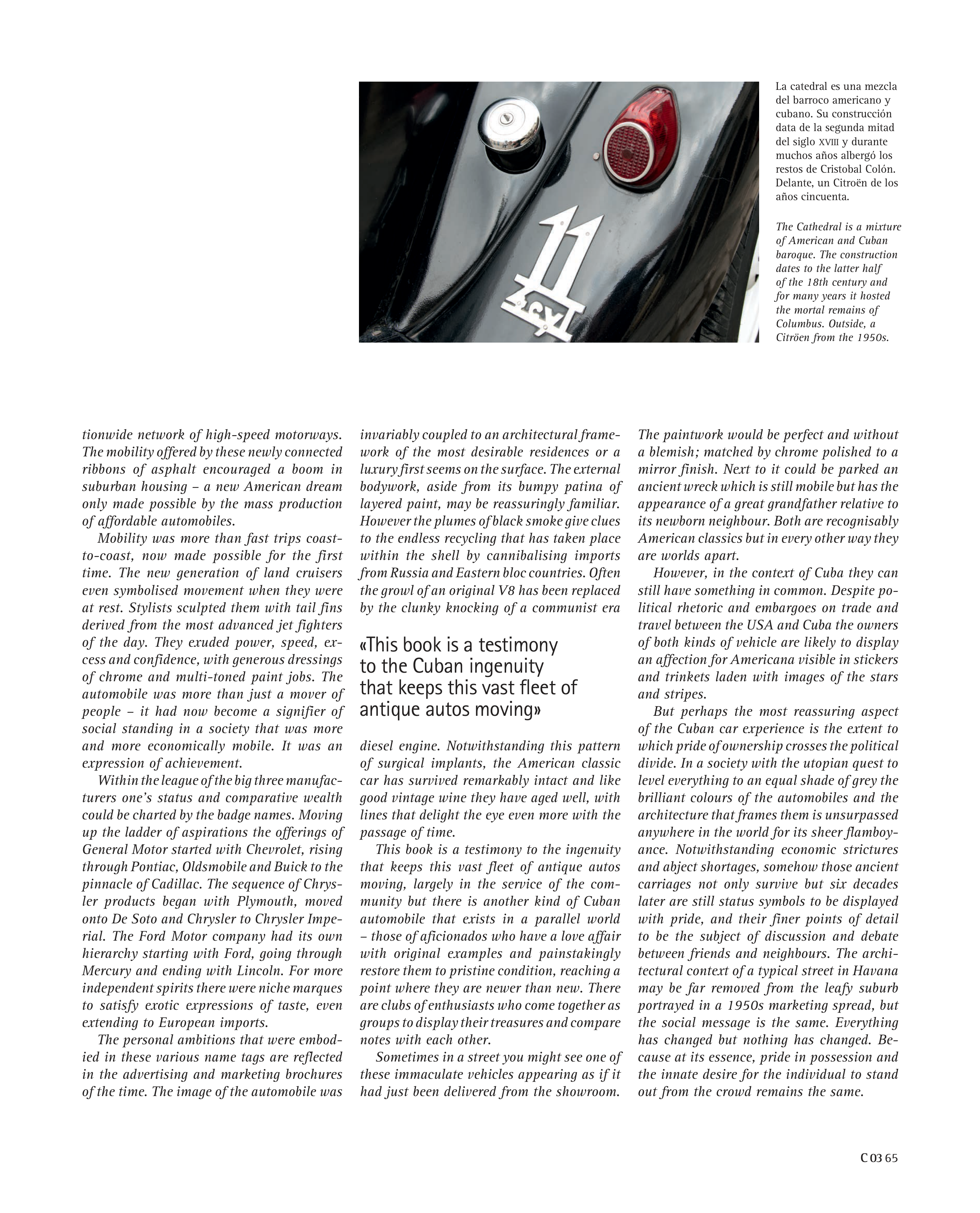
La catedral es una mezcla
del barroco americano y
cubano. Su construcción
data de la segunda mitad
del siglo xviii y durante
muchos años albergó los
restos de Cristobal Colón.
Delante, un Citroën de los
años cincuenta.
The Cathedral is a mixture
of American and Cuban
baroque. The construction
dates to the latter half
of the 18th century and
for many years it hosted
the mortal remains of
Columbus. Outside, a
Citröen from the 1950s.