6 C 01
La arquitectura y el urbanismo de Bakú, capital de Azerbaiyán, re-
flejan la herencia de una Unión Soviética a la que el país perteneció
hasta 1991. Desde su independencia, sin embargo, el Gobierno azer-
baiyano ha invertido concienzudamente en la modernización de las
infraestructuras de la ciudad, así como en la de su arquitectura. El
Centro Heydar Aliyev pertenece a esta renovación urbana y aspira
a convertirse en el principal exponente de los programas culturales
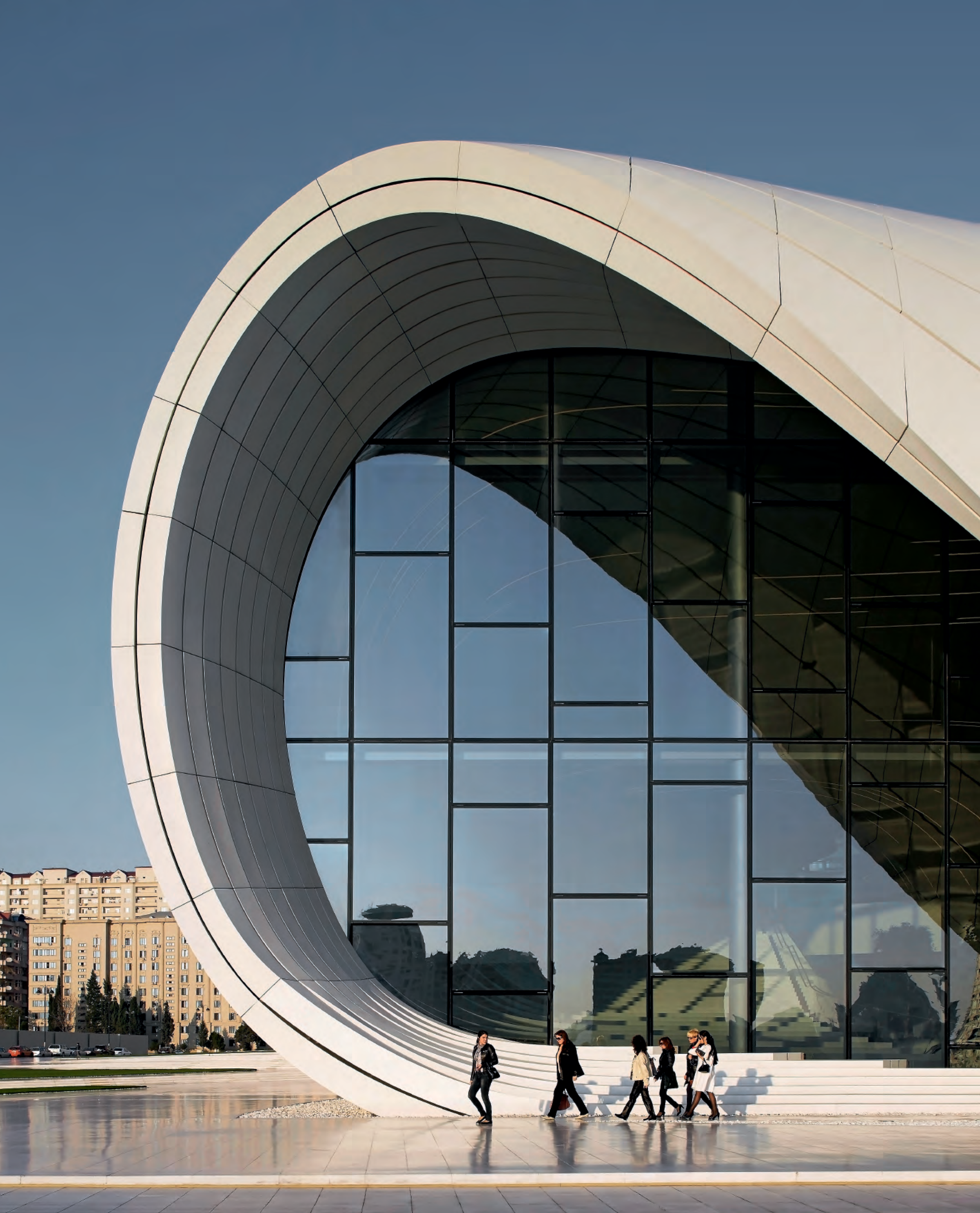
de la región. El diseño, de predominantes formas onduladas, rompe
con la rígida y monumental arquitectura soviética, para inspirarse en
aspectos de la cultura azerí, como su geométrica caligrafía. Utiliza
así una serie de curvas sucesivas con las que quiere transmitir un
mensaje de optimismo y progreso a una nación en desarrollo. Con
la intención de generar un espacio fluido en toda la intervención,
una plaza recibe el edificio para después prolongarse y convertirse
en un generoso vestíbulo público. Este acoge a los visitantes y los
distribuye entre los más de cien mil metros cuadrados de programa
—en el que destaca un auditorio y un museo—. Para la construc-
ción del complejo volumen se utilizaron herramientas de última
tecnología que permitieron no sólo sistematizar los procesos de
fabricación sino también monitorizar toda la evolución de la obra.
Por último, el diseño de la iluminación merece especial atención
ya que su estudio específico contribuye a enfatizar la continuidad
entre el espacio exterior y el interior.
Architecture and urban planning in Baku, the capital of Azerbaijan,
reflect the legacy of the Soviet Union, which the country belonged to
until the year 1991. Since independence, however, the Azerbaijan
government has conscientiously invested in the modernization of the
city’s network of infrastructures as well as in the development of its
architecture. The new Heydar Aliyev Center is part and parcel of this
urban renewal and aspires to become the main impulse of cultural
programs in the region at large. With its dominant undulating forms,
the design of the building breaks with the rigidity and monumen-
talism of Soviet architecture to draw inspiration from aspects of
Azeri culture, such as, for example, the geometry of its calligraphy.
It thus has a succession of curves sending a message of optimism
and progress to a nation steep in the process of development. With
the intention of creating a fluid space in the entire project, a square
takes in the building to later stretch on and become a spatious public
foyer, which, in turn, welcomes visitors and spreads them out within
the over 100,000 square meters of the program, including an audi-
torium and a museum. Tools of the latest technology were used to
materialize the complex volumetric scheme, making it possible not
only to systematize manufacturing processes but also to monitor the
whole evolution of the work. Finally, the lighting deserves special
attention because it is designed to help emphasize the continuity
between exterior and interior.
Zaha Hadid in Baku,
a warped icon
Heydar Aliyev Center
Architecture
Building
1
El proyecto para este
centro cultural de usos
mixtos arranca en 2007
como resultado de un
concurso internacional
convocado por el
Gobierno de la República
de Azerbaiyán y termina
de construirse en 2013.
The project for this
multipurpose cultural
center began in 2007 as a
result of an international
competition called by
the government of the
Republic of Azerbaijan,
and construction was
completed in 2013.