48 C 01
C 01 49
diseño están consideradas desde las fases más tempranas del proceso
de manera que se abren posibilidades ilimitadas para los arquitectos.
El proceso comienza con la recepción de materias primas, que
se almacenan por separado para evitar la contaminación, y que se
someten a un exhaustivo control de calidad. Una vez preparadas, las
materias primas se purifican antes de conducirse a la fase de molienda
en húmedo, durante el cual se mezclan en una determinada propor-
ción y se molturan hasta alcanzar el tamaño buscado de partícula. Es
aquí donde propiamente comienza el diseño del producto final, pues
el tamaño de gránulo condiciona tanto la velocidad de la reacción
química que da lugar a Dekton como sus propiedades finales.
Molturadas ya las materias primas, el proceso de diseño de las
partículas continúa con la fase de coloración —en la que se utilizan
sólo pigmentos inorgánicos— y con la de atomización, una de las
partes más importantes de la fabricación, por la cual la fórmula de
Dekton ya coloreada se seca hasta conseguir la forma y el tamaño
de gránulo deseados. Una vez depositado en silos independientes, el
polvo obtenido gracias a la atomización se hace pasar por los siste-
mas de decoración, en los que los gránulos o partículas de material
se van colocando cuidadosamente en diferentes lugares de una cinta
transportadora, dando lugar a una tabla continua y decorada con
efectos que pueden afectar tanto a la superficie como al espesor de
dicha tabla. Gracias a los 16 sistemas de decoración disponibles —que
El producto resiste los
impactos, los arañazos
y la abrasión de manera
que puede utilizarse
en zonas de mucho
tránsito. También ofrece
resistencia al choque
térmico frente al calor,
al hielo y al deshielo.
The product has a high
resistance to scratches
and abrasion, so it
can be used in spaces
subjected to intensive
use. It also has a very
good resistance to heat
and thermal shock, to
freezing and thawing.
most special about it is how it involves an altogether new way of
conceiving production, with design questions considered from the
earliest stages of the process. Broadly speaking, the idea is to design
the particles of the product with the shape, size, and color needed
to compose them in a specific design matrix that opens up infinite
new possibilities for architects.
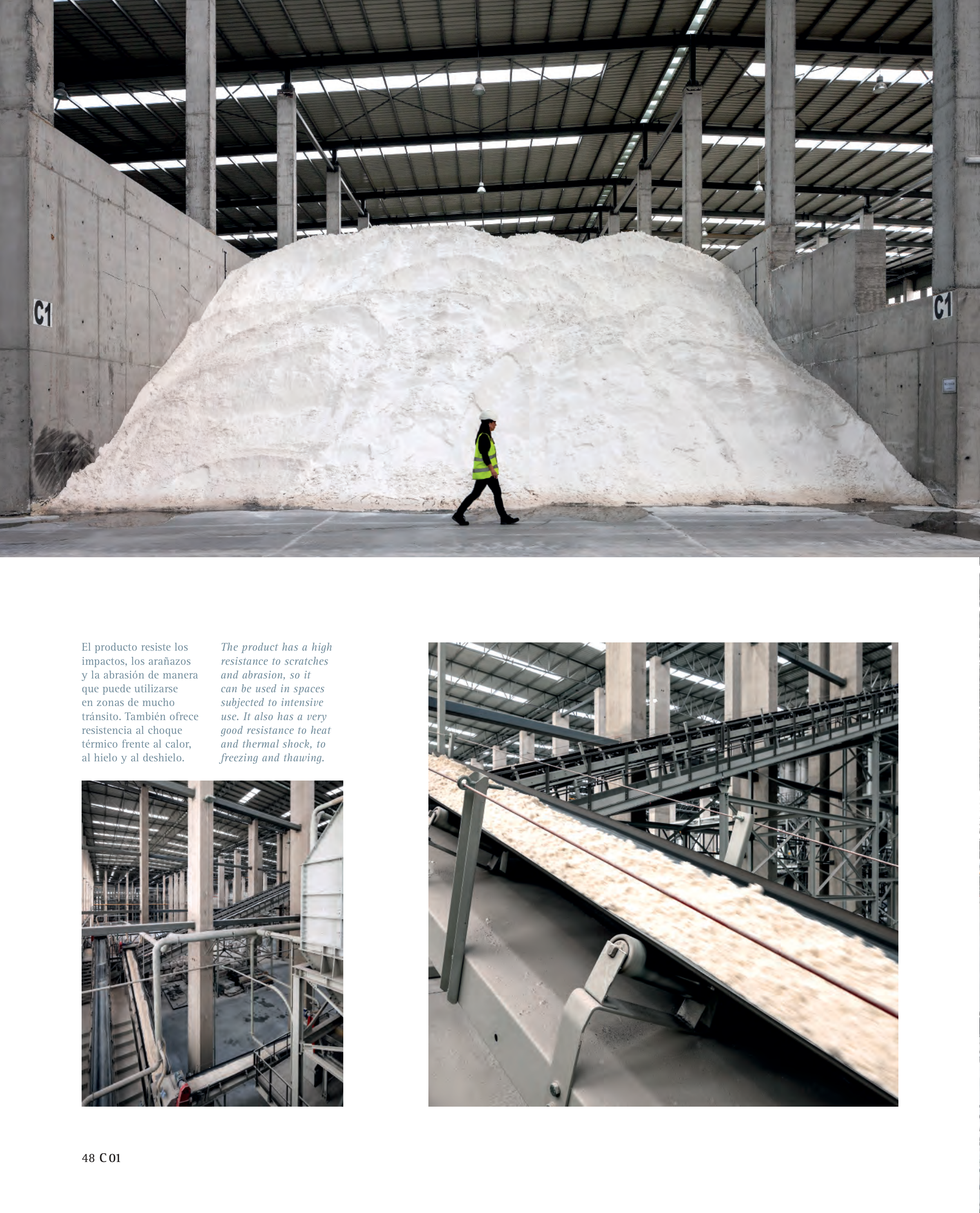
The process begins with the gathering of raw materials, which
are stored separately to avoid contamination and subjected to ex-
haustive quality control. When they are ready, they are purified,
and a wet-grinding phase ensues in which they are mixed in given
proportions and ground to the desired particle sizes. This is where
the actual design of the final product begins, given that the size of
the granule conditions both the rate of chemical reaction giving rise
to Dekton and its final properties.
Once the raw materials are ground, the process of designing the
particles continues with the coloring stage – using only inorganic
pigments – and the atomizing stage, one of the most important parts
of fabrication, through which the Dekton formula, now colored, is
dried until the granule takes on the shape and size desired. Once it is
deposited in separate silos, the powder obtained through atomization
is put through decoration systems where the granules or particles of
the material are carefully placed in different parts of a conveyor belt,
forming a continuous board decorated with effects that can affect