Ciclo: Monnalisiano Celato
Cycle: Hidden Monnalisian
1976/1978
Il primitivismo degli “Archeo murales”
conducono l’artista a riflettere sull’intimo dialogo
esistente fra il Tempo e la Memoria, tema caro
a molte poetiche del Novecento e sul finire
degli anni Settanta reinterpretato fra proiezioni
ed elaborazioni che il paesaggio monnalisiano
comunica. L’indeterminatezza e il silenzio che
affolla il fondale della Gioconda viene percepito
da Fossi come una pluralità pulviscolare di linee in
movimento che si evolvono in mappe e tracce di un
passato che giunge preponderante nel presente e
come un codice binario in sequenze da decifrare,
esprime quella stessa quiete che le spalle della
Monna Lisa nascondono. Di conseguenza dietro
alla struttura portante del quadro vi è un mondo
di connessioni invisibili e strade da percorrere che
devono solo essere tracciate e svelate.
Il ciclo del “Monnalisiano Celato” è la presa di
coscienza dell’artista dell’esistenza di un orizzonte
senza fine fra il prima e il dopo dell’Arte, fra ciò
che è stato creato e ciò che può essere creato
nuovamente. Ed è qui che finalmente scintilla la
convinzione che esista allora un segno depositario
dell’Origine, il brodo primordiale in cui l’Arte si è
generata e può generarsi ancora in nuove forme di
linguaggio. È in questo ciclo che per la prima volta
Franco Fossi riesce a tratteggiare l’unità minima del
codice estetico, una matrice che paradossalmente
e imprevedibilmente ritorna sempre uguale a sé
e nella sua riconoscibilità codificata può adesso
splendere di luce propria e dare vita a nuovi
Sistemi di comunicazione, capaci di mettere in
relazione dimensioni diverse con una puntualità
precedentemente impensabile.
The primitivism of the “Archeo murales”
lead the artist to reflect on the intimate dialogue
existing between Time and Memory, a theme dear
to many twentieth century poetics and to the
late seventies reinterpreted between projections
and elaborations that the Monnalisian landscape
communicates. The indeterminacy and the silence
that crowds the Mona Lisa backdrop is perceived
by Fossi as a nebulous plurality of moving lines that
evolve into maps and traces of a past that comes
predominantly in the present and as a binary code,
in sequences to be deciphered it expresses that
same peacefulness that the Mona Lisa’s shoulders
hide.
Consequently
behind
the
supporting
structure of the framework there is a world of
invisible connections and roads to be traveled that
only need to be traced and revealed.
The “Hidden Monnalisian” cycle is the
awareness of the artist and of the existence of an
endless horizon between the before and after of the
Art, between what has been created and what can
be created again.And it is here that finally shines
the conviction that there is then a depository sign
of the Origin, the primordial soup in which Art has
been generated and can still be generated in new
forms of language. It is in this cycle that for the
first time Franco Fossi manages to outline the
minimal unity of the aesthetic code, a matrix that
paradoxically and unpredictably returns always alike
and in its recognisable codification it can now shine
with its own light and give life to new Systems of
communication, able to relate different dimensions
with a previously unthinkable punctuality.
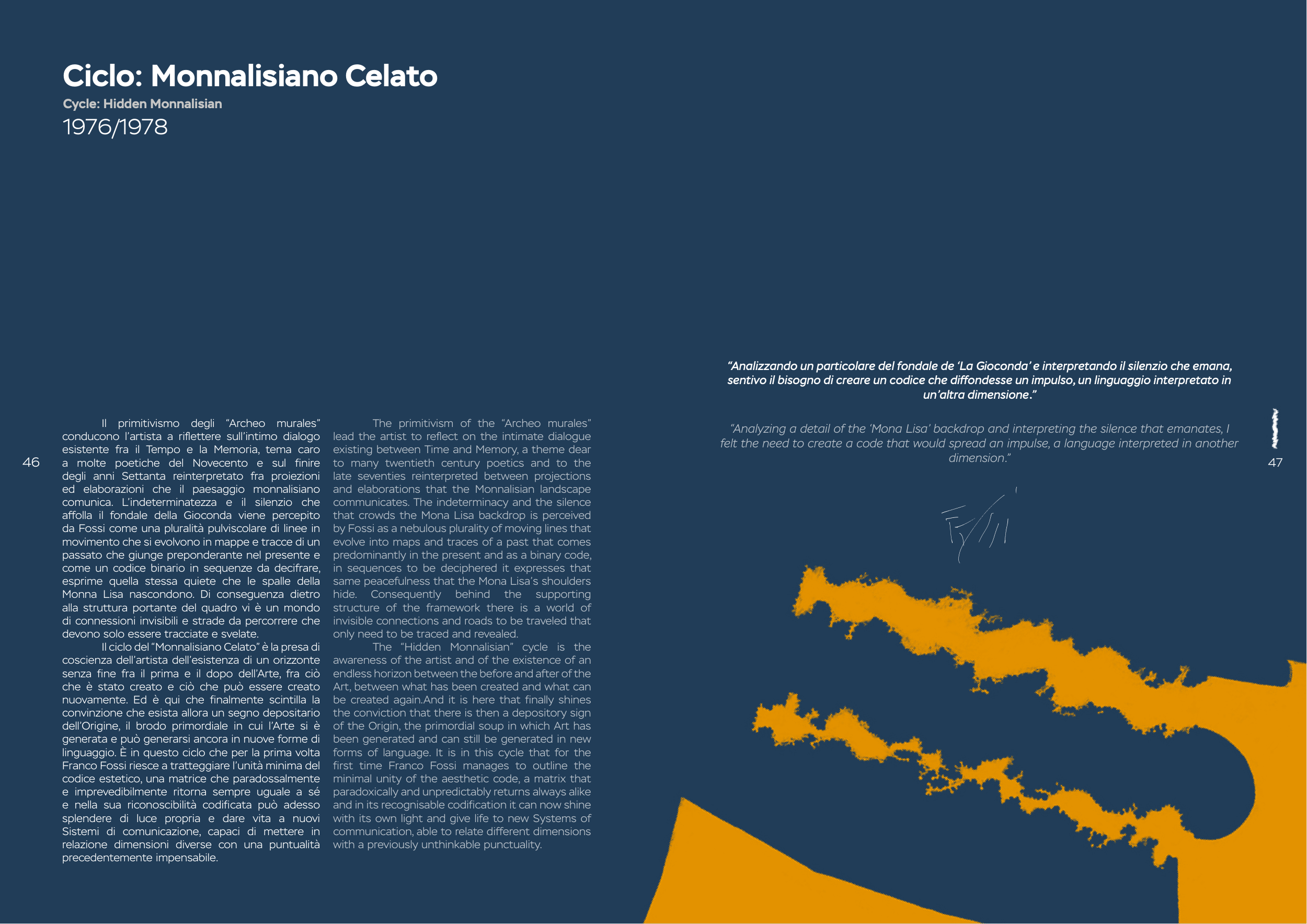
“Analizzando un particolare del fondale de ‘La Gioconda’ e interpretando il silenzio che emana,
sentivo il bisogno di creare un codice che diffondesse un impulso, un linguaggio interpretato in
un’altra dimensione.”
“Analyzing a detail of the ‘Mona Lisa’ backdrop and interpreting the silence that emanates, I
felt the need to create a code that would spread an impulse, a language interpreted in another
dimension.”
47
46