9
WWW.LEGRAND.COM
WHITE PAPER
THE UPS IN DATA CENTERS AND THEIR MAIN FEATURES
HOT SWAP
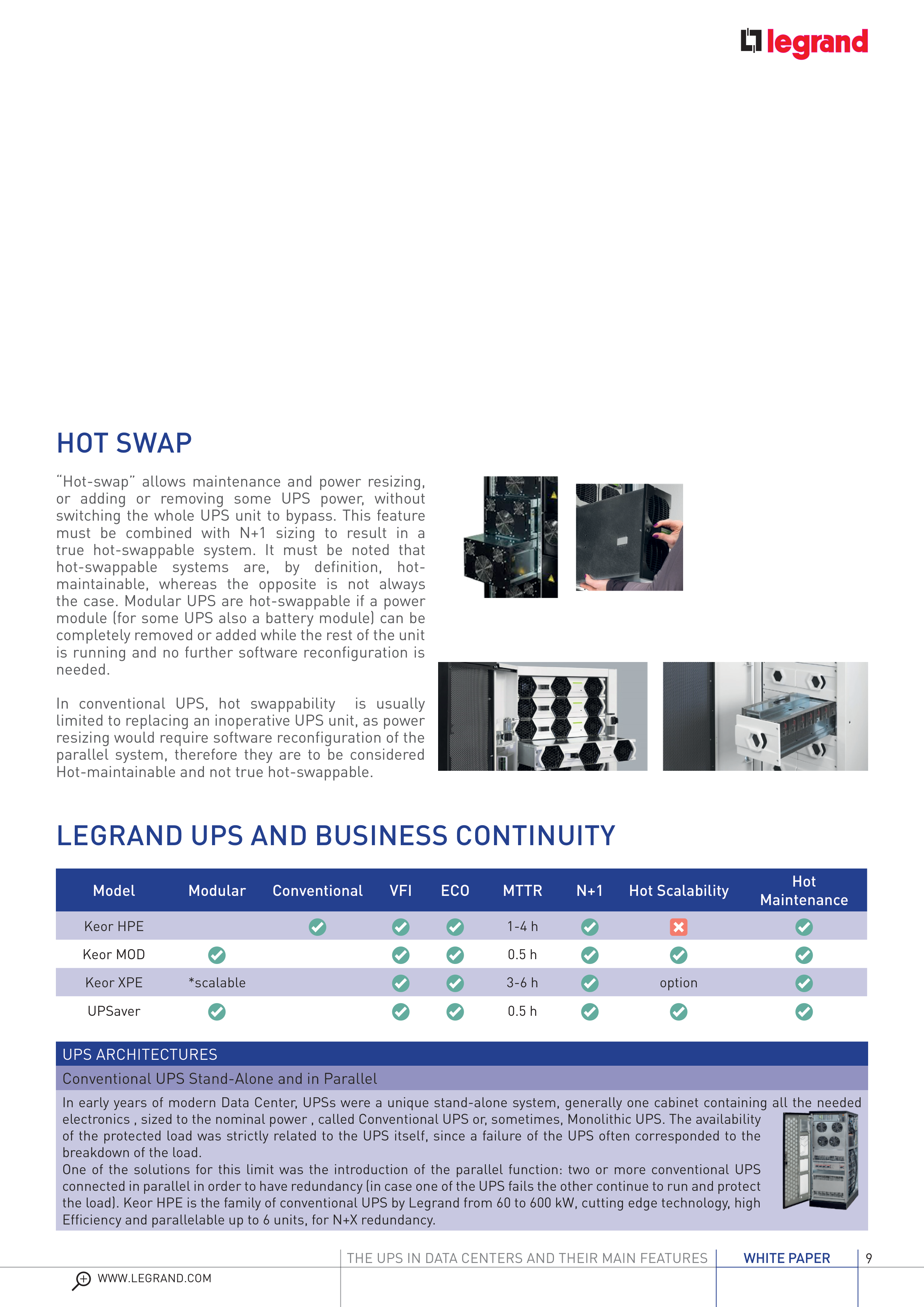
“Hot-swap” allows maintenance and power resizing,
or adding or removing some UPS power, without
switching the whole UPS unit to bypass. This feature
must be combined with N+1 sizing to result in a
true hot-swappable system. It must be noted that
hot-swappable systems are, by definition, hot-
maintainable, whereas the opposite is not always
the case. Modular UPS are hot-swappable if a power
module (for some UPS also a battery module) can be
completely removed or added while the rest of the unit
is running and no further software reconfiguration is
needed.
In conventional UPS, hot swappability is usually
limited to replacing an inoperative UPS unit, as power
resizing would require software reconfiguration of the
parallel system, therefore they are to be considered
Hot-maintainable and not true hot-swappable.
LEGRAND UPS AND BUSINESS CONTINUITY
Model
Modular
Conventional
VFI
ECO
MTTR
N+1
Hot Scalability
Hot
Maintenance
Keor HPE
✅
✅
✅
1-4 h
✅
❎
✅
Keor MOD
✅
✅
✅
0.5 h
✅
✅
✅
Keor XPE
*scalable
✅
✅
3-6 h
✅
option
✅
UPSaver
✅
✅
✅
0.5 h
✅
✅
✅
UPS ARCHITECTURES
Conventional UPS Stand-Alone and in Parallel
In early years of modern Data Center, UPSs were a unique stand-alone system, generally one cabinet containing all the needed
electronics , sized to the nominal power , called Conventional UPS or, sometimes, Monolithic UPS. The availability
of the protected load was strictly related to the UPS itself, since a failure of the UPS often corresponded to the
breakdown of the load.
One of the solutions for this limit was the introduction of the parallel function: two or more conventional UPS
connected in parallel in order to have redundancy (in case one of the UPS fails the other continue to run and protect
the load). Keor HPE is the family of conventional UPS by Legrand from 60 to 600 kW, cutting edge technology, high
Efficiency and parallelable up to 6 units, for N+X redundancy.