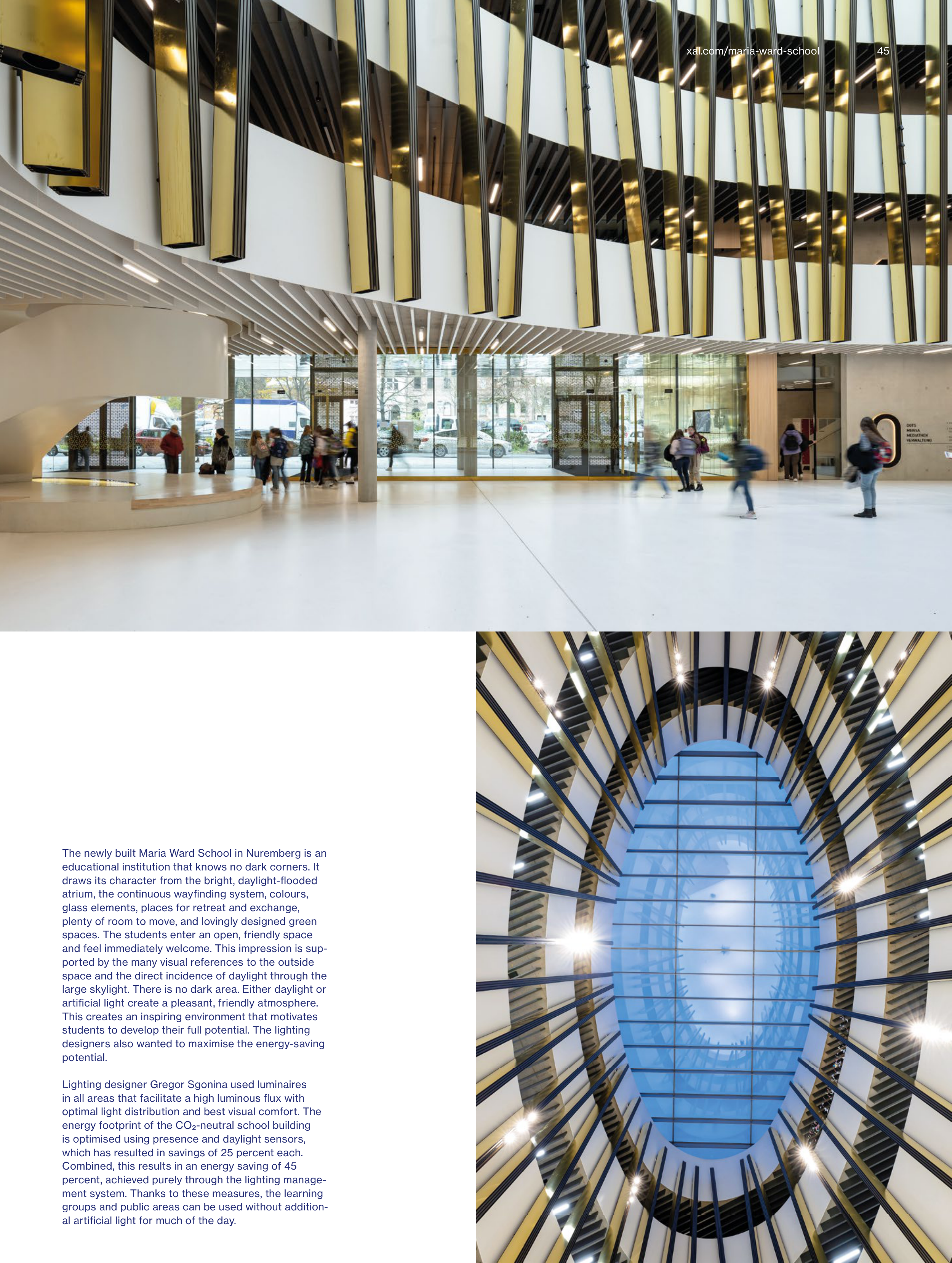
The newly built Maria Ward School in Nuremberg is an
educational institution that knows no dark corners. It
draws its character from the bright, daylight-fl ooded
atrium, the continuous wayfi nding system, colours,
glass elements, places for retreat and exchange,
plenty of room to move, and lovingly designed green
spaces. The students enter an open, friendly space
and feel immediately welcome. This impression is sup-
ported by the many visual references to the outside
space and the direct incidence of daylight through the
large skylight. There is no dark area. Either daylight or
artifi cial light create a pleasant, friendly atmosphere.
This creates an inspiring environment that motivates
students to develop their full potential. The lighting
designers also wanted to maximise the energy-saving
potential.
Lighting designer Gregor Sgonina used luminaires
in all areas that facilitate a high luminous fl ux with
optimal light distribution and best visual comfort. The
energy footprint of the CO2-neutral school building
is optimised using presence and daylight sensors,
which has resulted in savings of 25 percent each.
Combined, this results in an energy saving of 45
percent, achieved purely through the lighting manage-
ment system. Thanks to these measures, the learning
groups and public areas can be used without addition-
al artifi cial light for much of the day.
xal.com/maria-ward-school
45