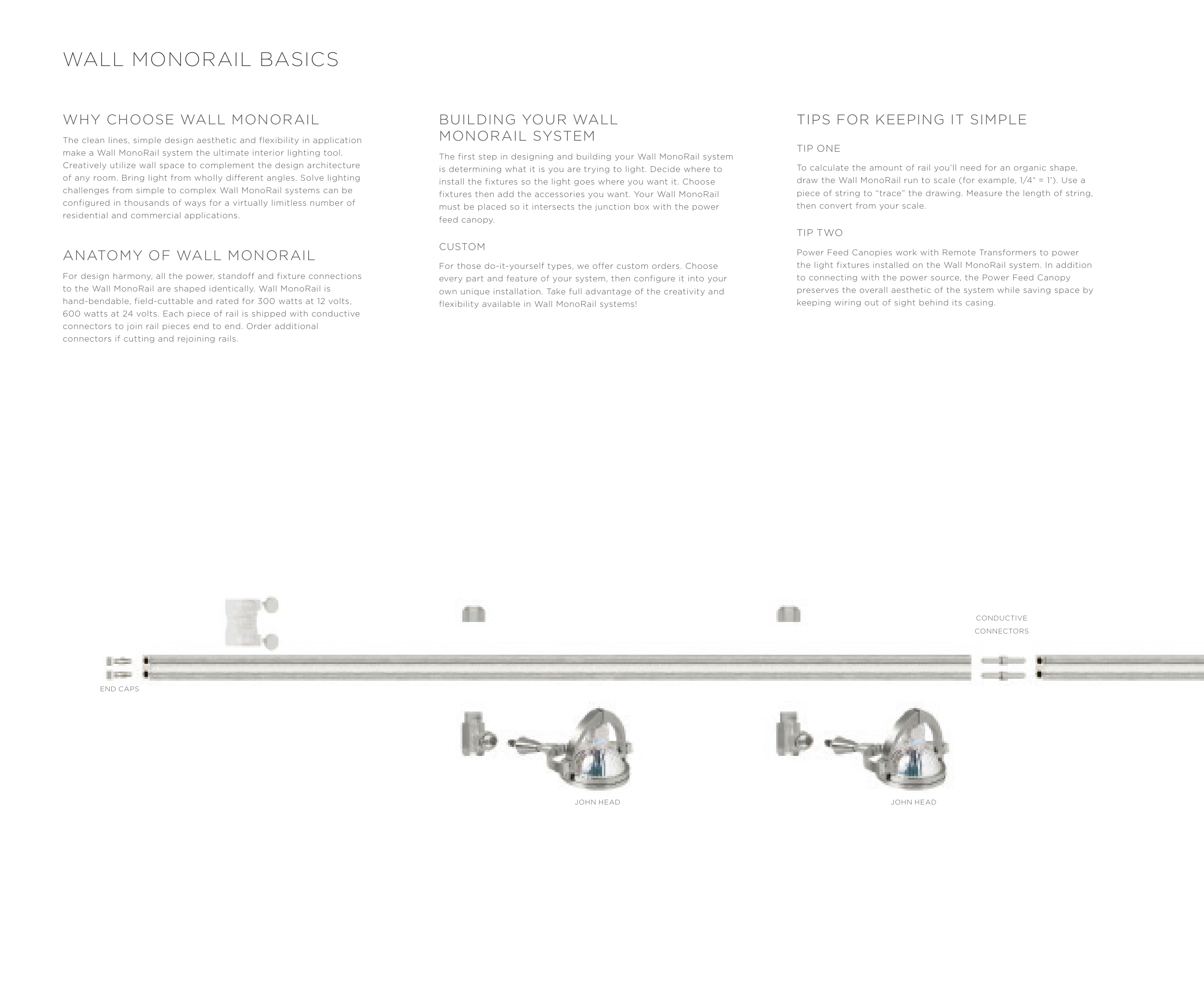
END CAPS
CONDUCTIVE
CONNECTORS
WALL MONORAIL BASICS
JOHN HEAD
JOHN HEAD
WHY CHOOSE WALL MONORAIL
The clean lines, simple design aesthetic and flexibility in application
make a Wall MonoRail system the ultimate interior lighting tool.
Creatively utilize wall space to complement the design architecture
of any room. Bring light from wholly different angles. Solve lighting
challenges from simple to complex Wall MonoRail systems can be
configured in thousands of ways for a virtually limitless number of
residential and commercial applications.
ANATOMY OF WALL MONORAIL
For design harmony, all the power, standoff and fixture connections
to the Wall MonoRail are shaped identically. Wall MonoRail is
hand-bendable, field-cuttable and rated for 300 watts at 12 volts,
600 watts at 24 volts. Each piece of rail is shipped with conductive
connectors to join rail pieces end to end. Order additional
connectors if cutting and rejoining rails.
BUILDING YOUR WALL
MONORAIL SYSTEM
The first step in designing and building your Wall MonoRail system
is determining what it is you are trying to light. Decide where to
install the fixtures so the light goes where you want it. Choose
fixtures then add the accessories you want. Your Wall MonoRail
must be placed so it intersects the junction box with the power
feed canopy.
CUSTOM
For those do-it-yourself types, we offer custom orders. Choose
every part and feature of your system, then configure it into your
own unique installation. Take full advantage of the creativity and
flexibility available in Wall MonoRail systems!
TIPS FOR KEEPING IT SIMPLE
TIP ONE
To calculate the amount of rail you’ll need for an organic shape,
draw the Wall MonoRail run to scale (for example, 1/4" = 1'). Use a
piece of string to “trace” the drawing. Measure the length of string,
then convert from your scale.
TIP TWO
Power Feed Canopies work with Remote Transformers to power
the light fixtures installed on the Wall MonoRail system. In addition
to connecting with the power source, the Power Feed Canopy
preserves the overall aesthetic of the system while saving space by
keeping wiring out of sight behind its casing.