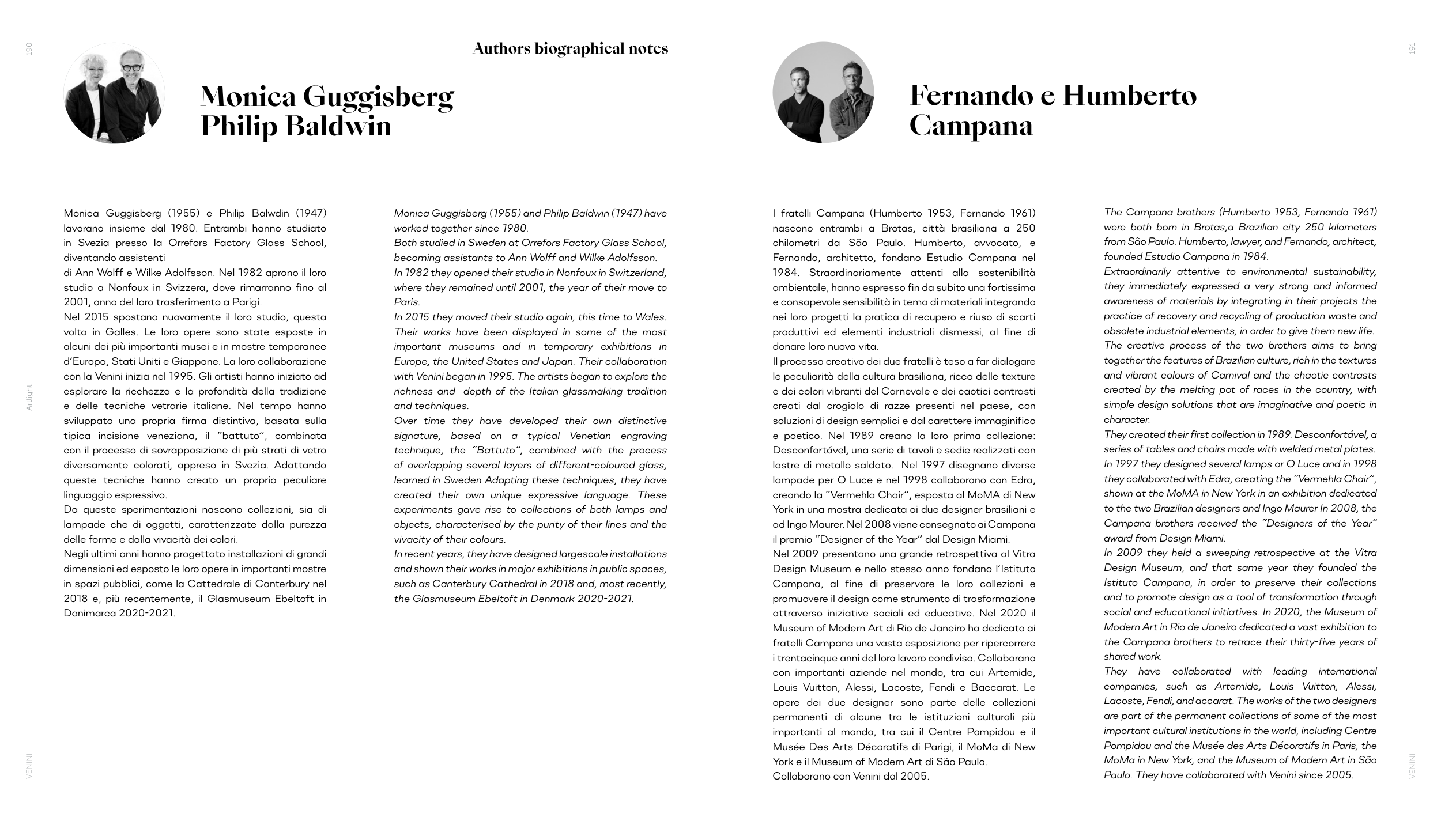
Monica Guggisberg
Philip Baldwin
Monica Guggisberg (1955) e Philip Balwdin (1947)
lavorano insieme dal 1980. Entrambi hanno studiato
in Svezia presso la Orrefors Factory Glass School,
diventando assistenti
di Ann Wolff e Wilke Adolfsson. Nel 1982 aprono il loro
studio a Nonfoux in Svizzera, dove rimarranno fino al
2001, anno del loro trasferimento a Parigi.
Nel 2015 spostano nuovamente il loro studio, questa
volta in Galles. Le loro opere sono state esposte in
alcuni dei più importanti musei e in mostre temporanee
d’Europa, Stati Uniti e Giappone. La loro collaborazione
con la Venini inizia nel 1995. Gli artisti hanno iniziato ad
esplorare la ricchezza e la profondità della tradizione
e delle tecniche vetrarie italiane. Nel tempo hanno
sviluppato una propria firma distintiva, basata sulla
tipica incisione veneziana, il “battuto”, combinata
con il processo di sovrapposizione di più strati di vetro
diversamente colorati, appreso in Svezia. Adattando
queste tecniche hanno creato un proprio peculiare
linguaggio espressivo.
Da queste sperimentazioni nascono collezioni, sia di
lampade che di oggetti, caratterizzate dalla purezza
delle forme e dalla vivacità dei colori.
Negli ultimi anni hanno progettato installazioni di grandi
dimensioni ed esposto le loro opere in importanti mostre
in spazi pubblici, come la Cattedrale di Canterbury nel
2018 e, più recentemente, il Glasmuseum Ebeltoft in
Danimarca 2020-2021.
Monica Guggisberg (1955) and Philip Baldwin (1947) have
worked together since 1980.
Both studied in Sweden at Orrefors Factory Glass School,
becoming assistants to Ann Wolff and Wilke Adolfsson.
In 1982 they opened their studio in Nonfoux in Switzerland,
where they remained until 2001, the year of their move to
Paris.
In 2015 they moved their studio again, this time to Wales.
Their works have been displayed in some of the most
important museums and in temporary exhibitions in
Europe, the United States and Japan. Their collaboration
with Venini began in 1995. The artists began to explore the
richness and depth of the Italian glassmaking tradition
and techniques.
Over time they have developed their own distinctive
signature, based on a typical Venetian engraving
technique, the “Battuto”, combined with the process
of overlapping several layers of different-coloured glass,
learned in Sweden Adapting these techniques, they have
created their own unique expressive language. These
experiments gave rise to collections of both lamps and
objects, characterised by the purity of their lines and the
vivacity of their colours.
In recent years, they have designed largescale installations
and shown their works in major exhibitions in public spaces,
such as Canterbury Cathedral in 2018 and, most recently,
the Glasmuseum Ebeltoft in Denmark 2020-2021.
Authors biographical notes
Artlight
190
VENINI
Fernando e Humberto
Campana
I fratelli Campana (Humberto 1953, Fernando 1961)
nascono entrambi a Brotas, città brasiliana a 250
chilometri da São Paulo. Humberto, avvocato, e
Fernando, architetto, fondano Estudio Campana nel
1984. Straordinariamente attenti alla sostenibilità
ambientale, hanno espresso fin da subito una fortissima
e consapevole sensibilità in tema di materiali integrando
nei loro progetti la pratica di recupero e riuso di scarti
produttivi ed elementi industriali dismessi, al fine di
donare loro nuova vita.
Il processo creativo dei due fratelli è teso a far dialogare
le peculiarità della cultura brasiliana, ricca delle texture
e dei colori vibranti del Carnevale e dei caotici contrasti
creati dal crogiolo di razze presenti nel paese, con
soluzioni di design semplici e dal carettere immaginifico
e poetico. Nel 1989 creano la loro prima collezione:
Desconfortável, una serie di tavoli e sedie realizzati con
lastre di metallo saldato. Nel 1997 disegnano diverse
lampade per O Luce e nel 1998 collaborano con Edra,
creando la “Vermehla Chair”, esposta al MoMA di New
York in una mostra dedicata ai due designer brasiliani e
ad Ingo Maurer. Nel 2008 viene consegnato ai Campana
il premio “Designer of the Year” dal Design Miami.
Nel 2009 presentano una grande retrospettiva al Vitra
Design Museum e nello stesso anno fondano l’Istituto
Campana, al fine di preservare le loro collezioni e
promuovere il design come strumento di trasformazione
attraverso iniziative sociali ed educative. Nel 2020 il
Museum of Modern Art di Rio de Janeiro ha dedicato ai
fratelli Campana una vasta esposizione per ripercorrere
i trentacinque anni del loro lavoro condiviso. Collaborano
con importanti aziende nel mondo, tra cui Artemide,
Louis Vuitton, Alessi, Lacoste, Fendi e Baccarat. Le
opere dei due designer sono parte delle collezioni
permanenti di alcune tra le istituzioni culturali più
importanti al mondo, tra cui il Centre Pompidou e il
Musée Des Arts Décoratifs di Parigi, il MoMa di New
York e il Museum of Modern Art di São Paulo.
Collaborano con Venini dal 2005.
The Campana brothers (Humberto 1953, Fernando 1961)
were both born in Brotas,a Brazilian city 250 kilometers
from São Paulo. Humberto, lawyer, and Fernando, architect,
founded Estudio Campana in 1984.
Extraordinarily attentive to environmental sustainability,
they immediately expressed a very strong and informed
awareness of materials by integrating in their projects the
practice of recovery and recycling of production waste and
obsolete industrial elements, in order to give them new life.
The creative process of the two brothers aims to bring
together the features of Brazilian culture, rich in the textures
and vibrant colours of Carnival and the chaotic contrasts
created by the melting pot of races in the country, with
simple design solutions that are imaginative and poetic in
character.
They created their first collection in 1989. Desconfortável, a
series of tables and chairs made with welded metal plates.
In 1997 they designed several lamps or O Luce and in 1998
they collaborated with Edra, creating the “Vermehla Chair”,
shown at the MoMA in New York in an exhibition dedicated
to the two Brazilian designers and Ingo Maurer In 2008, the
Campana brothers received the “Designers of the Year”
award from Design Miami.
In 2009 they held a sweeping retrospective at the Vitra
Design Museum, and that same year they founded the
Istituto Campana, in order to preserve their collections
and to promote design as a tool of transformation through
social and educational initiatives. In 2020, the Museum of
Modern Art in Rio de Janeiro dedicated a vast exhibition to
the Campana brothers to retrace their thirty-five years of
shared work.
They
have
collaborated
with
leading
international
companies, such as Artemide, Louis Vuitton, Alessi,
Lacoste, Fendi, and accarat. The works of the two designers
are part of the permanent collections of some of the most
important cultural institutions in the world, including Centre
Pompidou and the Musée des Arts Décoratifs in Paris, the
MoMa in New York, and the Museum of Modern Art in São
Paulo. They have collaborated with Venini since 2005.
191
VENINI