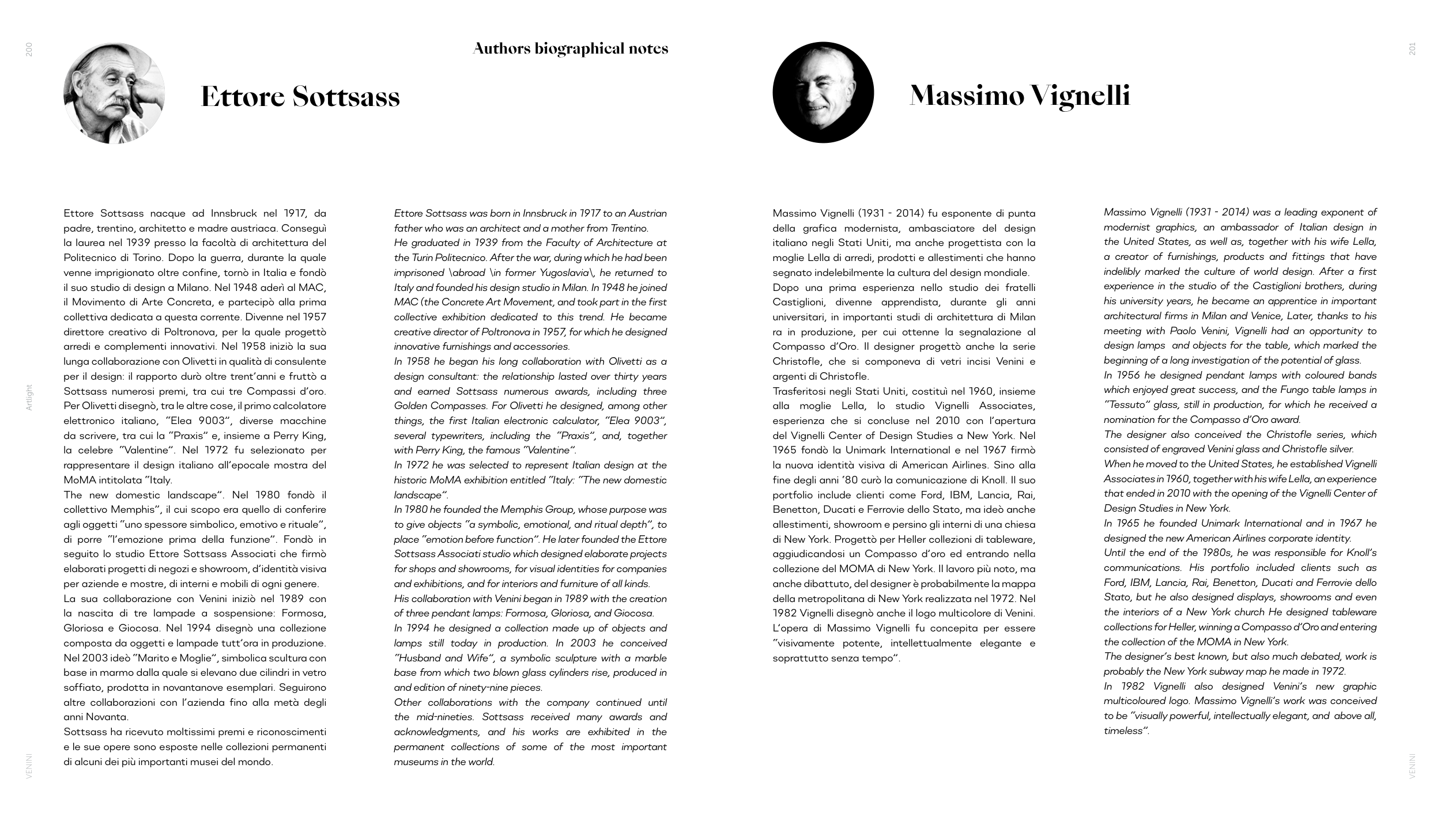
Ettore Sottsass
Ettore Sottsass nacque ad Innsbruck nel 1917, da
padre, trentino, architetto e madre austriaca. Conseguì
la laurea nel 1939 presso la facoltà di architettura del
Politecnico di Torino. Dopo la guerra, durante la quale
venne imprigionato oltre confine, tornò in Italia e fondò
il suo studio di design a Milano. Nel 1948 aderì al MAC,
il Movimento di Arte Concreta, e partecipò alla prima
collettiva dedicata a questa corrente. Divenne nel 1957
direttore creativo di Poltronova, per la quale progettò
arredi e complementi innovativi. Nel 1958 iniziò la sua
lunga collaborazione con Olivetti in qualità di consulente
per il design: il rapporto durò oltre trent’anni e fruttò a
Sottsass numerosi premi, tra cui tre Compassi d’oro.
Per Olivetti disegnò, tra le altre cose, il primo calcolatore
elettronico italiano, “Elea 9003”, diverse macchine
da scrivere, tra cui la “Praxis” e, insieme a Perry King,
la celebre “Valentine”. Nel 1972 fu selezionato per
rappresentare il design italiano all’epocale mostra del
MoMA intitolata “Italy.
The new domestic landscape”. Nel 1980 fondò il
collettivo Memphis”, il cui scopo era quello di conferire
agli oggetti “uno spessore simbolico, emotivo e rituale”,
di porre “l’emozione prima della funzione”. Fondò in
seguito lo studio Ettore Sottsass Associati che firmò
elaborati progetti di negozi e showroom, d’identità visiva
per aziende e mostre, di interni e mobili di ogni genere.
La sua collaborazione con Venini iniziò nel 1989 con
la nascita di tre lampade a sospensione: Formosa,
Gloriosa e Giocosa. Nel 1994 disegnò una collezione
composta da oggetti e lampade tutt’ora in produzione.
Nel 2003 ideò “Marito e Moglie”, simbolica scultura con
base in marmo dalla quale si elevano due cilindri in vetro
soffiato, prodotta in novantanove esemplari. Seguirono
altre collaborazioni con l’azienda fino alla metà degli
anni Novanta.
Sottsass ha ricevuto moltissimi premi e riconoscimenti
e le sue opere sono esposte nelle collezioni permanenti
di alcuni dei più importanti musei del mondo.
Ettore Sottsass was born in Innsbruck in 1917 to an Austrian
father who was an architect and a mother from Trentino.
He graduated in 1939 from the Faculty of Architecture at
the Turin Politecnico. After the war, during which he had been
imprisoned \abroad \in former Yugoslavia\, he returned to
Italy and founded his design studio in Milan. In 1948 he joined
MAC (the Concrete Art Movement, and took part in the first
collective exhibition dedicated to this trend. He became
creative director of Poltronova in 1957, for which he designed
innovative furnishings and accessories.
In 1958 he began his long collaboration with Olivetti as a
design consultant: the relationship lasted over thirty years
and earned Sottsass numerous awards, including three
Golden Compasses. For Olivetti he designed, among other
things, the first Italian electronic calculator, “Elea 9003”,
several typewriters, including the “Praxis”, and, together
with Perry King, the famous “Valentine”.
In 1972 he was selected to represent Italian design at the
historic MoMA exhibition entitled “Italy: “The new domestic
landscape”.
In 1980 he founded the Memphis Group, whose purpose was
to give objects “a symbolic, emotional, and ritual depth”, to
place “emotion before function”. He later founded the Ettore
Sottsass Associati studio which designed elaborate projects
for shops and showrooms, for visual identities for companies
and exhibitions, and for interiors and furniture of all kinds.
His collaboration with Venini began in 1989 with the creation
of three pendant lamps: Formosa, Gloriosa, and Giocosa.
In 1994 he designed a collection made up of objects and
lamps still today in production. In 2003 he conceived
“Husband and Wife”, a symbolic sculpture with a marble
base from which two blown glass cylinders rise, produced in
and edition of ninety-nine pieces.
Other collaborations with the company continued until
the mid-nineties. Sottsass received many awards and
acknowledgments, and his works are exhibited in the
permanent collections of some of the most important
museums in the world.
Authors biographical notes
Artlight
200
VENINI
Massimo Vignelli
Massimo Vignelli (1931 - 2014) fu esponente di punta
della grafica modernista, ambasciatore del design
italiano negli Stati Uniti, ma anche progettista con la
moglie Lella di arredi, prodotti e allestimenti che hanno
segnato indelebilmente la cultura del design mondiale.
Dopo una prima esperienza nello studio dei fratelli
Castiglioni, divenne apprendista, durante gli anni
universitari, in importanti studi di architettura di Milan
ra in produzione, per cui ottenne la segnalazione al
Compasso d’Oro. Il designer progettò anche la serie
Christofle, che si componeva di vetri incisi Venini e
argenti di Christofle.
Trasferitosi negli Stati Uniti, costituì nel 1960, insieme
alla moglie Lella, lo studio Vignelli Associates,
esperienza che si concluse nel 2010 con l’apertura
del Vignelli Center of Design Studies a New York. Nel
1965 fondò la Unimark International e nel 1967 firmò
la nuova identità visiva di American Airlines. Sino alla
fine degli anni ‘80 curò la comunicazione di Knoll. Il suo
portfolio include clienti come Ford, IBM, Lancia, Rai,
Benetton, Ducati e Ferrovie dello Stato, ma ideò anche
allestimenti, showroom e persino gli interni di una chiesa
di New York. Progettò per Heller collezioni di tableware,
aggiudicandosi un Compasso d’oro ed entrando nella
collezione del MOMA di New York. Il lavoro più noto, ma
anche dibattuto, del designer è probabilmente la mappa
della metropolitana di New York realizzata nel 1972. Nel
1982 Vignelli disegnò anche il logo multicolore di Venini.
L’opera di Massimo Vignelli fu concepita per essere
“visivamente potente, intellettualmente elegante e
soprattutto senza tempo”.
Massimo Vignelli (1931 - 2014) was a leading exponent of
modernist graphics, an ambassador of Italian design in
the United States, as well as, together with his wife Lella,
a creator of furnishings, products and fittings that have
indelibly marked the culture of world design. After a first
experience in the studio of the Castiglioni brothers, during
his university years, he became an apprentice in important
architectural firms in Milan and Venice, Later, thanks to his
meeting with Paolo Venini, Vignelli had an opportunity to
design lamps and objects for the table, which marked the
beginning of a long investigation of the potential of glass.
In 1956 he designed pendant lamps with coloured bands
which enjoyed great success, and the Fungo table lamps in
“Tessuto” glass, still in production, for which he received a
nomination for the Compasso d’Oro award.
The designer also conceived the Christofle series, which
consisted of engraved Venini glass and Christofle silver.
When he moved to the United States, he established Vignelli
Associates in 1960, together with his wife Lella, an experience
that ended in 2010 with the opening of the Vignelli Center of
Design Studies in New York.
In 1965 he founded Unimark International and in 1967 he
designed the new American Airlines corporate identity.
Until the end of the 1980s, he was responsible for Knoll’s
communications. His portfolio included clients such as
Ford, IBM, Lancia, Rai, Benetton, Ducati and Ferrovie dello
Stato, but he also designed displays, showrooms and even
the interiors of a New York church He designed tableware
collections for Heller, winning a Compasso d’Oro and entering
the collection of the MOMA in New York.
The designer’s best known, but also much debated, work is
probably the New York subway map he made in 1972.
In 1982 Vignelli also designed Venini’s new graphic
multicoloured logo. Massimo Vignelli’s work was conceived
to be “visually powerful, intellectually elegant, and above all,
timeless”.
201
VENINI