9
Can Bauhaus be found in your company?
Hard to say. Some employees have understood what our work-
pieces are all about, and it’s definitely visible through the furnish-
ings and products. You can feel Bauhaus if you want to. With
“Young Designers”, it is our gut feeling that decides whether or
not we want to include their designs in our programme. We
always have the entire collection in mind. This way, the new
designs harmoniously fit into the existing collection.
It was not Bauhaus, but woodcuts that drew your attention to
Wilhelm Wagenfeld in 1976. What inspired you about these pictures
at that time?
I discovered these expressionistic woodcuts by chance in an
archive in Worpswede. At first I was surprised, because I only knew
Wilhelm Wagenfeld’s later works and his designs for Lindner.
I then spontaneously visited him in Stuttgart and we talked for a
long time, whereby he dismissed the early woodcuts as a “youthful
indiscretion”. I can only remark: an adroit “youthful indiscretion”.
He had a few more, too. Some I eventually bought, because
I believe they belong to the complete works of Wilhelm Wagenfeld.
The initial production and distribution of Wa24 was not easy.
Material broke or couldn’t be used, and no furniture store was
interested in this cool design. Nevertheless, you sold the
already produced 250 pieces within three weeks. Were you always
convinced of the success?
Yes. An anecdote: In a telephone conversation with my wife, who
was still living in Sweden at the time, I asked for the address
of the Arts and Crafts Museum in Gothenburg in order to send a
publicity flyer there. I was convinced that this museum would
buy a lamp. And, after a few days, I received the order for a lamp
from the Röhsska Museum in Gothenburg. Naturally, such
a project is based on the conviction that it will be a success.
Copies and counterfeits are an issue that has accompanied you
since the late 1980s. Is it still a nuisance?
The situation has not improved and has become even more
complex owing to the possibilities provided by the Internet.
Putting a stop to this is hard. In other countries, different legal
frameworks apply. One can only hope that people will be able to
distinguish between the original and a plagiarism.
There have been changes in the technical field: the good old
incandescent lamp has been replaced by more efficient LED light
sources. What has changed for the lamps as a result?
Nothing has changed in the Bauhaus lamp’s design. In new
designs, the current technical possibilities are integrated into the
design.
Speaking of changes: With a view to the current design and
furnishing style, does the Wagenfeld lamp fit into today’s living
rooms?
It always fits in well-furnished homes, even though I think that
furnishing trends are artificially produced today. Presently,
it has to be expensive, yet look shabby – absurd. It’s the same
with contemporary art. Many things are very strained. One
thing I observe with great regret is that we have fewer and fewer
furniture stores. Meanwhile, people are buying on the Internet.
With your company TECNOLUMEN, you don’t only sell the
famous Wilhelm-Wagenfeld lamp, you have also designed lamps
yourself – what attracts you, personally, to design your own
objects?
There was something missing in our collection at that time,
and we wanted to extend our offer. Hence, we designed the lamps
with fabric shades. Of course we could have commissioned
someone. But by designing it ourselves, we were able to use what
was already there. Some designers have no idea of the technology
and therefore do not know what is possible. In addition, the idea
of applying what I had learnt through my intensive involvement
with Bauhaus designs and to create something of my own
appealed to me. Design has something to do with emotions. And
if you use the golden ratio, nothing can go wrong.
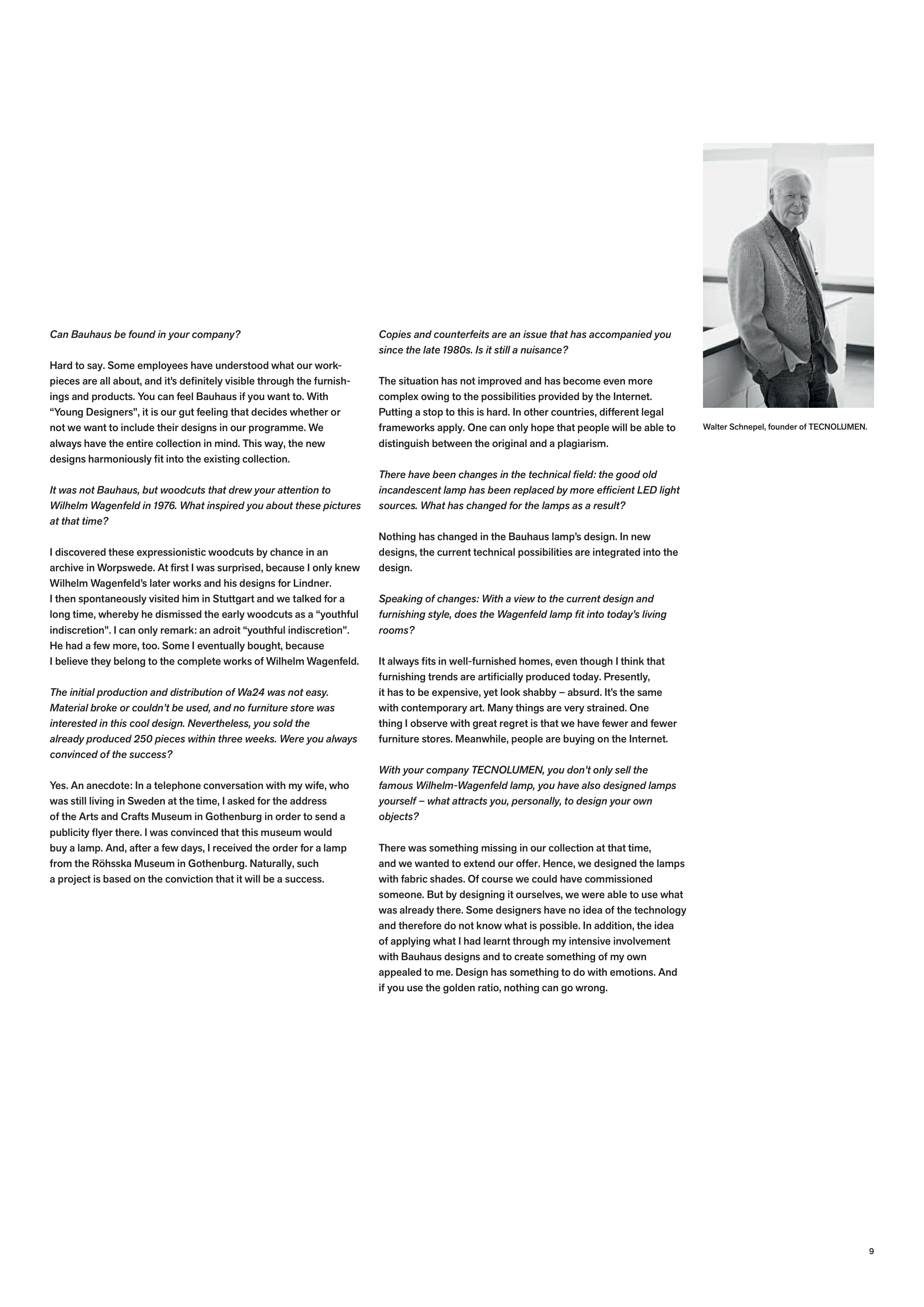
Walter Schnepel, founder of TECNOLUMEN.