5
In order to achieve this, Walter
Gropius developed the Bauhaus
teachings. The traditional form
of academic teaching was abolished
and replaced by a pluralistic
educational concept that promoted
the individual development of
creative talents and methods. The
academic prerequisites for
admission were abolished: every
gifted young person was to be
afforded the opportunity to study at
the Bauhaus school – regardless
of the school leaving certificate,
nationality or gender.
Bauhaus workshops were at the
heart of the design training,
and here the areas of teaching and
practice were not considered
separately.
Under the direction of László
Moholy-Nagy, the “Laboratorium für
Design“ (Laboratory for Design)
produced designs such as the
Bauhaus lamp by Wilhelm Wagen-
feld and the tea pot by Marianne
Brandt, which are still iconic items of
everyday use today.
The Bauhaus school was and is so
multi-faceted and heterogeneous
that deriving a uniform style is
impossible. And this is what makes it
so interesting and topical to this
very day. The democratic idea, the
demonstrative forthrightness and
modernity, as well as the timeless
topicality of the “Bauhaus classics”:
all serve to illustrate the social
self-understanding. Thus, Gropius’
guiding idea of synthesis of the arts
through the collaboration of art
and craftsmanship has once again
come to the fore. Today, workpieces
such as the Bauhaus lamp represent
a symbol of the cosmopolitanism
and diversity that made the Bauhaus
school in Weimar the starting point
of an epoch in 1919.
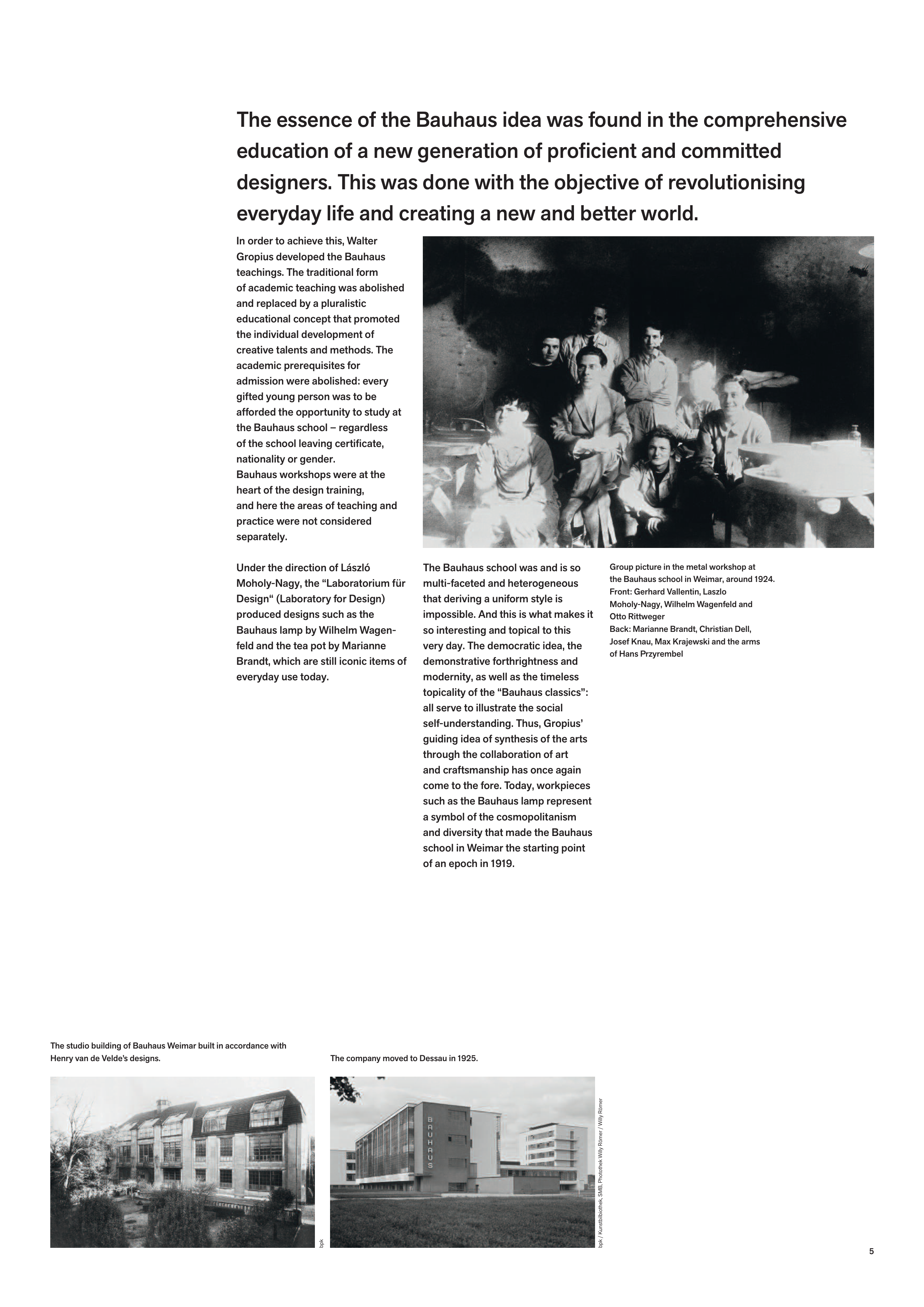
Group picture in the metal workshop at
the Bauhaus school in Weimar, around 1924.
Front: Gerhard Vallentin, Laszlo
Moholy-Nagy, Wilhelm Wagenfeld and
Otto Rittweger
Back: Marianne Brandt, Christian Dell,
Josef Knau, Max Krajewski and the arms
of Hans Przyrembel
The studio building of Bauhaus Weimar built in accordance with
Henry van de Velde’s designs.
The company moved to Dessau in 1925.
bpk / Kunstbilbiothek, SMB, Photothek Willy Römer / Willy Römer
bpk
The essence of the Bauhaus idea was found in the comprehensive
education of a new generation of proficient and committed
designers. This was done with the objective of revolutionising
everyday life and creating a new and better world.