15
So what was the thought behind
everything that Walter Schnepel had
when he gave Wa 24 to Dieter
Roth and to 31 other artists in the
course of the following few years?
As Peter Friese makes clear, it’s
neither about “re-examining the
proximity, or even the congruence of
art and design,” – and one might
almost want to add: “unnecessary” –
nor about a ranking list. No, it’s
about something else. It’s about the
design icon as an “object of artistic
interest,” about “opening up and
debating a field of experimentation”.
It’s about “using the means of
art to raise an outstanding design
product to another level of aesthetic
reflection that is traditionally
reserved for art”. In other words:
Walter Schnepel delivered a Wa 24
to 31 artists and received one work
of art from each of them in return.
scend boundaries and taboos were
created. Workpieces that question
the regularities of beauty and
function and juxtapose static objects
with a dynamic element – an idea
that is also inherent especially
to the Fluxus movement. And Dieter
Roth? Eventually, he placed his
Wa 24 on BAR no.1, put a beret on
it and poured red paint over it.
In his work, which is subject to con-
stant change, he thus sets a counter-
point to the timeless quality of the
Bauhaus lamp. Change and
rebelliousness instead of equality
and perfection. Above all, however,
as a result of all its interventions,
in all of its transformations, the
Bauhaus lamp acquires a symbolic
meaning, thereby extending its
function and beauty, and becoming
an “object plus y”.
The collection has already been
shown in:
Neues Museum Weserburg, Bremen
Kunstverein, Plön
Kiszelli Museum, Budapest
From June 2019
In the „Centrul de Interes“
cluj-napoca, Klausenburg, Romania
“You can’t make them better,”
Dieter Roth established when Walter Schnepel
handed him a WA 24,
“but you can always use a lamp.”
That was in 1995.
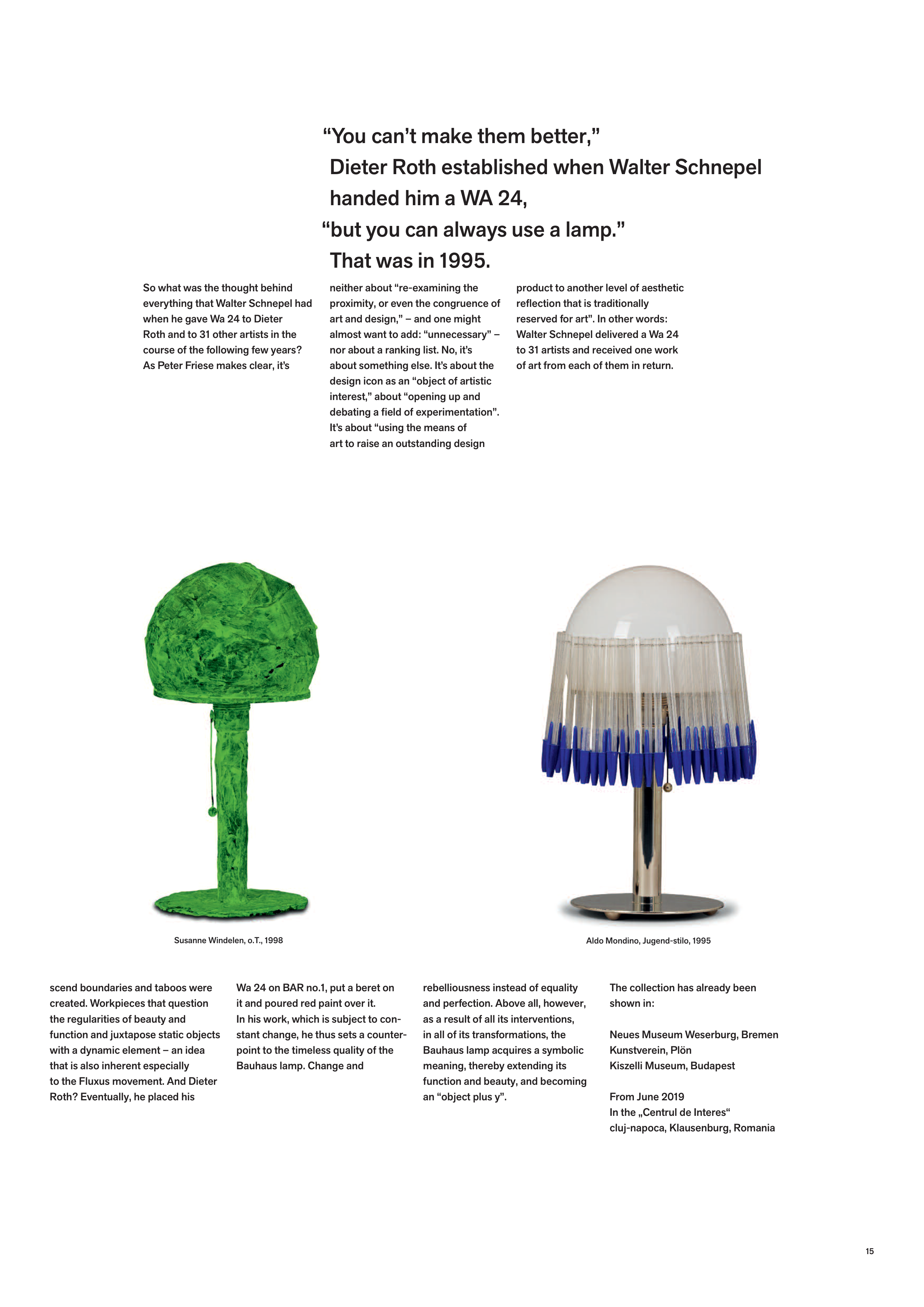
Susanne Windelen, o.T., 1998
Aldo Mondino, Jugend-stilo, 1995