4
The expectation that awaited
the “1919 Bauhaus 1928” MoMA
exhibition in 1938, was not
disappointed. The exhibition,
comprehensively staged by Walter
and Ilse Gropius, introduced the
Bauhaus approach to design
for the first time. In the catalogue
that documents the exhibition,
the programmatics, workshops and
institution protagonists are
portrayed in an encyclopaedic
scope. The momentum was
favourable. No nation in the world
was more in tune with Modernism
than the USA, which was more
optimally prepared for it than any
other. The Americans had been
very enthusiastic about Philip
Johnson’s minimalistically designed
exhibit “Machine Art”, which
celebrated safes, industrial glass
and ship propellers. And now the
Bauhaus with its programmatics
that reconcile industry and craft-
manship.
The designs put on display back
then met with an excellent response
from the open-minded Americans;
especially the objects that emerged
from the metal workshops
drew attention, in particular those
designed by Marianne Brandt.
The fact that Walter Gropius
directed such a clear focus onto
Marianne Brandt’s designs during
the exhibition was in part due
to the extraordinary aesthetic
quality of these objects. These
works distinguished themselves
fundamentally from most of the
other designs both in shape and
proportion as well as in their
aesthetic appearance. In addition,
Gropius used the attention that was
generated to refer to Brandt and
other Bauhaus designers, who
in the meantime were scattered
around the whole world.
If you leafed through the exhibition
catalogue you would inevitably
stop at her work. It is no coincidence
that Gropius selected the tea and
coffee set, created in 1924, in silver
as well as a model of the teapot in
silver-plated nickel, which
celebrates the primary geometric
shapes of Modernism in its hybrid
appearance, while simultaneously
radiating virtual, classic elegance.
We know this rare effect from
other truly outstanding designs of
the 20th century, for instance Mies
van der Rohe’s Barcelona Chair,
designed in 1929.
However, the spotlight that was
granted by the large-scale exhibition
in New York, did not reach the
originator of these masterpieces in
Germany. Brandt was denied the
new vital biographical branching
that we know happened to Josef and
Anni Albers, the Gropius couple,
Moholy-Nagy or Mies. A glimpse at
her eventful biography provides
some context. Born in Chemnitz in
1889, a daughter from a middle-
class, wealthy home, Brandt enjoys
an extensive artistic education at
various institutions. She is instructed
in drawing, sculptural work, and
finally in painting – studies that
began in Weimar and ended in
Munich. The marriage to Norwegian
painter Erik Brandt make Oslo the
centre of life for a short period of
time, however there are difficulties
with the painter’s parents. After
an intermezzo in Paris and Southern
France, the young pair returns to
Weimar where the designer briefly
studies sculpting again. The large
Weimar Bauhaus exhibition is rightly
attributed as the turning point
in Brandt’s life. She is accepted as a
student at the Bauhaus for the
winter semester in 1923, and in her
search for a suitable form of
expression finds Laszlo Moholy-
Nagy to be a dedicated mentor.
Contrary to all Bauhaus conventions
that would have preferred to see
Brandt in the weavery, Moholy-
Nagy made room for her in the metal
workshop, with emphasis on
training to become a silversmith.
The exuberant energy, the vital
productivity of those years in Weimar
and then later in Dessau already led
to astounding results early on.
Nothing illustrates the passionate
impulse for demonstrable,
representative prototypes more
clearly than the wide variation of
teapots, sugar and milk containers,
ashtrays and bowls from this
productive phase. Let’s not forget
that all of it basically arose in a very
short period of time under
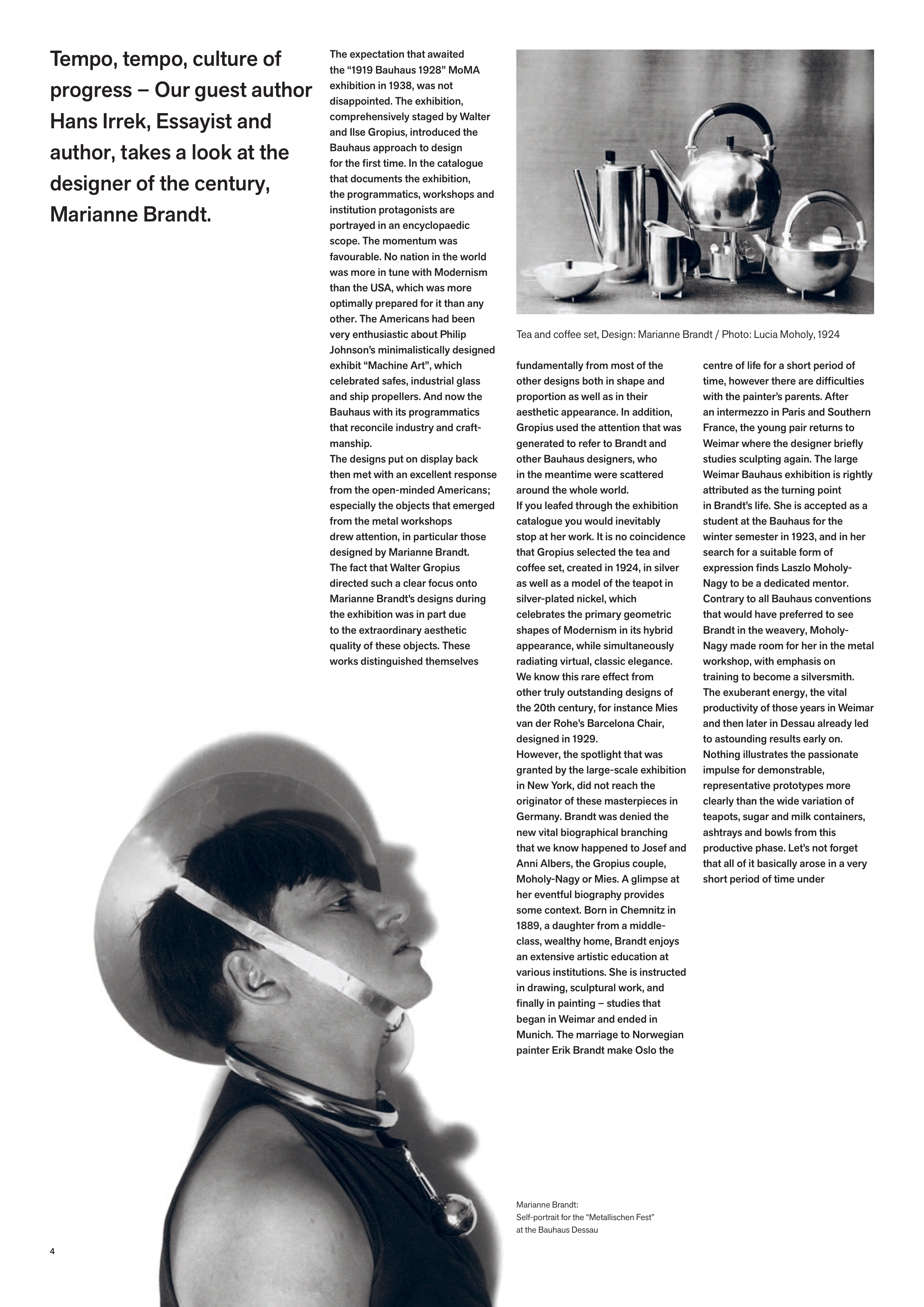
Tea and coffee set, Design: Marianne Brandt / Photo: Lucia Moholy, 1924
Marianne Brandt:
Self-portrait for the “Metallischen Fest”
at the Bauhaus Dessau
Tempo, tempo, culture of
progress – Our guest author
Hans Irrek, Essayist and
author, takes a look at the
designer of the century,
Marianne Brandt.