17
The deliberate reduction,
the omitting, the simplifi-
cation has a deeply
ethical basis: Something
that is simple can never
be disliked.
Egon Eiermann
The expression and culmination of
this liberation from everything
that had come before, are the steel
constructions that characterise
Egon Eiermann's work in both
architecture and furniture design.
He picked up on Bauhaus design
principles in his designs. The
permeability of the intermeshing of
the inside and outside, nature
and constructed space became an
expression of democracy in
architecture as well as in furniture
design. With its reduction to the line,
the reflection on pure form and
liberation from overflowing
accessories, anything heavy and
additional, Eiermann achieves a
modesty in his designs that seems to
free his objects from historical
contexts while still presenting them
as a consistent continuation of
what came before. Nonetheless, or
perhaps for this reason, the works
are characterised by timelessness. It
is no wonder then that his buildings
are classified as historical
monuments, his desks and chairs
enjoy great popularity up to this day,
and can be found in many public
buildings, as well as modern
agencies and private spaces. The
ceiling light from 1957 is no doubt
also one of the products that
is still as exciting as ever. Specially
designed by Egon Eiermann and
Sepp for the world exhibition
pavilion in Brussels and actually
produced in a small series, the
ES 57 soon enjoyed great popularity.
Egon Eiermann travelled to Italy in
1954 to take over the construction of
the Triennale in Milan. It is possible
that Gino Sarfatti inspired him here,
whose lights, which are exquisite
and functional at the same time,
like sculptures, set the stage for the
light itself. However, it is also
possible that the construction of the
pavilion with its intermeshing cubes,
the penetration of the exterior space
with the interior world, the crossing
lines and maximum transparency
culminate in this light.
They are commonly referred to
fondly as the “lipstick and powder
compact”, monument preservation
refers to it as a “city icon”,
and he himself calls it his life's work.
We are talking about the architectural
ensemble of the Kaiser-Wilhelm
Memorial Church in Berlin, that
deteriorating war ruin built in
the neo-romanticism style, that
Egon Eiermann provided with
a modern side. The architect didn't
hold much of preserving the old,
instead he relied on the consistent
progression of the familiar.
Functionality and practicality,
transparency and reduction to clear
lines were in the foreground of his
designs.
In his own activities, such as his role
as professor at the Technical
University Karlsruhe, he advanced
the development of the Modern.
Away from historical ballast,
towards lightness.
Then again, perhaps it is also the
influences of all his encounters with
architects from the previous
generation, with Walter Gropius,
Marcel Breuer or Ludwig Mies van
der Rohe. Perhaps it was the
confrontation with the ideas and
ideals of the Bauhaus, design
that reaches beyond the limits of
architecture. Perhaps it is the
concept of putting the focus of
design on functionality. It is possible
that his confrontation with
international developments
during his trips to the United States
also contributed to this German
architects signature. And it may also
be a blend of all of these aspects. In
any case, the ceiling light ES 27
continues to inspire – even sixty
years after the design of its fine,
delicate appearance. Featuring
abandonment of any embellishments,
reduction to functionality that
almost gives it a sculptural touch.
Egon Eiermann himself may
have been less excited about
creating an object that endured so
long. And perhaps he would not
have agreed to his structures
surrounded by scaffolding at the
Memorial Church in order to save its
substance. Instead he may have
preferred to design something new.
A new building, new furniture,
a new light ... but even though it was
constructed a long time ago, it is
still beautiful.
Kaiser-Wilhelm-Memorial Church,
Berlin 1957/63
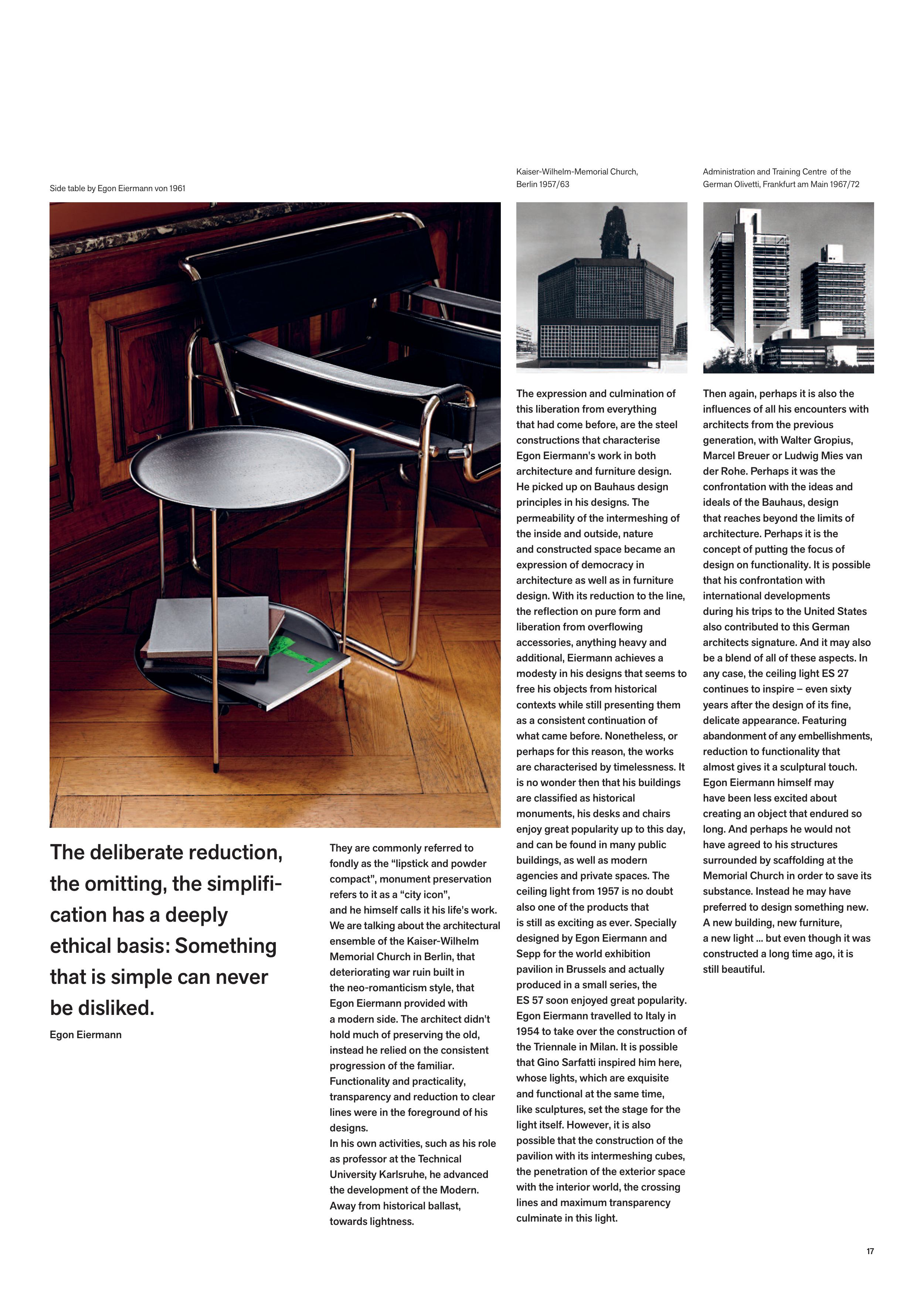
Side table by Egon Eiermann von 1961
Administration and Training Centre of the
German Olivetti, Frankfurt am Main 1967/72