come nasce una statuina
di capodimonte
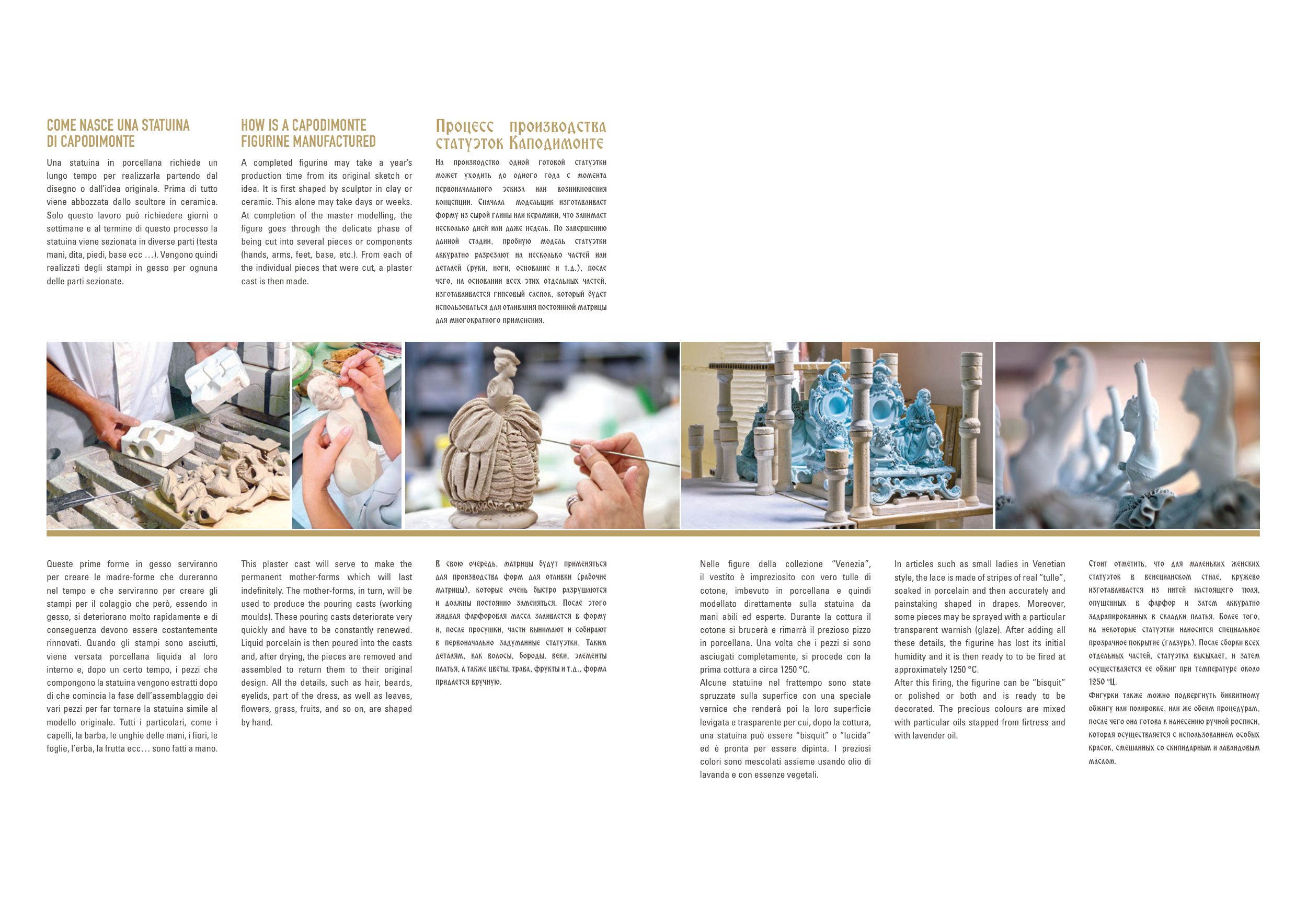
Una statuina in porcellana richiede un
lungo tempo per realizzarla partendo dal
disegno o dall’idea originale. Prima di tutto
viene abbozzata dallo scultore in ceramica.
Solo questo lavoro può richiedere giorni o
settimane e al termine di questo processo la
statuina viene sezionata in diverse parti (testa
mani, dita, piedi, base ecc …). Vengono quindi
realizzati degli stampi in gesso per ognuna
delle parti sezionate.
Queste prime forme in gesso serviranno
per creare le madre-forme che dureranno
nel tempo e che serviranno per creare gli
stampi per il colaggio che però, essendo in
gesso, si deteriorano molto rapidamente e di
conseguenza devono essere costantemente
rinnovati. Quando gli stampi sono asciutti,
viene versata porcellana liquida al loro
interno e, dopo un certo tempo, i pezzi che
compongono la statuina vengono estratti dopo
di che comincia la fase dell’assemblaggio dei
vari pezzi per far tornare la statuina simile al
modello originale. Tutti i particolari, come i
capelli, la barba, le unghie delle mani, i fiori, le
foglie, l’erba, la frutta ecc… sono fatti a mano.
how is a capodimonte
figurine manufactured
A completed figurine may take a year’s
production time from its original sketch or
idea. It is first shaped by sculptor in clay or
ceramic. This alone may take days or weeks.
At completion of the master modelling, the
figure goes through the delicate phase of
being cut into several pieces or components
(hands, arms, feet, base, etc.). From each of
the individual pieces that were cut, a plaster
cast is then made.
This plaster cast will serve to make the
permanent mother-forms which will last
indefinitely. The mother-forms, in turn, will be
used to produce the pouring casts (working
moulds). These pouring casts deteriorate very
quickly and have to be constantly renewed.
Liquid porcelain is then poured into the casts
and, after drying, the pieces are removed and
assembled to return them to their original
design. All the details, such as hair, beards,
eyelids, part of the dress, as well as leaves,
flowers, grass, fruits, and so on, are shaped
by hand.
Процесс производства
статуэток Каподимонте
На
производство
одной
готовой
статуэтки
может уходить до одного года с момента
первоначального
эскиза
или
возникновения
концепции. Сначала модельщик изготавливает
форму из сырой глины или керамики, что занимает
несколько дней или даже недель. По завершению
данной
стадии,
пробную
модель
статуэтки
аккуратно разрезают на несколько частей или
деталей (руки, ноги, основание и т.д.), после
чего, на основании всех этих отдельных частей,
изготавливается гипсовый слепок, который будет
использоваться для отливания постоянной матрицы
для многократного применения.
В свою очередь, матрицы будут применяться
для производства форм для отливки (рабочие
матрицы), которые очень быстро разрушаются
и должны постоянно заменяться. После этого
жидкая фарфоровая масса заливается в форму
и, после просушки, части вынимают и собирают
в первоначально задуманные статуэтки. Таким
деталям, как волосы, бороды, веки, элементы
платья, а также цветы, трава, фрукты и т.д., форма
придается вручную.
Nelle figure della collezione “Venezia”,
il vestito è impreziosito con vero tulle di
cotone, imbevuto in porcellana e quindi
modellato direttamente sulla statuina da
mani abili ed esperte. Durante la cottura il
cotone si brucerà e rimarrà il prezioso pizzo
in porcellana. Una volta che i pezzi si sono
asciugati completamente, si procede con la
prima cottura a circa 1250 °C.
Alcune statuine nel frattempo sono state
spruzzate sulla superfice con una speciale
vernice che renderà poi la loro superficie
levigata e trasparente per cui, dopo la cottura,
una statuina può essere “bisquit” o “lucida”
ed è pronta per essere dipinta. I preziosi
colori sono mescolati assieme usando olio di
lavanda e con essenze vegetali.
In articles such as small ladies in Venetian
style, the lace is made of stripes of real “tulle”,
soaked in porcelain and then accurately and
painstaking shaped in drapes. Moreover,
some pieces may be sprayed with a particular
transparent warnish (glaze). After adding all
these details, the figurine has lost its initial
humidity and it is then ready to to be fired at
approximately 1250 °C.
After this firing, the figurine can be “bisquit”
or polished or both and is ready to be
decorated. The precious colours are mixed
with particular oils stapped from firtress and
with lavender oil.
Стоит отметить, что для маленьких женских
статуэток
в
венецианском
стиле,
кружево
изготавливается из нитей настоящего тюля,
опущенных
в
фарфор
и
затем
аккуратно
задрапированных в складки платья. Более того,
на некоторые статуэтки наносится специальное
прозрачное покрытие (глазурь). После сборки всех
отдельных частей, статуэтка высыхает, и затем
осуществляется ее обжиг при температуре около
1250 °C.
Фигурки также можно подвергнуть биквитному
обжигу или полировке, или же обеим процедурам,
после чего она готова к нанесению ручной росписи,
которая осуществляется с использованием особых
красок, смешанных со скипидарным и лавандовым
маслом.