G
H
Interview with
Stephan Gottinger and
Martin Hermann
The flood in Passau in 2013 was the second-worst flood disaster
in the history of the city. Along with the Danube and the Ilz, the Inn
also overflowed into the streets. Your house, directly on the river-
bank, was partly washed away and left in ruins. Why did you de-
cide to build your new house on exactly the same site?
Stephan Gottinger: The flood in Passau hit us so badly that we
couldn’t keep our old house. It was heavily damaged. The location
remained a flood zone; the flood might have returned and the house,
at risk of collapsing, would have to be repaired again and again. We
knew that this wasn’t sustainable. At the same time, we wanted to
stay in this special location where we feel so at home. That’s why we
decided to build something new.
Martin Hermann: It took a long time and lots of planning before we
were sure we would be allowed to build. Once the official decision
was made, we knew we would see it through.
Why did you decide to work with the architecture firm koeberl
doeringer architekten?
Stephan Gottinger: We knew immediately which architects we
wanted to work with. They knew us personally and were familiar with
our lifestyle. We asked them whether they would like to build our new
house, they agreed and got back to us a few weeks later with a first
draft. With a few minimal changes, this became the final design.
Martin Hermann: From the beginning, our premise was that we
wanted to give the architects free rein. We did give them a few re-
quests, though. On top of that, there were a few specifications that
had to be met. For example, the new building had to exceed the
requirements of the current flood protection measures.
Where does the name “Fels in der Brandung” come from?
Stephan Gottinger: That was the architects’ idea. They wanted to
build a sort of stronghold as a reaction to the flood. When the old
house was finally torn down and we dug deep, a rock was uncovered.
Martin called our architect Albert Köberl straight away – we had found
the solid rock – the Fels.
The concrete building to defy the floods. Instead of a cellar, there
is a flood space between concrete bulkheads with a bank rein-
forcement made from granite. The exposed concrete surfaces can
be cleaned quickly and easily after a flood. How did you come to
choose black exposed concrete?
Stephan Gottinger: When the architects asked us how we would
imagine our house, we didn’t have a specific answer for them. Martin
just knew that he would be happy with concrete. When they sug
gested black concrete, it took our breath away at first.
Martin Hermann: But we were expecting something unusual, as
we were familiar with the other houses from the architects. The fact
that they reinvent architecture with every build is what makes them
stand out.
What convinced you about black exposed concrete in the end?
Stephan Gottinger: We saw a small sample of the black concrete. But
we couldn’t yet imagine how it would look all over. Still, we decided
to go for it.
And you’ve never regretted your decision?
Stephan Gottinger: At first, we thought the black concrete might look
too dark and oppressive. When the concrete was poured, it looked
like tar to start with. But as the walls were gradually finished, it all
came together.
Martin Hermann: At that point we could already see how high the
ceilings would be – by then we had no more doubts. Although the
walls are black, the rooms have a liberating feel.
How does the lighting influence this effect?
Martin Hermann: The dark concrete actually has a warm color, which
the lighting really brings out. It makes the raw material shine and
creates a cosy atmosphere. The warm interior light also reinforces this
atmosphere of being protected.
Instead of art, the light is the only thing decorating the walls ...
Martin Hermann: In the previous build, we had a picture hanging on
every wall. In the new build, it quickly became clear that this wasn’t
possible. That’s why the pictures are on the floor, leaning against
the wall.
Stephan Gottinger: The light makes the exposed concrete itself look
like a work of art. When the light falls on it, it creates beautiful plays
of light and shadow – hanging pictures on the wall would almost ruin
the effect. The spotlights from Occhio showcase the concrete and
present its texture atmospherically.
What role does light play in your life in the new house?
Stephan Gottinger: It plays a very important role, especially in the
evenings and at night. As we can position the spotlights flexibly
and use different settings for the light, we can always generate a
new ambience.
Martin Hermann: In our home, we don’t just switch the light on or
off – we create different light scenarios. Whether we are sitting on the
sofa or cooking for our guests, we use light very consciously.
What makes the house and its location a place of longing for you?
Stephan Gottinger: The site, right by the river, was always extraordi-
nary. The flood disaster made us feel even more attached to the place.
Martin Hermann: When I approach the house and see the light pour-
ing out through the windows, I feel at home. If we hadn’t been able
to build here, I would always be longing for this place.
» The exposed
concrete
itself becomes
a work of art
through light. «
Stephan Gottinger
Interview
Interview
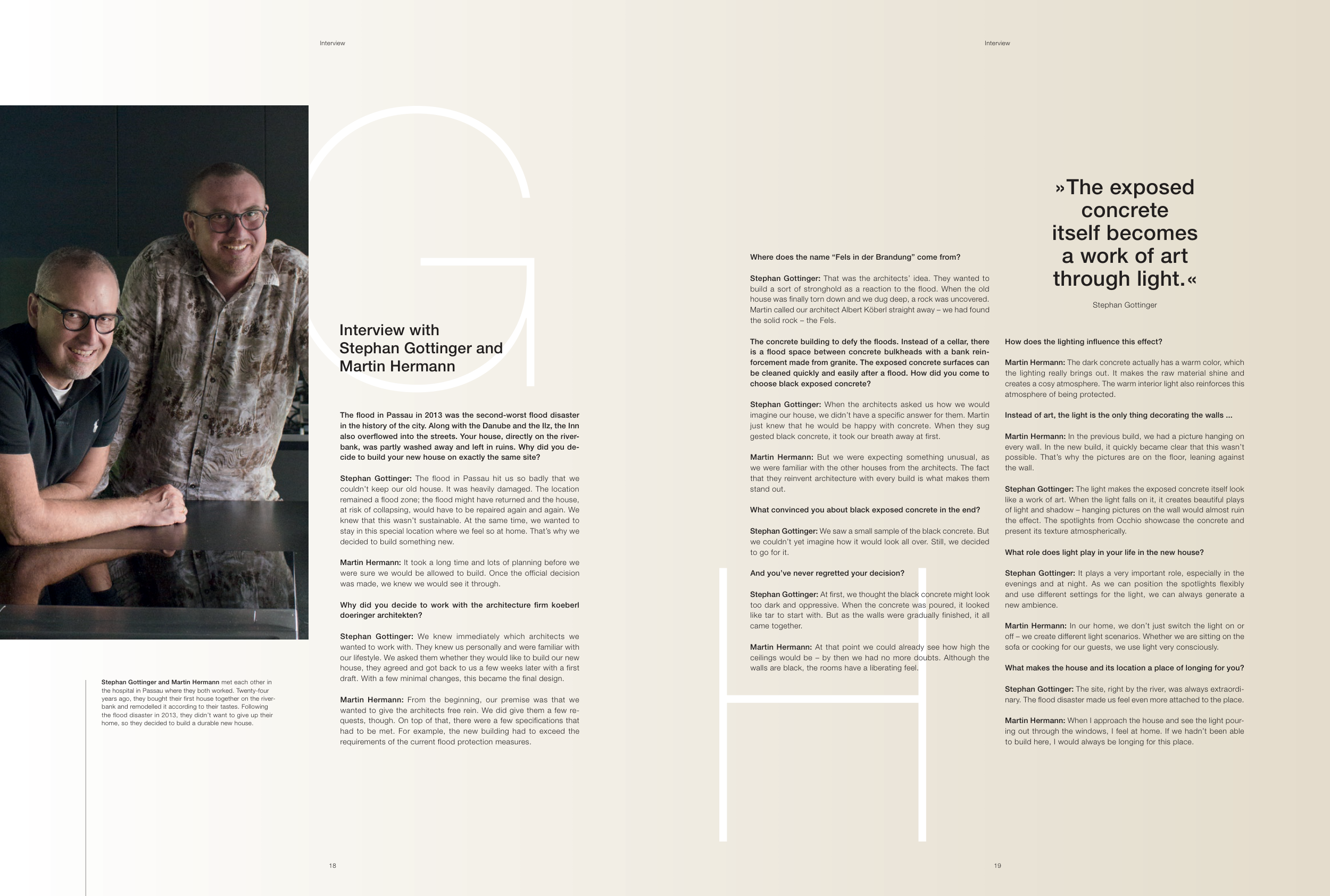
Stephan Gottinger and Martin Hermann met each other in
the hospital in Passau where they both worked. Twenty-four
years ago, they bought their first house together on the river-
bank and remodelled it according to their tastes. Following
the flood disaster in 2013, they didn’t want to give up their
home, so they decided to build a durable new house.
19
18