pp. 138
/139
Setting the Elegance
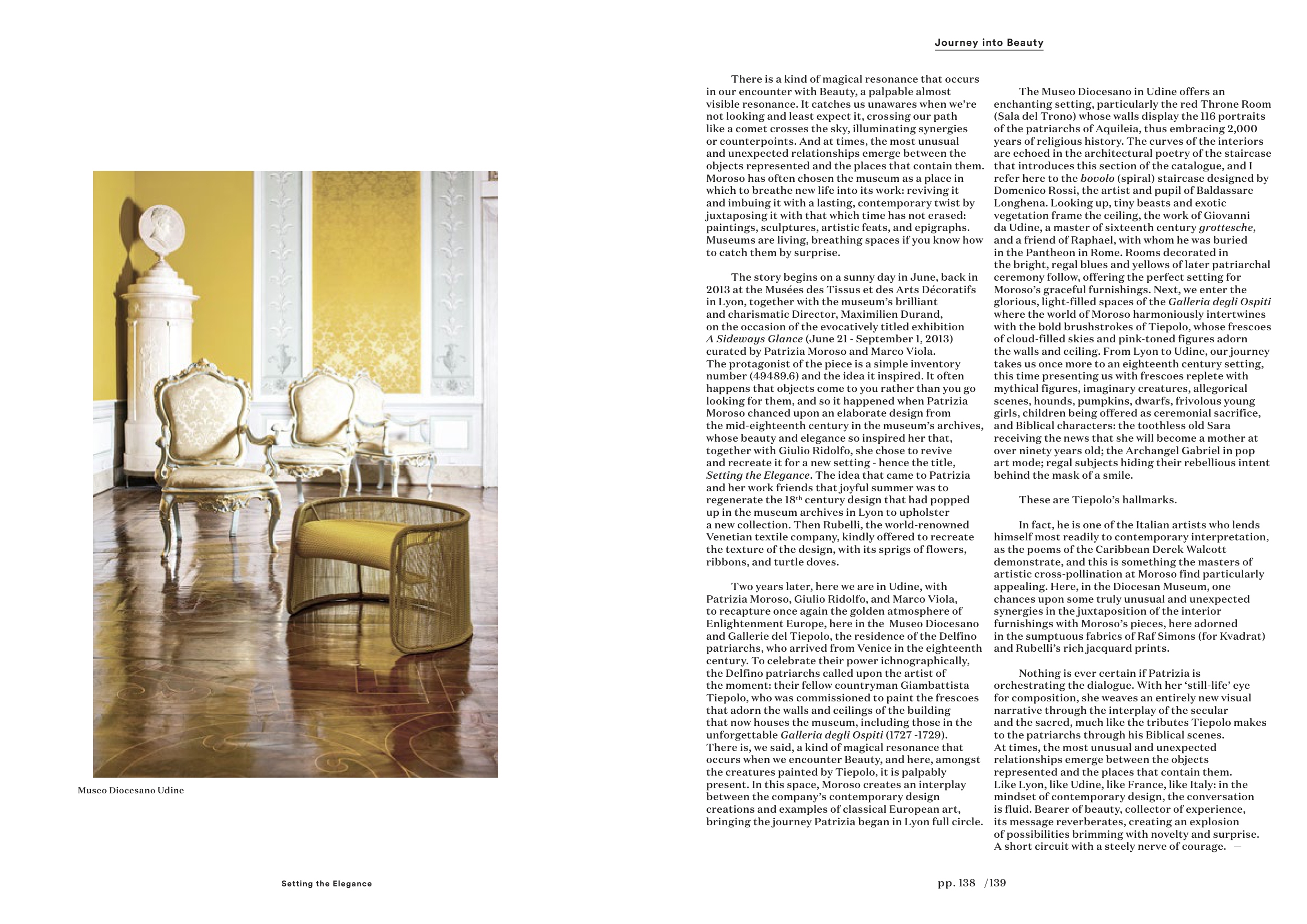
Museo Diocesano Udine
There is a kind of magical resonance that occurs
in our encounter with Beauty, a palpable almost
visible resonance. It catches us unawares when we’re
not looking and least expect it, crossing our path
like a comet crosses the sky, illuminating synergies
or counterpoints. And at times, the most unusual
and unexpected relationships emerge between the
objects represented and the places that contain them.
Moroso has often chosen the museum as a place in
which to breathe new life into its work: reviving it
and imbuing it with a lasting, contemporary twist by
juxtaposing it with that which time has not erased:
paintings, sculptures, artistic feats, and epigraphs.
Museums are living, breathing spaces if you know how
to catch them by surprise.
The story begins on a sunny day in June, back in
2013 at the Musées des Tissus et des Arts Décoratifs
in Lyon, together with the museum’s brilliant
and charismatic Director, Maximilien Durand,
on the occasion of the evocatively titled exhibition
A Sideways Glance (June 21 - September 1, 2013)
curated by Patrizia Moroso and Marco Viola.
The protagonist of the piece is a simple inventory
number (49489.6) and the idea it inspired. It often
happens that objects come to you rather than you go
looking for them, and so it happened when Patrizia
Moroso chanced upon an elaborate design from
the mid-eighteenth century in the museum’s archives,
whose beauty and elegance so inspired her that,
together with Giulio Ridolfo, she chose to revive
and recreate it for a new setting - hence the title,
Setting the Elegance. The idea that came to Patrizia
and her work friends that joyful summer was to
regenerate the 18th century design that had popped
up in the museum archives in Lyon to upholster
a new collection. Then Rubelli, the world-renowned
Venetian textile company, kindly offered to recreate
the texture of the design, with its sprigs of flowers,
ribbons, and turtle doves.
Two years later, here we are in Udine, with
Patrizia Moroso, Giulio Ridolfo, and Marco Viola,
to recapture once again the golden atmosphere of
Enlightenment Europe, here in the Museo Diocesano
and Gallerie del Tiepolo, the residence of the Delfino
patriarchs, who arrived from Venice in the eighteenth
century. To celebrate their power ichnographically,
the Delfino patriarchs called upon the artist of
the moment: their fellow countryman Giambattista
Tiepolo, who was commissioned to paint the frescoes
that adorn the walls and ceilings of the building
that now houses the museum, including those in the
unforgettable Galleria degli Ospiti (1727 -1729).
There is, we said, a kind of magical resonance that
occurs when we encounter Beauty, and here, amongst
the creatures painted by Tiepolo, it is palpably
present. In this space, Moroso creates an interplay
between the company’s contemporary design
creations and examples of classical European art,
bringing the journey Patrizia began in Lyon full circle.
The Museo Diocesano in Udine offers an
enchanting setting, particularly the red Throne Room
(Sala del Trono) whose walls display the 116 portraits
of the patriarchs of Aquileia, thus embracing 2,000
years of religious history. The curves of the interiors
are echoed in the architectural poetry of the staircase
that introduces this section of the catalogue, and I
refer here to the bovolo (spiral) staircase designed by
Domenico Rossi, the artist and pupil of Baldassare
Longhena. Looking up, tiny beasts and exotic
vegetation frame the ceiling, the work of Giovanni
da Udine, a master of sixteenth century grottesche,
and a friend of Raphael, with whom he was buried
in the Pantheon in Rome. Rooms decorated in
the bright, regal blues and yellows of later patriarchal
ceremony follow, offering the perfect setting for
Moroso’s graceful furnishings. Next, we enter the
glorious, light-filled spaces of the Galleria degli Ospiti
where the world of Moroso harmoniously intertwines
with the bold brushstrokes of Tiepolo, whose frescoes
of cloud-filled skies and pink-toned figures adorn
the walls and ceiling. From Lyon to Udine, our journey
takes us once more to an eighteenth century setting,
this time presenting us with frescoes replete with
mythical figures, imaginary creatures, allegorical
scenes, hounds, pumpkins, dwarfs, frivolous young
girls, children being offered as ceremonial sacrifice,
and Biblical characters: the toothless old Sara
receiving the news that she will become a mother at
over ninety years old; the Archangel Gabriel in pop
art mode; regal subjects hiding their rebellious intent
behind the mask of a smile.
These are Tiepolo’s hallmarks.
In fact, he is one of the Italian artists who lends
himself most readily to contemporary interpretation,
as the poems of the Caribbean Derek Walcott
demonstrate, and this is something the masters of
artistic cross-pollination at Moroso find particularly
appealing. Here, in the Diocesan Museum, one
chances upon some truly unusual and unexpected
synergies in the juxtaposition of the interior
furnishings with Moroso’s pieces, here adorned
in the sumptuous fabrics of Raf Simons (for Kvadrat)
and Rubelli’s rich jacquard prints.
Nothing is ever certain if Patrizia is
orchestrating the dialogue. With her ‘still-life’ eye
for composition, she weaves an entirely new visual
narrative through the interplay of the secular
and the sacred, much like the tributes Tiepolo makes
to the patriarchs through his Biblical scenes.
At times, the most unusual and unexpected
relationships emerge between the objects
represented and the places that contain them.
Like Lyon, like Udine, like France, like Italy: in the
mindset of contemporary design, the conversation
is fluid. Bearer of beauty, collector of experience,
its message reverberates, creating an explosion
of possibilities brimming with novelty and surprise.
A short circuit with a steely nerve of courage. —
Journey into Beauty