50
“As for my not letting people in on the joke, there are times when real life is funnier than
deliberate comedy. Therefore I try to create the illusion of a 'real-life' situation or character.
However, it must be believed totally; if I were to let people in on the joke, it wouldn’t have
that effect… Finally, concerning my 'brief flirtation' with levitation, this is something I have
studied and practiced for several years and I take it very seriously.”
(From a letter written by Andy Kaufman to Rolling Stone)
Ball Don't Lie is an expression used
in the world of basketball to indicate a situa-
tion where a player is given a questionable
foul and at the free throw misses the shot.
The ball does not lie; if there had been an
real offense the ball would have entered the
hoop. But what would happen if we decided
to use this power of divination in another way,
for example by using basket shots to answer
some of our questions? Let’s try this: is Ro-
berto Fassone a basketball player? Without
much effort, the ball drops through the hoop.
Okay, but isn’t Roberto also an artist? For a
second time the ball’s trajectory ends up in-
side the basket. This result, especially consi-
dering none of us knows how to play basket-
ball, only confirms what we already knew
before: Roberto Fassone is a basketball player
and an artist.
As told at the beginning of Hans Ulrich Obrist
interviews Roberto Fassone (2016), an inter-
view with the famous Swiss curator and critic,
the game has always been an important ele-
ment in the research of the artist.
Game as an attitude, but also as a tool for ana-
lysis, and a very precise system of rules for
the creation of a taxonomy of the creative pro-
cesses.
For example, sibi (2012-ongoing), an online
software that generates instructions for the
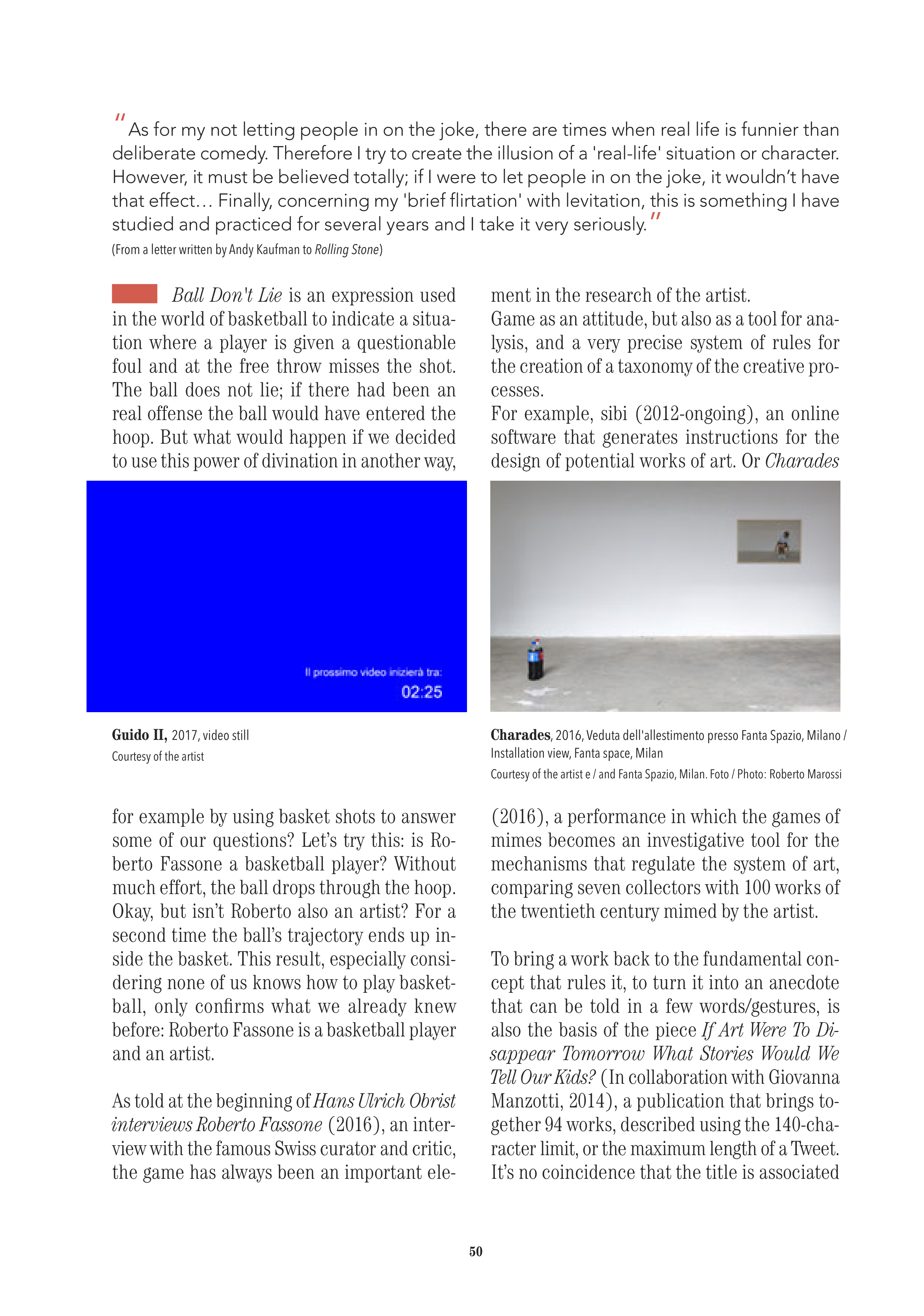
design of potential works of art. Or Charades
(2016), a performance in which the games of
mimes becomes an investigative tool for the
mechanisms that regulate the system of art,
comparing seven collectors with 100 works of
the twentieth century mimed by the artist.
To bring a work back to the fundamental con-
cept that rules it, to turn it into an anecdote
that can be told in a few words/gestures, is
also the basis of the piece If Art Were To Di-
sappear Tomorrow What Stories Would We
Tell Our Kids? (In collaboration with Giovanna
Manzotti, 2014), a publication that brings to-
gether 94 works, described using the 140-cha-
racter limit, or the maximum length of a Tweet.
It’s no coincidence that the title is associated
Charades, 2016, Veduta dell'allestimento presso Fanta Spazio, Milano /
Installation view, Fanta space, Milan
Courtesy of the artist e / and Fanta Spazio, Milan. Foto / Photo: Roberto Marossi
Guido II, 2017, video still
Courtesy of the artist