31
tomy, and the raw scratching of rock carvings.
They immerge from a pool of influences looted
from unscrupulous and visceral painting,
spontaneous and visionary, that seems to
spring from their instinctive dispositions.
They have a visionary and subversive quality
that prior to being enacted on a canvas was
formed on the street, in the vocabulary of
graffiti, a breaking of the canon and a dissen-
ting challenge to purity. This desire to break
down the wall of indifference of passers-by,
to give meaning to a building that had been
made invisible by the passage of time, the
thrill of illegality and risk, the acceptance of
the ephemeral, the furious feelings of anta-
gonism, the speed and approximation of the
execution of the work, are all factors without
which the powerful paintings of Canemorto
would not be what they are.
The same darting and energetic dynamism,
underpinned by chromatic research, is found
in the paintings where the immediacy of the
stroke is applied to more complex and consi-
dered iconography, often representing the
fight between Good and Evil as an eternal op-
position that exists in distinguishing the win-
ners from the losers. However, the works ne-
ver allude to any precise meaning nor are
they connected to reality. They take the form
of hallucinatory visions, the result of states
of being and suggestions coming from every-
day life, rather than being a direct represen-
tation.
In these terms Canemorto is successful be-
cause they communicate with people, they
provoke reactions from passers-by, and they
give shape to a malaise that is above all col-
lective state of being. Their relationship with
outsiders and the sense of belonging, sharing,
and accessibility, has influenced how they
spread their work, including printing fanzines,
creating gadgets, and making videos.
Their art is well-rounded, versatile, eclectic,
and flows like an underground river, an un-
welcome presence that insinuates itself into
public spaces, that lies at rest when the sun
rises and prepares the next assault at sun-
down.
Elisa Fusi
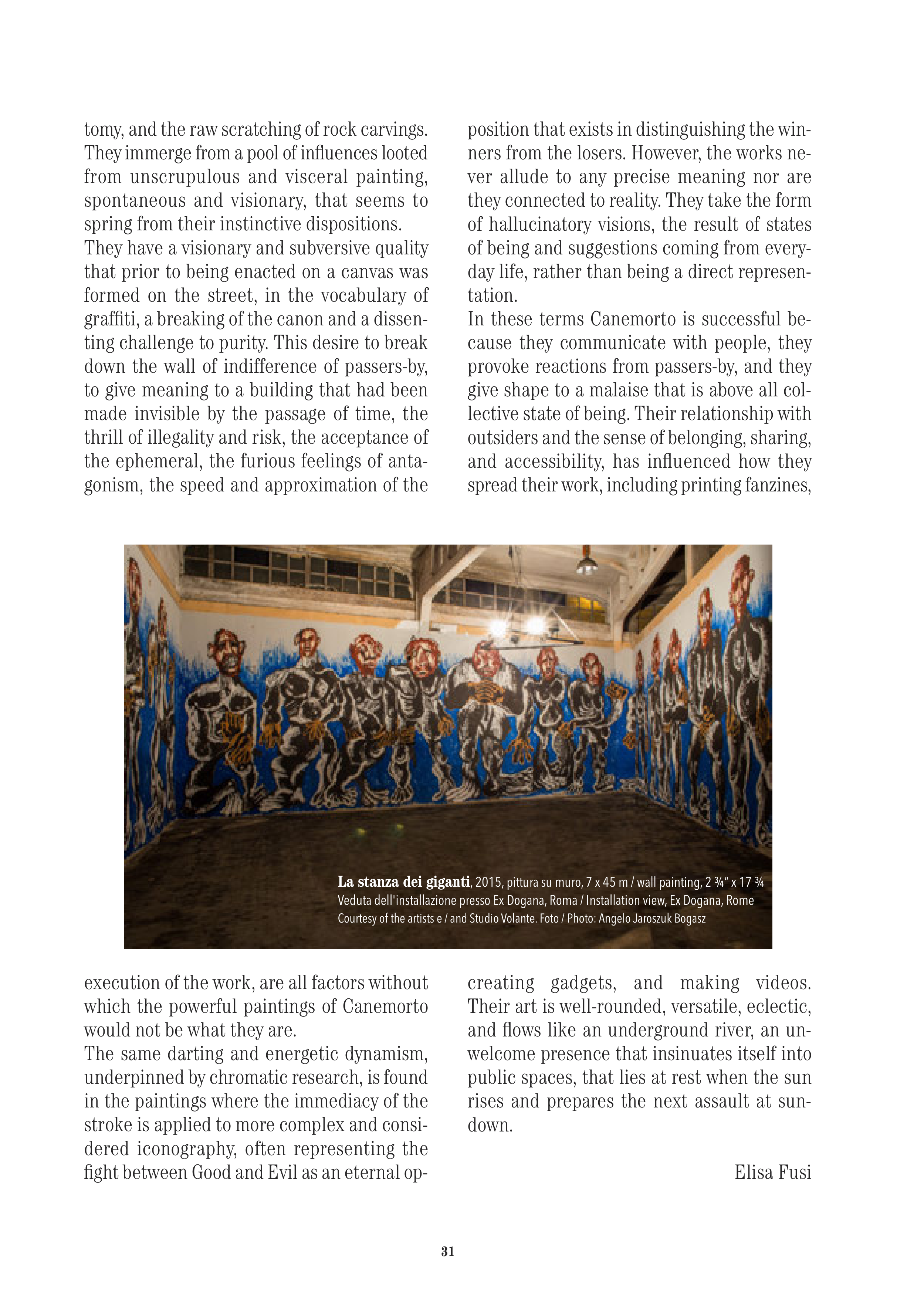
La stanza dei giganti, 2015, pittura su muro, 7 x 45 m / wall painting, 2 ¾” x 17 ¾
Veduta dell'installazione presso Ex Dogana, Roma / Installation view, Ex Dogana, Rome
Courtesy of the artists e / and Studio Volante. Foto / Photo: Angelo Jaroszuk Bogasz