124
to construction, and at its conclusion, demo-
lition. Here the idea is to create and then di-
smantle something, so that it is preserved
only in the memory of those who experienced
it firsthand. A former church now in ruins,
dedicated to San Rocco, was made tempora-
rily available day and night, thanks to a stair-
case where you were protected and at the
same time encaged by a wire mesh, which pe-
netrated the dilapidated church architecture
until it ended in a wedge in a small window
upstairs. The timed illumination of the public
streetlights was linked to the inside of the
former church. Night and day the visitors, in
a truly ascendant path, could get back into
what, abandoned for years, had become a
dead spot in the urban fabric of the city of
Bergamo. The experience designed by Mo-
scardini (also in this case a simple course,
clean cut, made from the paper in the space),
at the same time protected but engaged, pro-
vides a means of contemplation that does not
allow any direct interaction with the place,
which has been reopened for the occasion. If
looked at from an architectural perspective,
the audixence is locked in a metal cage, con-
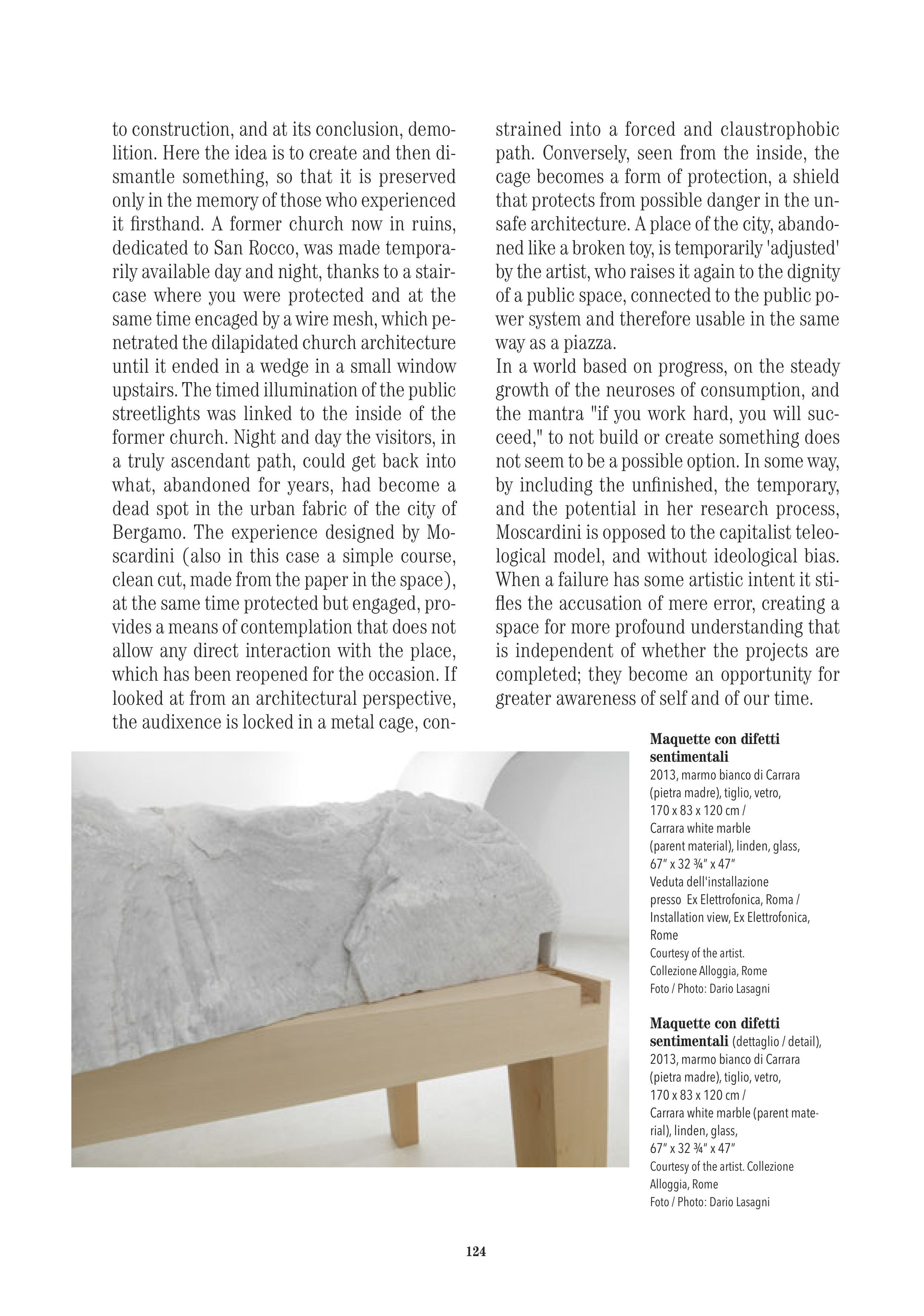
Maquette con difetti
sentimentali
2013, marmo bianco di Carrara
(pietra madre), tiglio, vetro,
170 x 83 x 120 cm /
Carrara white marble
(parent material), linden, glass,
67” x 32 ¾” x 47”
Veduta dell'installazione
presso Ex Elettrofonica, Roma /
Installation view, Ex Elettrofonica,
Rome
Courtesy of the artist.
Collezione Alloggia, Rome
Foto / Photo: Dario Lasagni
Maquette con difetti
sentimentali (dettaglio / detail),
2013, marmo bianco di Carrara
(pietra madre), tiglio, vetro,
170 x 83 x 120 cm /
Carrara white marble (parent mate-
rial), linden, glass,
67” x 32 ¾” x 47”
Courtesy of the artist. Collezione
Alloggia, Rome
Foto / Photo: Dario Lasagni
strained into a forced and claustrophobic
path. Conversely, seen from the inside, the
cage becomes a form of protection, a shield
that protects from possible danger in the un-
safe architecture. A place of the city, abando-
ned like a broken toy, is temporarily 'adjusted'
by the artist, who raises it again to the dignity
of a public space, connected to the public po-
wer system and therefore usable in the same
way as a piazza.
In a world based on progress, on the steady
growth of the neuroses of consumption, and
the mantra "if you work hard, you will suc-
ceed," to not build or create something does
not seem to be a possible option. In some way,
by including the unfinished, the temporary,
and the potential in her research process,
Moscardini is opposed to the capitalist teleo-
logical model, and without ideological bias.
When a failure has some artistic intent it sti-
fles the accusation of mere error, creating a
space for more profound understanding that
is independent of whether the projects are
completed; they become an opportunity for
greater awareness of self and of our time.