98
Story of Your Life, a short story by Ted Chiang,
adapted for film in 2016 by Denis Villeneuve
in Arrival, takes an approach I’d never seen
before: although he does not depart from the
concept of the technological portal, Chiang
gives language – aptly presented as the device
that it is – the function of activating the gates
of space and time. Through learning the alien
language of the Heptapods, brought as a gift
by the alien creatures, the protagonist disco-
vers a hidden future memory, which will be
used as a deterrent to the impending war and
a worldwide lingua franca.
For Invernomuto (Simone Bertuzzi and Si-
mone Trabucchi), in the same way, it is lan-
guage (but also symbols and the body) that
become the vehicles for space-time travel,
even when, unlike Chiang, they address the
more problematic issue of the possibility of a
global Esperanto. For artists in fact, it is in
the hyper-specific and micro-local that the
principal motivation for the journey to distant
places is found. And if for Mar-
cel Mauss the unique use of lan-
guage is one of the main featu-
res that unites culture in the
identification of the magician
in the community, Invernomuto
is equally influenced by the pe-
culiar magnetic force of those
who, in their personal presence,
become like shamans in ‘tradi-
tional’ cultures, portals to other
places and other times.
I n T o a n d T h r o u g h
Although the editors of Wikipedia
have taken on the burden of extensive cata-
loguing of images, there is a paradoxical shor-
tage of imagination in the representation of
one of the most common topics of literature,
film, and videogame production of fantasy
fiction: the phenomenon that in real theore-
tical physics is called the Einstein-Rosen
bridge, or more commonly a wormhole. A "cu-
nicolo spazio temporale" (the Italian lan-
guage has not been able to find a better
phrase) is a hypothetical astronomical object
in which two points connect in space faster
than it would take light to travel the distance.
In most cases, where this concept was made
use of in popular culture, the wormhole has
taken the form of a circle (Stargate), an oval
(Portal), and only in the rarest but most in-
teresting cases, of objects more commonly
used, such as a window (in the trilogy His
Dark Materials by Philip Pullman), a war-
drobe (in The Chronicles of Narnia by C.S.
Lewis), or a rabbit hole or mirror (Alice in
Wonderland and Alice Through
the Looking Glass of Lewis Car-
roll). If the idea of physical tra-
vel through a portal to some
distant place is suited to te-
chnological representation,
very little work has been done
to imagine a device that exce-
eds a figuration that, funda-
mentally, has been the same
for centuries, and as an inven-
tion long precedes its concep-
tion in theoretical physics.
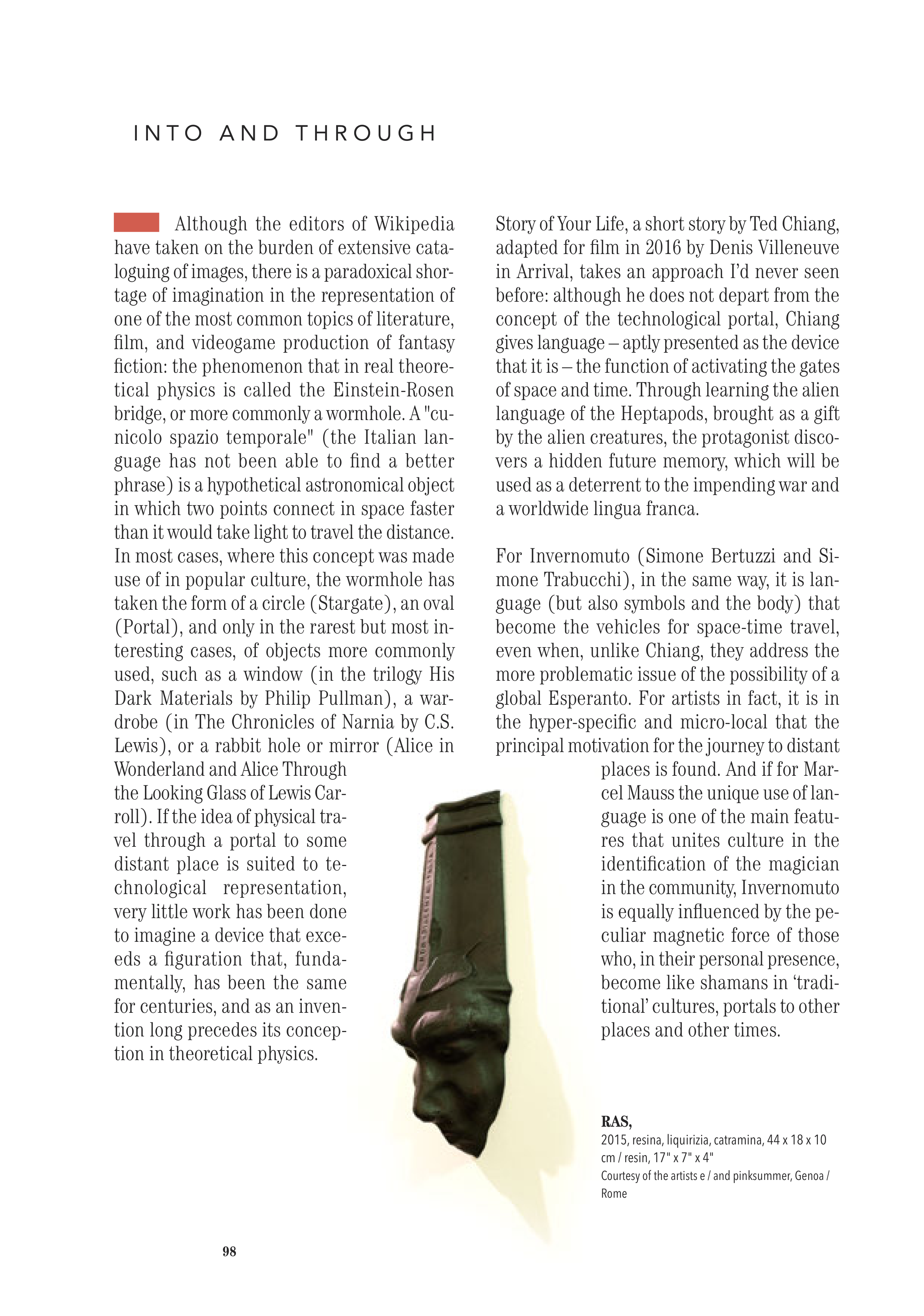
RAS,
2015, resina, liquirizia, catramina, 44 x 18 x 10
cm / resin, 17" x 7" x 4"
Courtesy of the artists e / and pinksummer, Genoa /
Rome