15
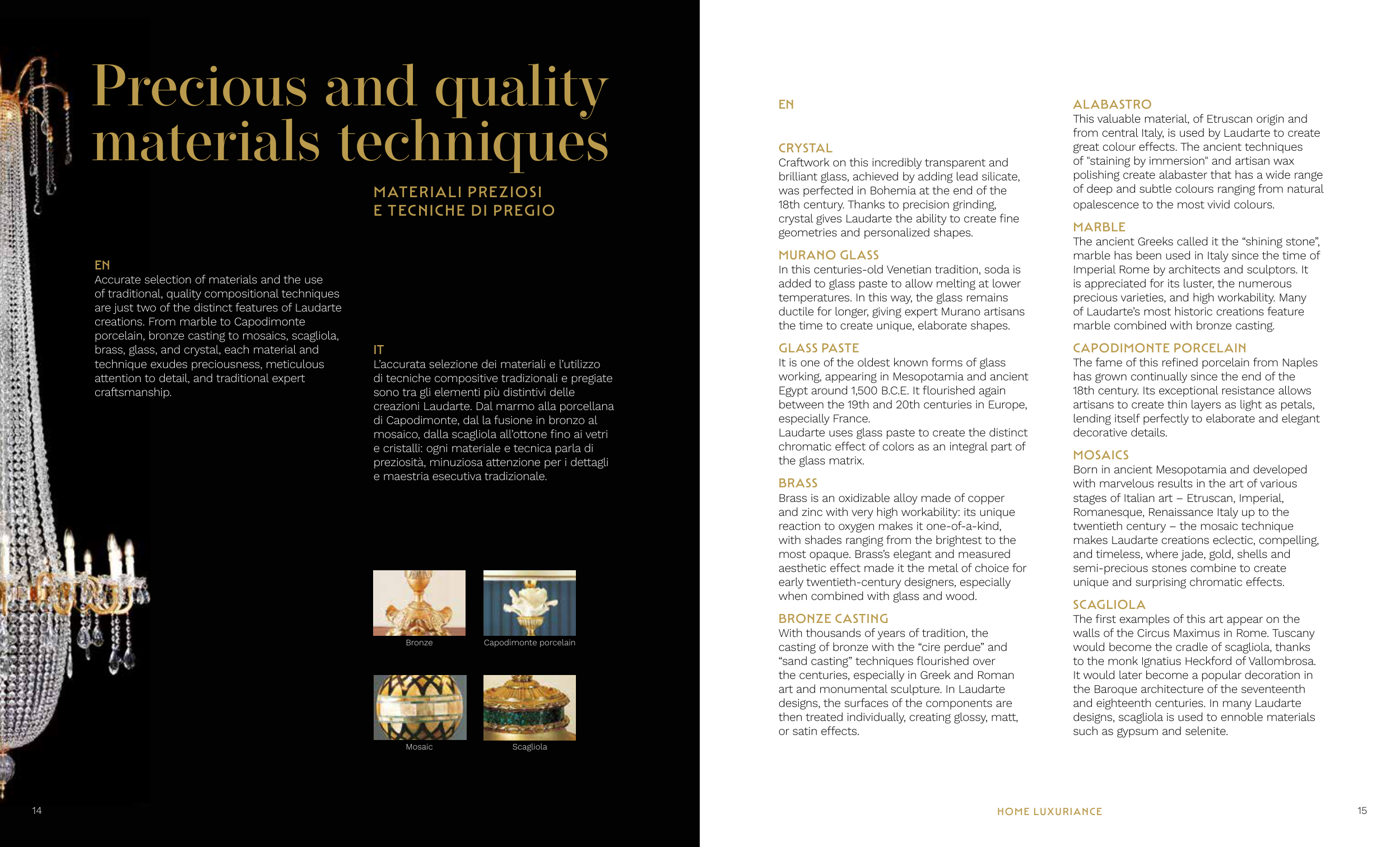
Scagliola
Capodimonte porcelain
Mosaic
Bronze
HOME LUXURIANCE
14
EN
Accurate selection of materials and the use
of traditional, quality compositional techniques
are just two of the distinct features of Laudarte
creations. From marble to Capodimonte
porcelain, bronze casting to mosaics, scagliola,
brass, glass, and crystal, each material and
technique exudes preciousness, meticulous
attention to detail, and traditional expert
craftsmanship.
CRYSTAL
Craftwork on this incredibly transparent and
brilliant glass, achieved by adding lead silicate,
was perfected in Bohemia at the end of the
18th century. Thanks to precision grinding,
crystal gives Laudarte the ability to create fine
geometries and personalized shapes.
MURANO GLASS
In this centuries-old Venetian tradition, soda is
added to glass paste to allow melting at lower
temperatures. In this way, the glass remains
ductile for longer, giving expert Murano artisans
the time to create unique, elaborate shapes.
GLASS PASTE
It is one of the oldest known forms of glass
working, appearing in Mesopotamia and ancient
Egypt around 1,500 B.C.E. It flourished again
between the 19th and 20th centuries in Europe,
especially France.
Laudarte uses glass paste to create the distinct
chromatic effect of colors as an integral part of
the glass matrix.
BRASS
Brass is an oxidizable alloy made of copper
and zinc with very high workability: its unique
reaction to oxygen makes it one-of-a-kind,
with shades ranging from the brightest to the
most opaque. Brass’s elegant and measured
aesthetic effect made it the metal of choice for
early twentieth-century designers, especially
when combined with glass and wood.
BRONZE CASTING
With thousands of years of tradition, the
casting of bronze with the “cire perdue” and
“sand casting” techniques flourished over
the centuries, especially in Greek and Roman
art and monumental sculpture. In Laudarte
designs, the surfaces of the components are
then treated individually, creating glossy, matt,
or satin effects.
ALABASTRO
This valuable material, of Etruscan origin and
from central Italy, is used by Laudarte to create
great colour effects. The ancient techniques
of "staining by immersion" and artisan wax
polishing create alabaster that has a wide range
of deep and subtle colours ranging from natural
opalescence to the most vivid colours.
MARBLE
The ancient Greeks called it the “shining stone”,
marble has been used in Italy since the time of
Imperial Rome by architects and sculptors. It
is appreciated for its luster, the numerous
precious varieties, and high workability. Many
of Laudarte’s most historic creations feature
marble combined with bronze casting.
CAPODIMONTE PORCELAIN
The fame of this refined porcelain from Naples
has grown continually since the end of the
18th century. Its exceptional resistance allows
artisans to create thin layers as light as petals,
lending itself perfectly to elaborate and elegant
decorative details.
MOSAICS
Born in ancient Mesopotamia and developed
with marvelous results in the art of various
stages of Italian art – Etruscan, Imperial,
Romanesque, Renaissance Italy up to the
twentieth century – the mosaic technique
makes Laudarte creations eclectic, compelling,
and timeless, where jade, gold, shells and
semi-precious stones combine to create
unique and surprising chromatic effects.
SCAGLIOLA
The first examples of this art appear on the
walls of the Circus Maximus in Rome. Tuscany
would become the cradle of scagliola, thanks
to the monk Ignatius Heckford of Vallombrosa.
It would later become a popular decoration in
the Baroque architecture of the seventeenth
and eighteenth centuries. In many Laudarte
designs, scagliola is used to ennoble materials
such as gypsum and selenite.
IT
L’accurata selezione dei materiali e l’utilizzo
di tecniche compositive tradizionali e pregiate
sono tra gli elementi più distintivi delle
creazioni Laudarte. Dal marmo alla porcellana
di Capodimonte, dal la fusione in bronzo al
mosaico, dalla scagliola all’ottone fino ai vetri
e cristalli: ogni materiale e tecnica parla di
preziosità, minuziosa attenzione per i dettagli
e maestria esecutiva tradizionale.
Precious and quality
materials techniques
EN
MATERIALI PREZIOSI
E TECNICHE DI PREGIO