La qualità acustica è un elemento
fondamentale nella progettazione degli
ambienti e dipende principalmente dalla
loro geometria, dal tipo di materiali
presenti al loro interno e dalla loro
disposizione rispetto alle sorgenti
sonore, dalla riverberazione del suono e
dal livello totale del rumore di fondo.
D’altra parte per una corretta progettazione
acustica di un ambiente è necessario
definire a priori la destinazione d’uso per
cui esso verrà impiegato. Differenti sono
infatti le caratteristiche che deve possedere
un teatro rispetto ad un auditorium, un
ufficio rispetto ad un’aula scolastica, ad una
palestra o ad un ristorante. Ciò che invece li
dovrebbe accomunare è il fatto che i segnali
sonori che si propagano al loro interno
possano trasmettere a chi li ascolta con
pienezza di significato e perfetta definizione
il messaggio di cui si fanno carico, sia che
si tratti di un brano musicale che di una
comunicazione verbale. Non è inusuale
trovarsi in locali ed essere immersi in
un’atmosfera talmente densa di rumori da
rendere molto difficoltoso qualunque
scambio d’opinione con chi ci è di fronte.
Questa condizione solitamente stimola ad
alzare i toni della comunicazione con
l’obiettivo di ripristinare un livello accettabile
di intelligibilità, contribuendo ad
incrementare ulteriormente il livello di
pressione sonora generale nell’ambiente in
una escalation senza fine. Onde
scongiurare situazioni di questo tipo, il
principale parametro da controllare per
garantire un’acustica corretta è la
riverberazione, intesa come la totalità del
suono che, pur avendo la sorgente sonora
cessato di emettere, continua a perdurare
per un certo intervallo di tempo
nell’ambiente. Il decadimento di questa
’coda sonora’ può essere quantitativamente
descritto attraverso il ’tempo di
riverberazione’, che è inversamente
proporzionale all’assorbimento acustico
totale dell’ambiente. Pertanto l’applicazione
di materiali fonoassorbenti permette di
abbassare e contenere questo tempo entro
valori ottimali in funzione del tipo di utilizzo
previsto, garantendo l’impressione di un
ambiente acusticamente asciutto e ben
definito, condizione imprescindibile per
garantire un livello di comunicazione ideale
e di conseguenza un comfort elevato.
Acoustic quality is a fundamental aspect
of the design of a room. It depends
primarily on the geometry of the space,
the type of materials present within it,
their distribution relative to sources of
noise, sound reverberation, and total
background noise level.
The correct acoustic design of a space is
only possible if its destined use is defined
beforehand. Indeed, different characteristics
are required for a theatre than for a concert
hall, for an office than for a classroom, and
for a gym than for a restaurant.
What they should all have in common,
however, is the fact that the sound signals
that propagate within them should convey
to the listener the full meaning and perfect
definition of the message they carry, be it
in the form of a piece of music or a verbal
communication.
It is not unusual for people to find
themselves in rooms where the
atmosphere is so thick with noise that it
becomes very difficult to hold any kind of
conversation with their companions. This
condition generally leads everyone to raise
the volume of their communications in
order to restore an acceptable level of
intelligibility, thereby further increasing the
overall level of sound pressure in the room,
a phenomenon which is destined to
escalate ad infinitum.
In order to prevent situations of this kind,
the main parameter to be controlled so as
to ensure good acoustics is reverberation,
the total sound that persists within a space
for a certain period of time after the source
has stopped emitting the sound.
The decline in this ’tail of sound’ can be
quantified as a ’reverberation time’, which
is inversely proportionate to the total
acoustic absorption capacity of the room.
Thus, the application of sound-absorbent
materials makes it possible to reduce and
contain this time within an optimal range of
values, according to the intended use of
the space, and so to guarantee the
impression of an acoustically ’dry’ and well-
defined environment, a fundamental
condition in ensuring ideal communication
levels and optimal acoustic comfort.
Akustische Qualität ist ein wesentliches
Element der Raumplanung und
hängt in erster Linie von den räumlichen
Gegebenheiten ab, den Materialien,
die sich im Raum befinden und ihrer
Anordnung in Bezug auf die
Schallquellen, vom Nachhall und dem
Gesamtpegel der Hintergrundgeräusche.
Andererseits muss für eine korrekte
Akustikplanung der Räume ihr späterer
Bestimmungszweck vorab definiert werden.
So sind die Eigenschaften verschieden, die
ein Theater gegenüber einem Konzertsaal,
ein Büro gegenüber einem Schulzimmer
oder eine Sporthalle gegenüber einem
Restaurant aufweisen müssen.
Ihnen allen sollte aber gemeinsam sein,
dass die akustischen Signale, die sich im
Raum verbreiten, dem Zuhörer die volle
Bedeutung und perfekte Definition der
Botschaft vermitteln, die sie enthalten,
gleichgültig ob es ein Musikstück oder eine
gesprochene Mitteilung ist.
Es gibt Räume mit einem so dichten
Geräuschaufkommen, dass es schwierig
ist, sich mit seinem Gegenüber zu
unterhalten. Das führt gewöhnlich dazu,
dass man die Lautstärke der eigenen
Mitteilung erhöht, um verständlich zu sein,
was natürlich den Gesamt-Schalldruckpegel
im Raum weiter anwachsen lässt und zu
einer Eskalation ohne Ende führt.
Um derartige Situationen zu vermeiden,
ist die wichtigste Kenngröße, die für eine
korrekte Akustik zu überprüfen ist, der
Nachhall, verstanden als Gesamtheit des
Schallerlebnisses, das nach beendeter
Schallemission für eine gewisse Zeitspanne
im Raum weiter besteht. Die Abnahme
dieses „akustischen Nachspiels“ kann
quantitativ über die Nachhallzeit gemessen
werden, die sich umgekehrt proportional
zur Gesamt-Schallabsorption eines Raums
verhält. Die Verwendung von
schallabsorbierenden Materialien ermöglicht
es daher, diese Zeit zu reduzieren und
innerhalb einer für den vorgesehenen
Verwendungszweck eines Raums idealen
Zeitspanne zu halten, also
eine akustisch klare, gut definierte
Wahrnehmbarkeit zu garantieren, die ideale
Kommunikationsbedingungen schafft und
den Raumkomfort erhöht.
ACOUSTIC PANELLING SYSTEM
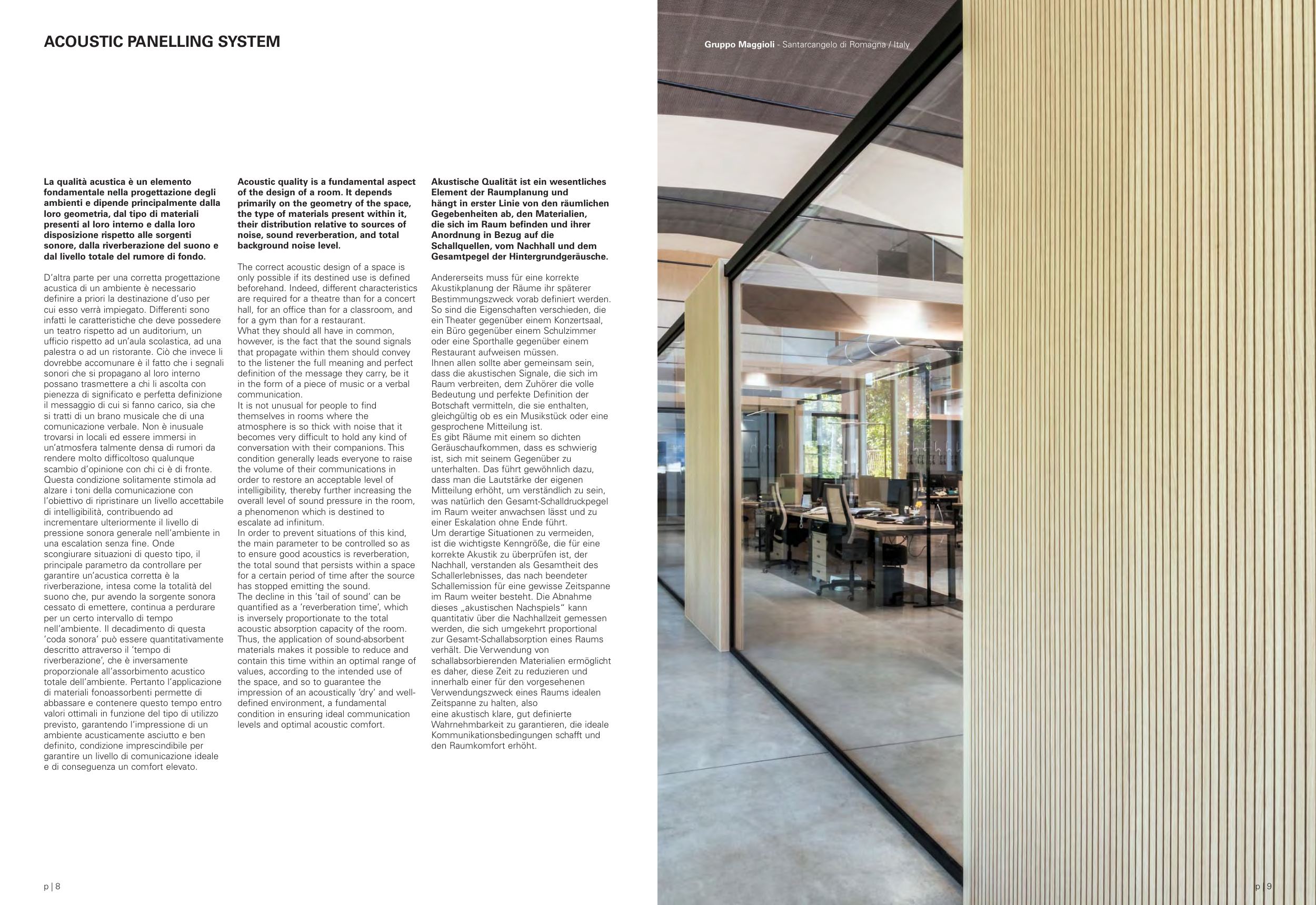
Gruppo Maggioli - Santarcangelo di Romagna / Italy
p | 8
p | 9