12
Paolo STACCIOLI
IL PRIMATO DELLA STORIA
Dal catalogo della mostra
Le gioiose ceramiche di Paolo Staccioli, Museo delle
Porcellane di Palazzo Pitti, Firenze,ottobre 2005 – giu-
gno 2006
L
a leggerezza, la grazia, l’ironia. Ecco tre stelle
fisse per orientarsi nell’opera di Paolo Staccioli
ceramografo. La leggerezza prima di tutto per-
chè la materia è pesante, pesanti e complicate sono le
tecniche. Non ci vuol niente a farsi trascinare in bas-
so verso la irrimediabile opacità del mestiere saccente
e compiaciuto. Staccioli lo sa. Non glielo ha mai detto
nessuno. Lo sa d’istinto e gioca come sollevato a mezz’a-
ria, schivando retoriche ed estetismi, volando via veloce
come un uccellino sagace dalle insidie citazionistiche e
virtuosistiche.
Poi la grazia che è una virtù duttile e trasparente. Non
la si impara a scuola e neppure a bottega. Dio la dà a chi
vuole. Per un artista grazia è la capacità di usare il lin-
guaggio del suo tempo (per Staccioli la lingua del secolo
è quella di Arturo Martini, di Giacometti, di Marino,
di Fantoni, etc) in un modo individuale, riconoscibile,
inconfondibile e al tempo stesso gradito, suasivo, stimo-
lante. Uno guarda una ceramica di Staccioli, ne accarez-
za la pelle iridata, ne valuta il peso, la forma, le propor-
zioni, sente cantare l’ingobbio lucente quando l’unghia
lo sfiora, si accorge che, alla vista e al tatto, il cuore si
scalda e gli occhi provano curiosità e piacere; ecco que-
sto è il riconoscimento della grazia. La grazia: qualcosa
di indefinibile che gli altri chiameranno (ma la formula
è convenzionale e un poco raggelante) riconoscimento
dell’autentica individualità dell’artista. Io, quella cosa,
preferisco chiamarla grazia, e voglio testimoniare che le
ceramiche di Staccioli la possiedono. Infine l’ironia, la
capacità di giocare con tenerezza e stupore di fronte alle
sirene della modernità e alle memorie dell’antico. Si può
scherzare con il Marte di Todi e con l’Arringatore? Con
lo Stile Orientalizzante e con il Liberty? Con le torri di
San Gimignano e con l’obelisco di Axum? Con Giò Ponti
e con Picasso? Certo che si può, anzi si deve. Poiché l’i-
ronia, il sorriso, il disincanto sono antidoti efficacissimi
contro la retorica e contro i manierismi.
E dunque, ricapitolando, la leggerezza, la grazia, l’iro-
nia. Usate queste tre chiavi di lettura quando guardate le
ceramiche di Paolo Staccioli e vi accorgerete che non ne
esistono di migliori per riconoscere l’autentica qualità
quando la si incontra.
Antonio Paolucci
Soprintendente per il Polo Museale Fiorentino
Mostra Paolo Staccioli’s joyful ceramic works
Florence, Pitti Palace
Museo degli Argenti e delle Porcellane
29 October 2005 – 25 June 2006
L
ightness, grace, irony. These three fixed stars
allow us to chart our course through the work
of Paolo Staccioli. Lightness, first of all, because
matter is heavy, and the techniques are heavy and
complicated. It would take very little to be dragged
down towards the irremediable dullness of a conceited,
complacent profession. Staccioli understands this, even
if nobody has ever told him. He knows it instinctively,
and plays as if he is floating in mid-air, avoiding
rhetoric and aestheticism, quickly flying away like a
shrewd bird from the traps of name-dropping and vain
virtuosities. Then grace, which is a flexible, transparent
virtue. It is not learnt at school, or in the workshop.
God grants it to those who He chooses. For an artist,
grace is the ability to use the language of his time (for
Staccioli, the language of the century is that of Arturo
Martini, Giacometti, Marino, Fantoni etc.) in a way
that is individual, recognisable, unmistakable, and at
the same time, pleasant, persuasive, and stimulating.
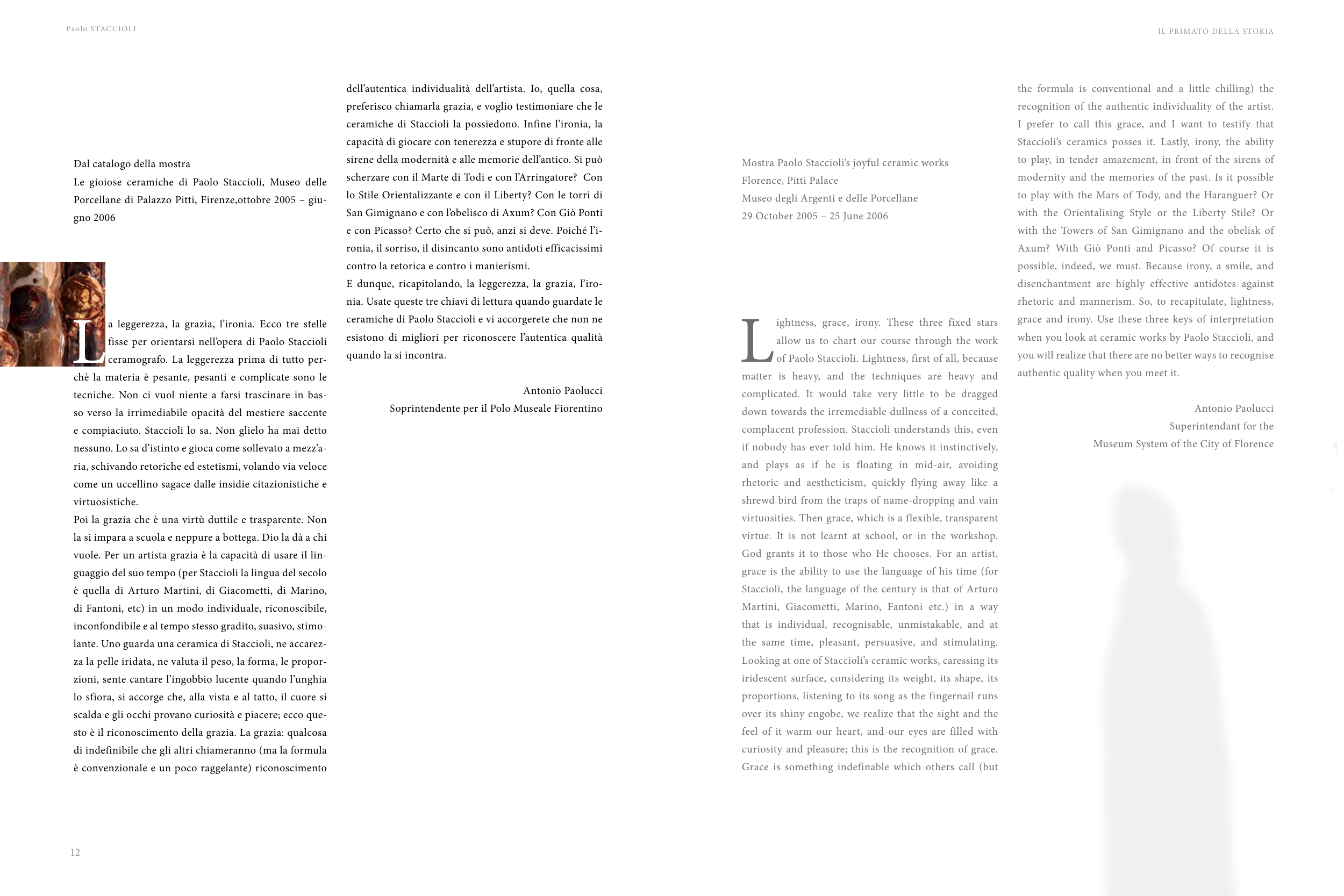
Looking at one of Staccioli’s ceramic works, caressing its
iridescent surface, considering its weight, its shape, its
proportions, listening to its song as the fingernail runs
over its shiny engobe, we realize that the sight and the
feel of it warm our heart, and our eyes are filled with
curiosity and pleasure; this is the recognition of grace.
Grace is something indefinable which others call (but
the formula is conventional and a little chilling) the
recognition of the authentic individuality of the artist.
I prefer to call this grace, and I want to testify that
Staccioli’s ceramics posses it. Lastly, irony, the ability
to play, in tender amazement, in front of the sirens of
modernity and the memories of the past. Is it possible
to play with the Mars of Tody, and the Haranguer? Or
with the Orientalising Style or the Liberty Stile? Or
with the Towers of San Gimignano and the obelisk of
Axum? With Giò Ponti and Picasso? Of course it is
possible, indeed, we must. Because irony, a smile, and
disenchantment are highly effective antidotes against
rhetoric and mannerism. So, to recapitulate, lightness,
grace and irony. Use these three keys of interpretation
when you look at ceramic works by Paolo Staccioli, and
you will realize that there are no better ways to recognise
authentic quality when you meet it.
Antonio Paolucci
Superintendant for the
Museum System of the City of Florence