Ciclo: L’Origine
Cycle: L’origine
1972-1973
La
decostruzione
monnalisiana
segna
inesorabilmente l’origine della poetica fossiana: da
codice a codice le rielaborazioni di Fossi dialogano
fra loro tramite rapporti differenziali che ricercano
la partecipazione significativa di un segno non/
rappresentato, come il semantema primo, assente
ma percettibile, che rimanda a tutti gli altri segni
nell’infinita concatenazione dell’Unità artistica. Se
la comunicazione avviene attraverso un complesso
sistema di segni, allora la Gioconda è una forma
di scrittura, pura e immediata, che si esprime
mediante un sistema logocentrico di segni e che
si apre proprio nell’atto della sua indicibilità. Solo
disarticolando il testo visivo dell’opera è possibile
penetrarla e permettere l’apertura delle sue
incoerenze. In tale varco consiste la decostruzione
di Fossi fra cecità e nuova visione, nella convinzione
che l’opera d’arte sia nella sua stessa natura un “self-
reflecting mirror”, ossia che contenga già in sé le
proprie modalità di decostruzione e i contrassegni
retorici che la caratterizzano. Sequenze, sintesi,
schemi e proiezioni iconografiche della Gioconda
permettono all’artista di viaggiare nella Creazione alla
ricerca del Mito, il quale si intensifica pacatamente
in monocromi e linee: l’immagine viene riflessa in
una specularità cangiante, volta a ristabilire i legami
vitali del centro dell’Unità; il “tronco della memoria”,
che pian piano prende forma nella deformazione, si
costruisce nella decostruzione, diviene codice nella
sua quieta illeggibilità.
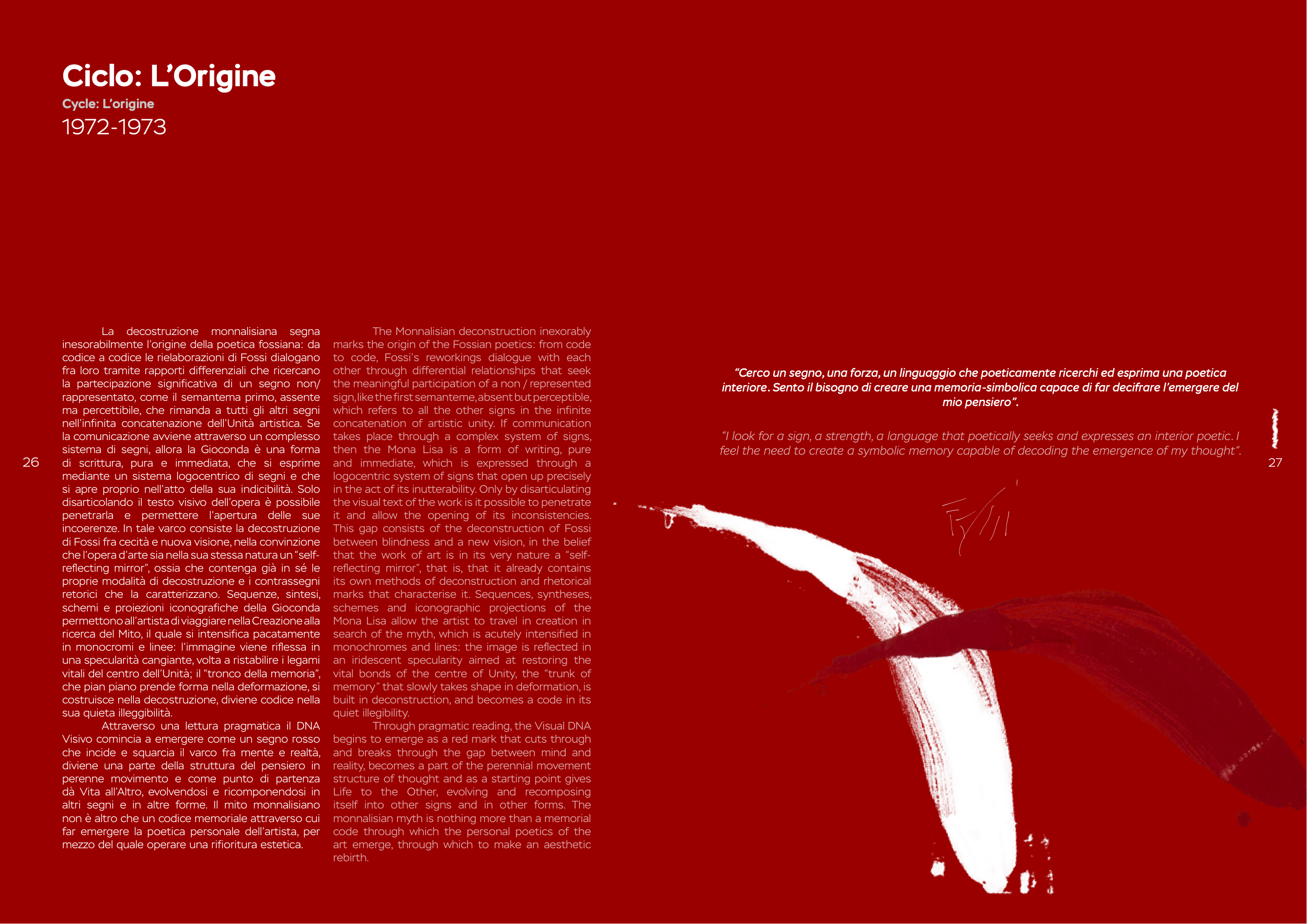
Attraverso una lettura pragmatica il DNA
Visivo comincia a emergere come un segno rosso
che incide e squarcia il varco fra mente e realtà,
diviene una parte della struttura del pensiero in
perenne movimento e come punto di partenza
dà Vita all’Altro, evolvendosi e ricomponendosi in
altri segni e in altre forme. Il mito monnalisiano
non è altro che un codice memoriale attraverso cui
far emergere la poetica personale dell’artista, per
mezzo del quale operare una rifioritura estetica.
The Monnalisian deconstruction inexorably
marks the origin of the Fossian poetics: from code
to code, Fossi’s reworkings dialogue with each
other through differential relationships that seek
the meaningful participation of a non / represented
sign, like the first semanteme, absent but perceptible,
which refers to all the other signs in the infinite
concatenation of artistic unity. If communication
takes place through a complex system of signs,
then the Mona Lisa is a form of writing, pure
and immediate, which is expressed through a
logocentric system of signs that open up precisely
in the act of its inutterability. Only by disarticulating
the visual text of the work is it possible to penetrate
it and allow the opening of its inconsistencies.
This gap consists of the deconstruction of Fossi
between blindness and a new vision, in the belief
that the work of art is in its very nature a “self-
reflecting mirror”, that is, that it already contains
its own methods of deconstruction and rhetorical
marks that characterise it. Sequences, syntheses,
schemes and iconographic projections of the
Mona Lisa allow the artist to travel in creation in
search of the myth, which is acutely intensified in
monochromes and lines: the image is reflected in
an iridescent specularity aimed at restoring the
vital bonds of the centre of Unity, the “trunk of
memory” that slowly takes shape in deformation, is
built in deconstruction, and becomes a code in its
quiet illegibility.
Through pragmatic reading, the Visual DNA
begins to emerge as a red mark that cuts through
and breaks through the gap between mind and
reality, becomes a part of the perennial movement
structure of thought and as a starting point gives
Life to the Other, evolving and recomposing
itself into other signs and in other forms. The
monnalisian myth is nothing more than a memorial
code through which the personal poetics of the
art emerge, through which to make an aesthetic
rebirth.
27
26
“Cerco un segno, una forza, un linguaggio che poeticamente ricerchi ed esprima una poetica
interiore. Sento il bisogno di creare una memoria-simbolica capace di far decifrare l’emergere del
mio pensiero”.
“I look for a sign, a strength, a language that poetically seeks and expresses an interior poetic. I
feel the need to create a symbolic memory capable of decoding the emergence of my thought”.