40
Milano
Milano
41
Il quartiere di Brenta è caratterizzato
da un’anima popolare e da un passato
industriale che ne ha definito la morfologia
e il tessuto sociale. La zona è delimitata a
nord-ovest dallo scalo di Porta Romana,
recentemente
portato
all’attenzione
politica e mediatica grazie al grande
progetto di riqualificazione degli scali
ferroviari milanesi dismessi; a nord-est
dal tracciato di corso Lodi (la via Emilia),
e l’ex insediamento industriale del TIBB
(Tecnomasio Italiano Brown Boveri); a
sud dalla campagna nella quale hanno
inizio i tracciamenti delle nuove strade
che caratterizzano l’espansione urbana
di Milano. La dismissione delle realtà
industriali attive fine agli anni ’70 si è
tradotta nella riappropriazione di alcuni
spazi che oggi ospitano numerose attività
terziarie, artigianali e realtà associative
operanti sul territorio. Negli ultimi tempi,
il quartiere ha subito una trasformazione
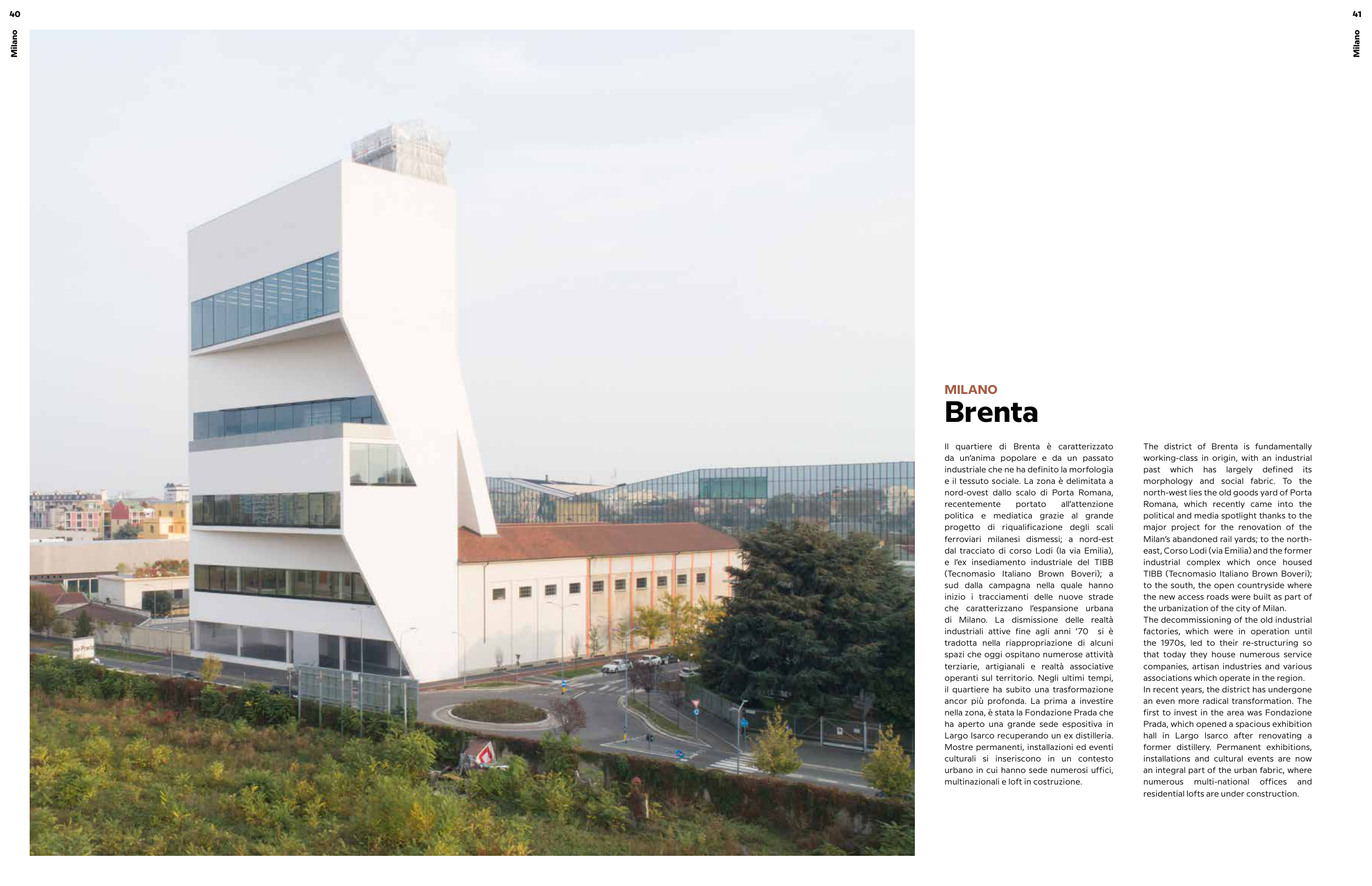
ancor più profonda. La prima a investire
nella zona, è stata la Fondazione Prada che
ha aperto una grande sede espositiva in
Largo Isarco recuperando un ex distilleria.
Mostre permanenti, installazioni ed eventi
culturali si inseriscono in un contesto
urbano in cui hanno sede numerosi uffici,
multinazionali e loft in costruzione.
Brenta
MILANO
The district of Brenta is fundamentally
working-class in origin, with an industrial
past
which
has
largely
defined
its
morphology and social fabric. To the
north-west lies the old goods yard of Porta
Romana, which recently came into the
political and media spotlight thanks to the
major project for the renovation of the
Milan’s abandoned rail yards; to the north-
east, Corso Lodi (via Emilia) and the former
industrial complex which once housed
TIBB (Tecnomasio Italiano Brown Boveri);
to the south, the open countryside where
the new access roads were built as part of
the urbanization of the city of Milan.
The decommissioning of the old industrial
factories, which were in operation until
the 1970s, led to their re-structuring so
that today they house numerous service
companies, artisan industries and various
associations which operate in the region.
In recent years, the district has undergone
an even more radical transformation. The
first to invest in the area was Fondazione
Prada, which opened a spacious exhibition
hall in Largo Isarco after renovating a
former distillery. Permanent exhibitions,
installations and cultural events are now
an integral part of the urban fabric, where
numerous
multi-national
offices
and
residential lofts are under construction.