So itˇs not so easy to know when to
stop. Even so, Struve’s collection
does of course have its highlights.
Besides lamps and door handles,
he also has a few industrial so-called
master clocks with slave clocks for
use in factories, as well as furniture
made of bent beechwood. Bentwood
furniture already featured among
the first collection items, products
of industrialised furniture production
of Viennese coffee-house furnish-
ings. How is it possible to keep track
of the items when there are so
many of them? “Iˇm still behind with
archiving all the things in the
collection”, confesses Struve. It is
both time—and space—consuming
to make sure the archive items are
stored properly and professionally.
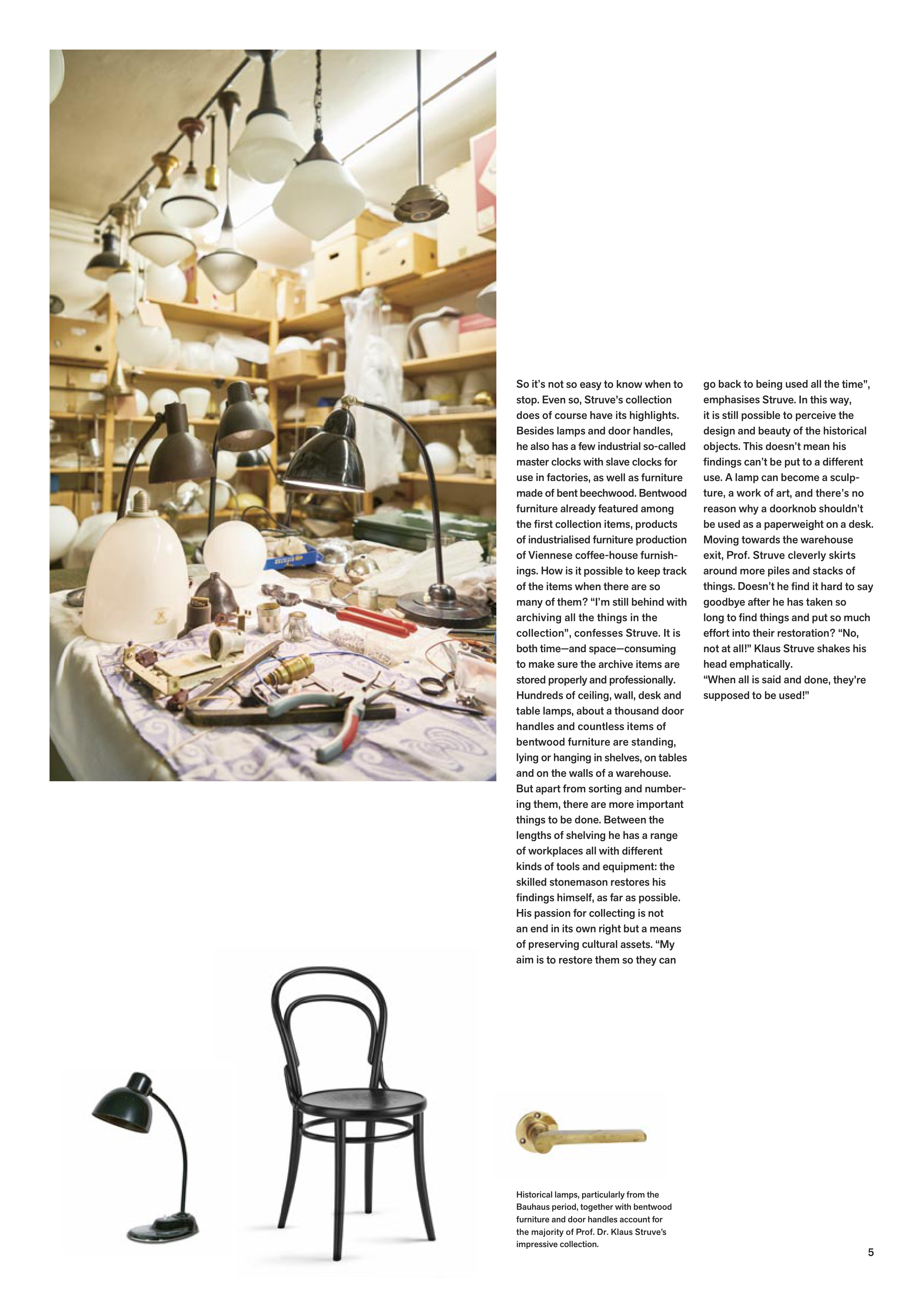
Hundreds of ceiling, wall, desk and
table lamps, about a thousand door
handles and countless items of
bentwood furniture are standing,
lying or hanging in shelves, on tables
and on the walls of a warehouse.
But apart from sorting and number-
ing them, there are more important
things to be done. Between the
lengths of shelving he has a range
of workplaces all with different
kinds of tools and equipment: the
skilled stonemason restores his
findings himself, as far as possible.
His passion for collecting is not
an end in its own right but a means
of preserving cultural assets. “My
aim is to restore them so they can
go back to being used all the time”,
emphasises Struve. In this way,
it is still possible to perceive the
design and beauty of the historical
objects. This doesnˇt mean his
findings canˇt be put to a different
use. A lamp can become a sculp-
ture, a work of art, and thereˇs no
reason why a doorknob shouldn't
be used as a paperweight on a desk.
Moving towards the warehouse
exit, Prof. Struve cleverly skirts
around more piles and stacks of
things. Doesnˇt he find it hard to say
goodbye after he has taken so
long to find things and put so much
effort into their restoration? “No,
not at all!” Klaus Struve shakes his
head emphatically.
“When all is said and done, they’re
supposed to be used!”
5
Historical lamps, particularly from the
Bauhaus period, together with bentwood
furniture and door handles account for
the majority of Prof. Dr. Klaus Struve’s
impressive collection.