110 | URBAN
L
EH
EH
L (cd/m2) (≥) U0 (≥) UI (≥) fTi (%) (≤) REI (≥)
M1
2,00
0,40
0,70
10
0,35
M2
1,50
0,40
0,70
10
0,35
M3
1,00
0,40
0,60
15
0,30
M4
0,75
0,40
0,60
15
0,30
M5
0,50
0,35
0,40
15
0,30
M6
0,30
0,35
0,40
20
0,30
Ē (lx) (≥)
U0 (≥)
fTi (%) (≤)
C0
50,0
0,40
10
C1
30,0
0,40
10
C2
20,0
0,40
15
C3
15,0
0,40
15
C4
10,0
0,40
15
C5
7,50
0,40
20
Ē (lx) (≥)
Emin (lx) (≥)
fTi (%) (≤)
P1
15,0
3,00
20
P2
10,0
2,00
25
P3
7,50
1,50
25
P4
5,00
1,00
30
P5
3,00
0,60
30
P6
2,00
0,40
35
P7
-
-
-
The standard defines, using photometric requirements, the performance needed by
classes for street lighting. EN1301-2-2015 considers the vision needs of road users and
covers the environmental aspects of street lighting. The norm takes into consideration
relevant areas for groups of lighting situations, conflict areas, calming traffic measures
and pedestrian crossing. Moreover, it provides information about glare control, color
rendering, night-time use and visual guidance.
EN 13201-2-2015
PERFORMANCE REQUIREMENTS
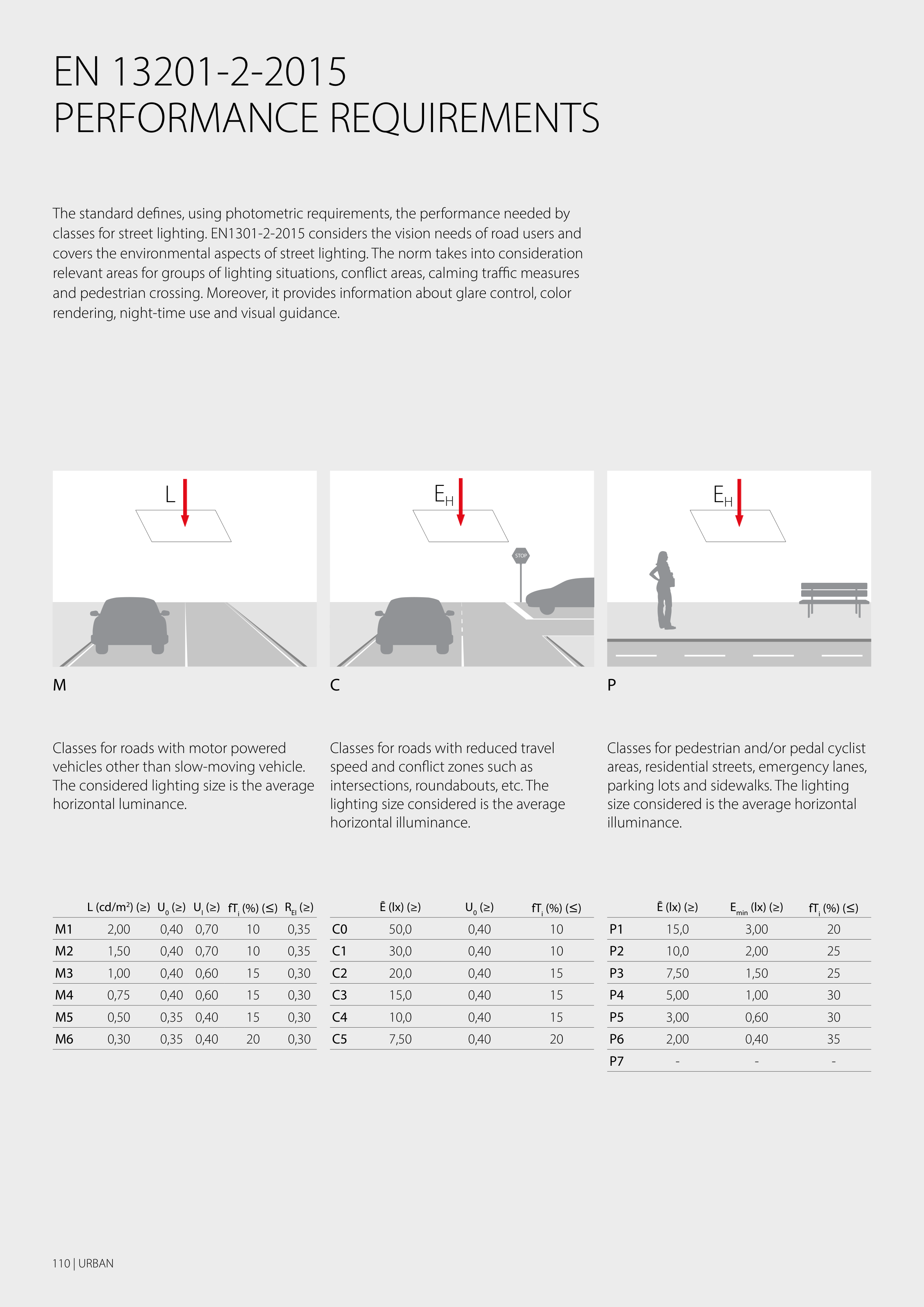
Classes for roads with reduced travel
speed and conflict zones such as
intersections, roundabouts, etc. The
lighting size considered is the average
horizontal illuminance.
Classes for roads with motor powered
vehicles other than slow-moving vehicle.
The considered lighting size is the average
horizontal luminance.
Classes for pedestrian and/or pedal cyclist
areas, residential streets, emergency lanes,
parking lots and sidewalks. The lighting
size considered is the average horizontal
illuminance.
C
P
M