Given the weaving process and the fibres used,
we advise that great care be taken in fabric main-
tenance: weekly cleaning should be carried out
with a vacuum cleaner fitted with a soft brush
and then by hand with a clothes brush, taking
care to brush in the same direction as the pile.
At regular intervals, after this procedure, we advise
using an adhesive brush (eliminating detached
threads), always in the direction of the pile.
To eliminate colour changes due to fabric flattening
we advise using steam on the surfaces with an
iron at 110° at a distance of about 10/15 cm and
simultaneously brush respecting the direction of
the fleece (generally from top to bottom) using
a brush with soft fibers.
To eliminate more resistant or stubborn marks,
vaporize the surface at a distance of about
5/10cm and simultaneously brush respecting
the direction of the fleece (generally from top to
bottom) using a brush with soft fibers.
If tide marks are caused by contact with liquids,
dampen the whole surface of the upholstery (not
just the tide mark area) using a household spray
until the surface colour is uniform.
Wait for the upholstery to dry naturally (do not
use direct heat) and brush in the direction of the
pile as mentioned above.
For stains, use the advice on the Upholstery
Maintenance sheet, always with care and attention.
If dry cleaning is necessary we advise a speciali-
sed firm, providing the technical reference sheet
referred to the product with the product itself.
Date caratteristiche costruttive e fibre utilizzate si
raccomanda particolare cura ed attenzione nella
manutenzione. Per la pulizia settimanale si consiglia
di aspirare i rivestimenti con aspirapolvere dotato
di spazzole morbide e di trattare le superfici con
spazzole da abbigliamento agendo sempre nel
senso del pelo.
Periodicamente, dopo l’operazione descritta al punto
precedente, si consiglia i trattare le superfici con
una spazzola adesiva (eliminazione dei filamenti
caduchi) sempre seguendo il senso del pelo.
Per eliminare le variazioni di colore causate dallo
schiacciamento del tessuto si consiglia di vaporiz-
zare le superfici utilizzando un ferro a 110° ad una
distanza di circa 10/15 centimetri e contemporane-
amente spazzolare rispettando il senso del vello
(generalmente dall’alto verso il basso) utilizzando
una spazzola a fibre morbide.
Per i segni più marcati o più di%icili da eliminare
vaporizzare la superficie ad una distanza di circa
5/10 centimetri e contemporaneamente spazzo-
lare rispettando il senso del vello (generalmente
dall’alto verso il basso) utilizzando una spazzola a
fibre morbide.
In caso di aloni provocati dal contatto con liquidi
provvedere a inumidire tutta la superficie del rive-
stimento (non solo la sezione dell’alone) utilizzando
un nebulizzatore domestico fino alla completa
uniformazione cromatica della superficie trattata.
Aspettare che il rivestimento si asciughi naturalmente
(non utilizzare fonti di calore) e spazzolare nel senso
del vello secondo quanto descritto in precedenza.
In presenza di macchie utilizzare i consigli contenuti
nella scheda Manutenzione Rivestimenti, avendo
sempre cura di intervenire delicatamente.
Ove fosse necessario ricorrere ad un lavaggio a
secco si consiglia di rivolgersi ad aziende specia-
lizzate accompagnando al prodotto la scheda
tecnica di riferimento.
MAINTENANCE
MANUTENZIONE
CHENILLE
CINIGLIA
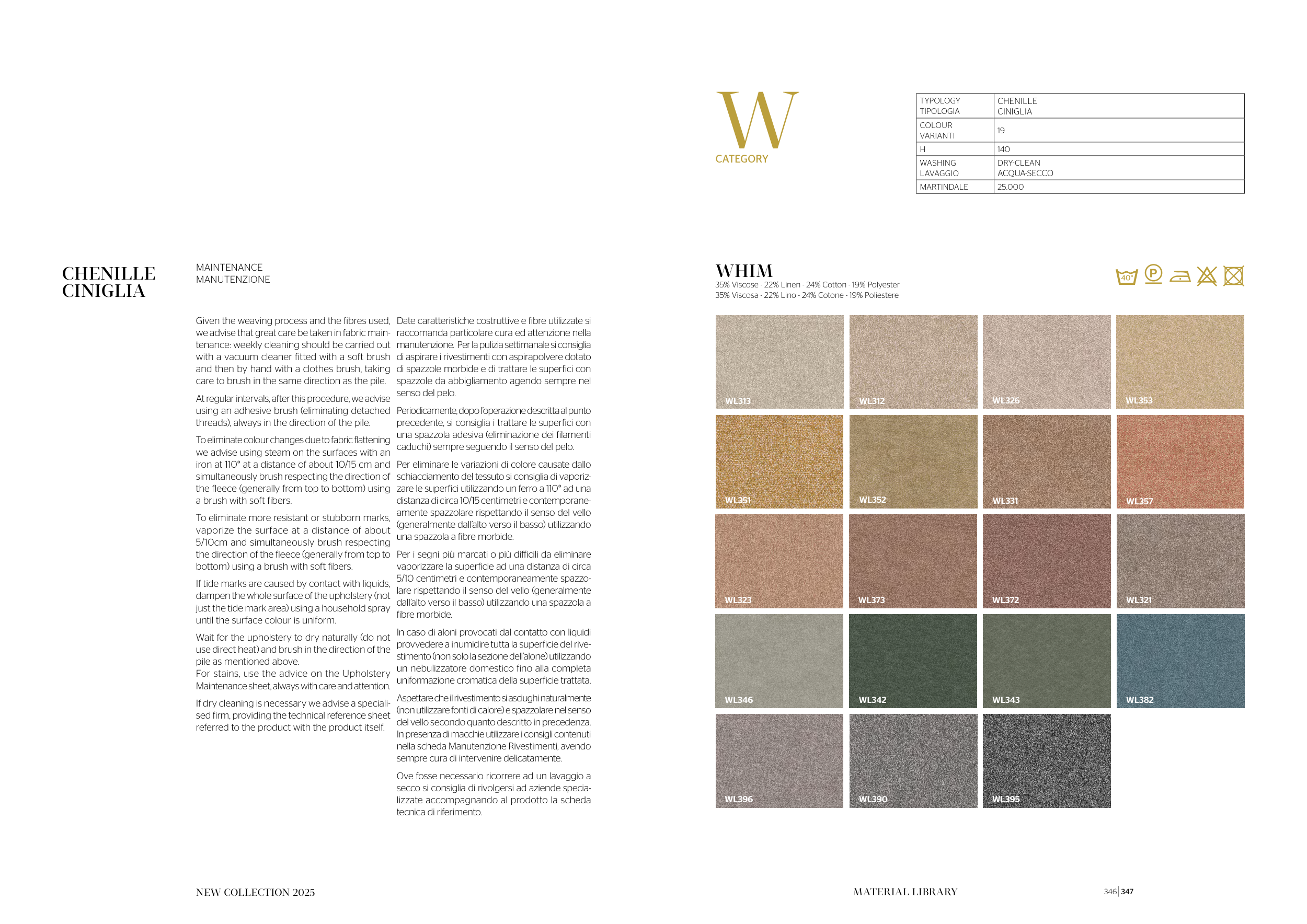
WHIM
35% Viscose - 22% Linen - 24% Cotton - 19% Polyester
35% Viscosa - 22% Lino - 24% Cotone - 19% Poliestere
TYPOLOGY
TIPOLOGIA
CHENILLE
CINIGLIA
COLOUR
VARIANTI
19
H
140
WASHING
LAVAGGIO
DRY#CLEAN
ACQUA#SECCO
MARTINDALE
25.000
CATEGORYW
WL396
WL321
WL323
WL373
WL372
WL382
WL342
WL343
WL346
WL351
WL313
WL312
WL326
WL352
WL353
WL331
WL357
WL390
WL395
346 347
NEW COLLECTION 2025
MATERIAL LIBRARY