17
16
Raisonné 03
Taito, and Tynell in particular, became known
among architects and across the country as the
premier designer of light for public spaces. His
talent for creating indirect light was especially
sought after in spaces such as restaurants and
movie theaters, where softer, more atmospheric
lighting is highly prized.
The ’30s and ’40s were largely a time of
experimentation for Tynell, who evolved his style
from the functionalist and art deco designs of
his earlier career to more decorative and elegant
expressions. He served as chairman of Ornamo,
Finland’s association of industrial designers, from
1926 to 1929 and 1936 to 1945.
Through Taito, Tynell provided training and
support for young designers, enlisting them as
drafting assistants, and training them in the skills
needed to kickstart their own careers. One such
assistant, the glass designer Helena Turpeinen,
married Tynell in 1947, working alongside him at
Taito until 1953.
After World War II ended, Tynell returned to
one of his earliest materials, creating a series of
highly individual lamps that used perforated and
polished brass to imbue traditional aesthetics with
a modern sensibility.
From the ’30s and throughout the ’50s, Tynell
was considered Finland’s premier lighting designer,
called on to illuminate public spaces across the
country. In Helsinki in particular, Tynell’s lighting
is part of the fabric of the city. Many of his grand
installations survive today, in buildings ranging
from train stations and churches to hotels and
educational institutions. His influence spread
abroad, too, with Tynell becoming especially
successful in the U.S., where he acquired near-
celebrity status as a designer.
The merger of Taito with the lighting factory
Idman Oy in 1953 prompted Tynell’s retirement as
managing director of the company, but he continued
designing for Taito and other lighting brands in
Finland and abroad. Most notably, he designed for
the respected brand Lightolier in the U.S., enjoying
a productive partnership until 1966.
Tynell’s
distinctive
style,
coupled
with
his understanding of light’s role in shaping an
atmosphere, proved to have a timeless appeal. His
lamps remained in demand among collectors and in-
the-know design fans long after his death in 1973.
Marked by delicacy and softness,
Tynell’s most famous lamps of this time
echo the structures of nature – sculptural
shapes reminiscent of tree branches,
swirling snowflakes, and seashells.
The Genius of Paavo Tynell
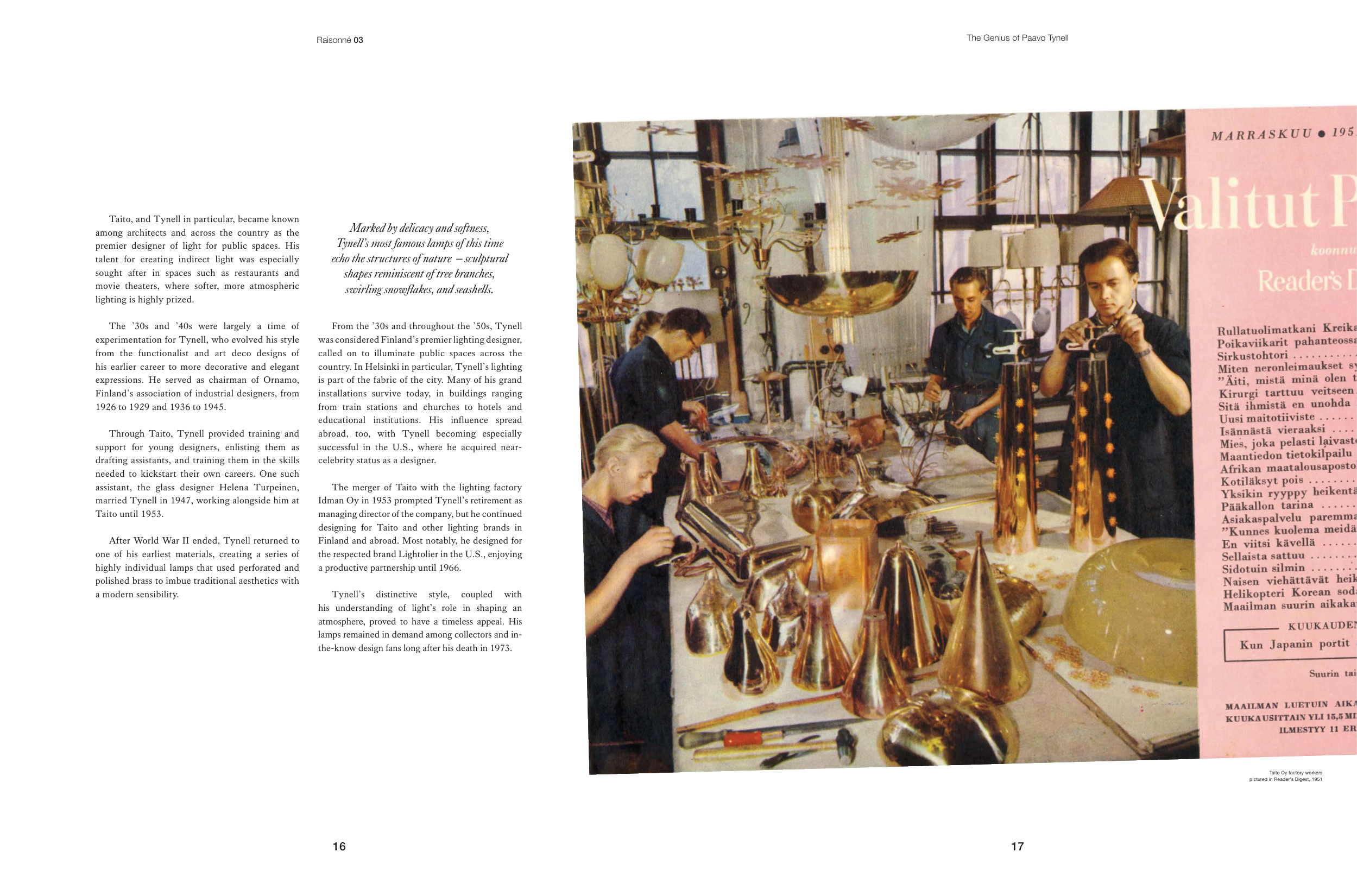
Taito Oy factory workers
pictured in Reader's Digest, 1951