22
23
These were hotels where you would forget daily
nuisances and illnesses. The guests would be on
slower holiday time, which would last even months.
They would have brilliant conversations and elegant
(and maybe even gallant) strolls along the promenades
or with the backdrops of beautiful landscapes. Guests
would whisper amongst themselves if they saw the
Duse, Lina Cavalieri, or the Marquise Casati, who
were the “femmes fatales” of the time. Guests would
take a quick look at the artistic beauty and nature
in Italy, but those staying at the Grand Hotel were
not generally interested in culture and political and
social events. Rather, they loved their rendezvous
for afternoon tea concerts or dinner with exquisite
menus, dance parties under Murano chandeliers with
a thousand pendants, and the dames dripping with
pearls and dressed in Poiret and Worth dresses, who
would show off their silhouettes in their Art Nouveau
style as the gentlemen would be in tails and lavender
gloves.
Those were the Belle Époque years, beautiful only
for lords and ladies and for the new industrialists of
considerable means. The season was destined not to
last for long, as the war, the First Great War, from
one day to the next turned off the lights in those
halls where elegant couples had danced their last
waltzes. The rooms with a view became a shelter for
the wounded coming from in the trenches and the
battlefields.
The Grand Hotel season seemed inexorably over,
and yet, just a few years later, it flourished again. Of
course, it did not have the idle calm of before, even if,
as Baudelaire would say, luxury and voluptuousness
remained and indeed was even more on exhibit. By
now, it was the tumultuous Twenties. One would no
longer arrive at the Grand Hotel, later translated into
“Grande Albergo” in compliance with the regime’s
directives, on exhausting train journeys. Guests
were arriving by car, and, from the Americas, on the
enormous transatlantic ships with smoking funnels,
or even by airplane. The ladies had long abandoned
their long gowns with trains and ostrich feathers
and the gentlemen were no longer in tails. Now the
women were in fashionable short dresses, with deep
necklines and high and sturdy heels, suitable for the
Foxtrot and the Charleston. These dances no longer
took place in rooms with velvet sofas and tall vases
with palm fronds. People would go to the kursaal
or the dancing halls, which had rooms that were
promptly set up and flaunted in advertisements. If
you were at the seaside, people would dance outside
in the open-air roundabout, since the holiday season
took place during the long months of summer and it
could be enjoyed by the rich and rampant bourgeoisie
and no longer solely by the worn-out nobility.
Autumn holidays were only taken in Salsomaggiore,
Montecatini or San Pellegrino. People would meet
up just after Christmas or during Carnival time in the
hotels with balconies and wooden gables in the Aosta
Valley and the Dolomites to enjoy bobsleighs, skating,
dizzying ski descents and, for the more daring,
trampoline jumping.
The new Grand Hotels soon had a different style: more
modern and simple but, at the same time, luxurious.
Around the actual building that was dedicated to
the hotel rooms, there were often spaces that were
exclusively for leisure, with thematic and imaginative
decorative inventions, almost as if to compensate for
the more austere feel of the more institutional spaces.
In the important Thermal bath complex of the Grand
Hotel di Castrocaro there was even an independent
building, the Padiglione delle Feste, with its
extraordinarily captivating designs by Tito Chini. All
of these hotels, old and new, promptly adapted to the
needs of a rather sophisticated clientele by introducing
the American bar, furnished with mirrors and crystals,
fine metal furniture and linoleum floors, table tennis in
what had been the billiard room, and a garage for the
cars, emblem of the prestige that had been acquired
and the luxury that people were eager to display. On
the seashore there was an exclusive beach area with
brightly coloured cabins and umbrellas. In the rooms
there was no lack of telephone or hot water. However,
not all rooms had private bathrooms. The legendary
Grand Hotel of Rimini had only 7 common bathrooms,
in the corridors, and 50 private bathrooms for their 150
rooms. All of this novelty and comfort was flaunted on
swanky advertising posters that showcased the deep
blue of the sea, where beautiful and smiling women
with their “garçonne” hairstyles would lounge in
swimsuits made of stretch fabric.
The Grand Hotel was a luxurious refuge in the 1920s
and 1930s, where divas and film stars would meet, as
well as beautiful and rich people, more or less regular
couples and captains of industry who were ready
to go for a swim. The “dolce far niente” enjoyed by
Freud during his Italian stay in 1910 was no longer
fashionable. At the Grand Hotel, people would show
off healthy and attractive bodies as well as the wealth
they had acquired. They wanted to be carefree and
even a little eccentric, even though not exactly like
Zelda and F. Scott Fitzgerald. They would see films
that had just arrived from Hollywood, drink cocktails
on the terrace, and dance like Fred and Ginger.
As the guests would return to their rooms at very late
hours, if not at dawn, the always impeccable and
discreet doormen would give the guests their keys
that were tied to heavy medallions with the name of
the hotel. Soon, however, there was another war on
the horizon and it would never really be the same at
the Grand Hotel.
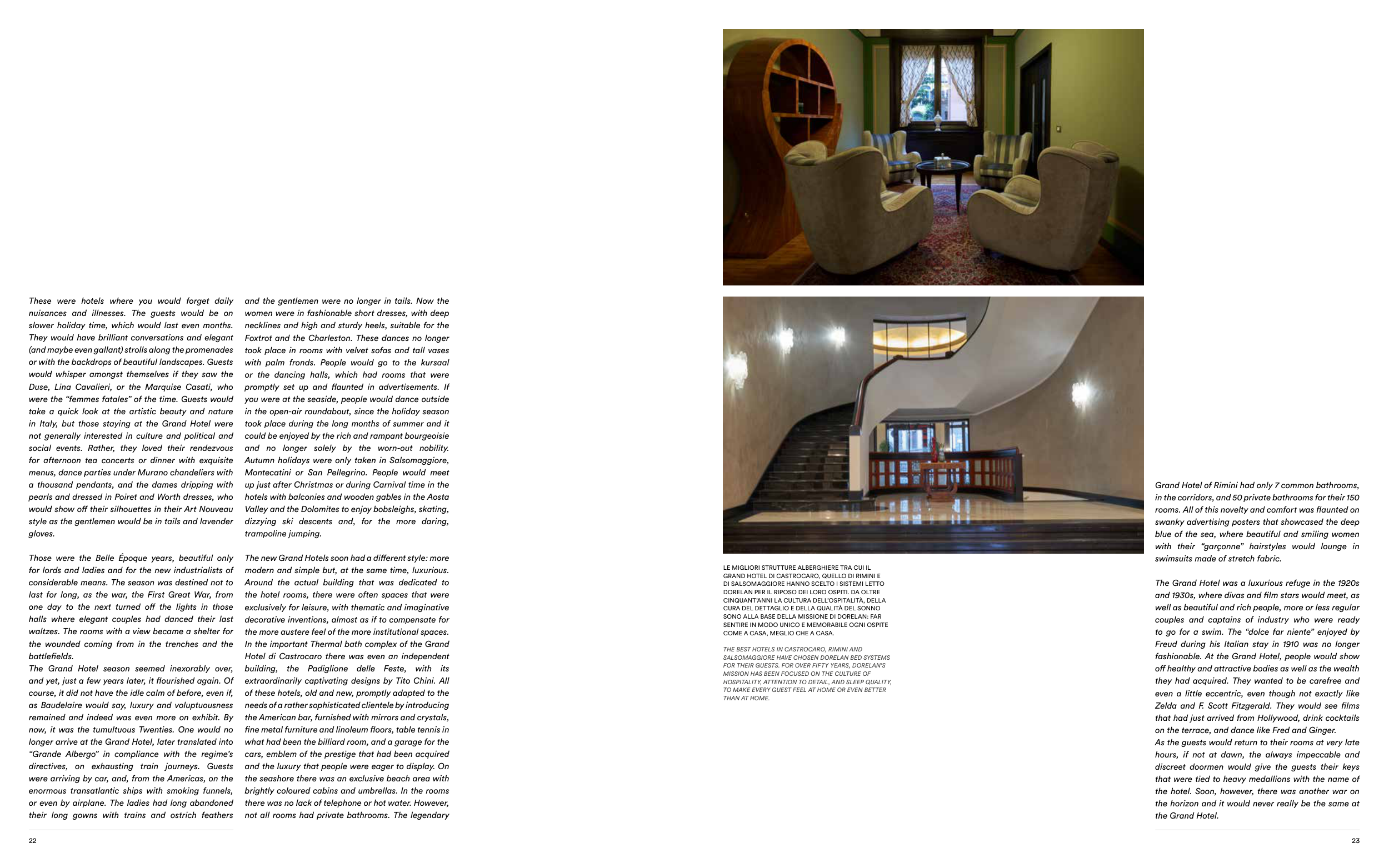
LE MIGLIORI STRUTTURE ALBERGHIERE TRA CUI IL
GRAND HOTEL DI CASTROCARO, QUELLO DI RIMINI E
DI SALSOMAGGIORE HANNO SCELTO I SISTEMI LETTO
DORELAN PER IL RIPOSO DEI LORO OSPITI. DA OLTRE
CINQUANT’ANNI LA CULTURA DELL’OSPITALITÀ, DELLA
CURA DEL DETTAGLIO E DELLA QUALITÀ DEL SONNO
SONO ALLA BASE DELLA MISSIONE DI DORELAN: FAR
SENTIRE IN MODO UNICO E MEMORABILE OGNI OSPITE
COME A CASA, MEGLIO CHE A CASA.
THE BEST HOTELS IN CASTROCARO, RIMINI AND
SALSOMAGGIORE HAVE CHOSEN DORELAN BED SYSTEMS
FOR THEIR GUESTS. FOR OVER FIFTY YEARS, DORELAN’S
MISSION HAS BEEN FOCUSED ON THE CULTURE OF
HOSPITALITY, ATTENTION TO DETAIL, AND SLEEP QUALITY,
TO MAKE EVERY GUEST FEEL AT HOME OR EVEN BETTER
THAN AT HOME.