149
C - TOP
Hubo un tiempo en el que, como cantaba Scott McKenzie, si ibas a San
Francisco debías llevar flores en el pelo. La libertad se impuso a las
rigideces de posguerra, la psicodelia ponía sonido y gráfica al final de la
década de los 60 y la creatividad explosionaba en comunidades como la
de Haight-Ashbury, el barrio hippie por excelencia.
Luis Antonio Pérez, puertorriqueño de nacimiento y consultor privado
de compensación de personas con discapacidad, aterrizó en la ciudad
californiana en 1977. Venía de Nueva York buscando una vida con más
tolerancia al colectivo LGTBI.
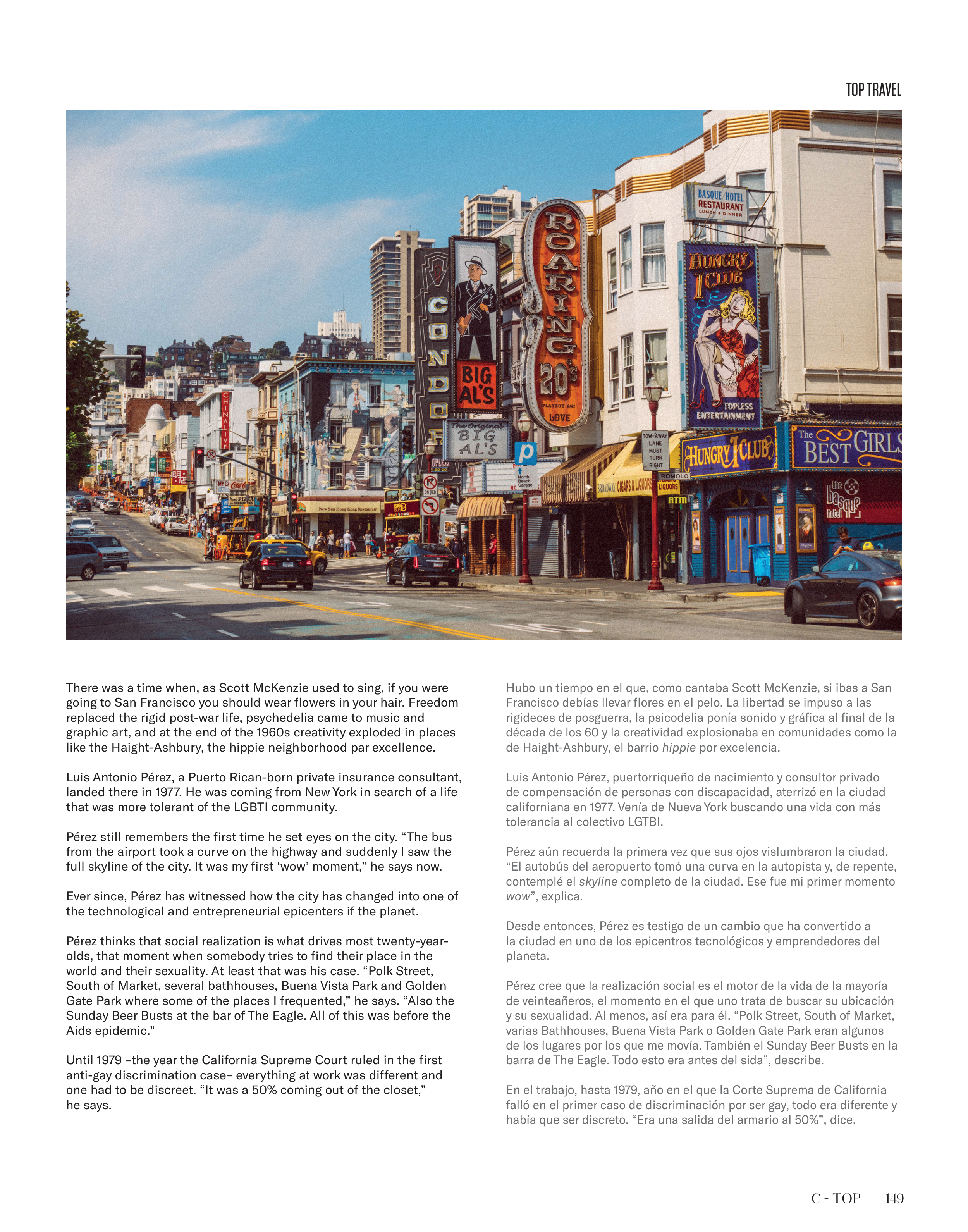
Pérez aún recuerda la primera vez que sus ojos vislumbraron la ciudad.
“El autobús del aeropuerto tomó una curva en la autopista y, de repente,
contemplé el skyline completo de la ciudad. Ese fue mi primer momento
wow”, explica.
Desde entonces, Pérez es testigo de un cambio que ha convertido a
la ciudad en uno de los epicentros tecnológicos y emprendedores del
planeta.
Pérez cree que la realización social es el motor de la vida de la mayoría
de veinteañeros, el momento en el que uno trata de buscar su ubicación
y su sexualidad. Al menos, así era para él. “Polk Street, South of Market,
varias Bathhouses, Buena Vista Park o Golden Gate Park eran algunos
de los lugares por los que me movía. También el Sunday Beer Busts en la
barra de The Eagle. Todo esto era antes del sida”, describe.
En el trabajo, hasta 1979, año en el que la Corte Suprema de California
falló en el primer caso de discriminación por ser gay, todo era diferente y
había que ser discreto. “Era una salida del armario al 50%”, dice.
There was a time when, as Scott McKenzie used to sing, if you were
going to San Francisco you should wear flowers in your hair. Freedom
replaced the rigid post-war life, psychedelia came to music and
graphic art, and at the end of the 1960s creativity exploded in places
like the Haight-Ashbury, the hippie neighborhood par excellence.
Luis Antonio Pérez, a Puerto Rican-born private insurance consultant,
landed there in 1977. He was coming from New York in search of a life
that was more tolerant of the LGBTI community.
Pérez still remembers the first time he set eyes on the city. “The bus
from the airport took a curve on the highway and suddenly I saw the
full skyline of the city. It was my first ‘wow’ moment,” he says now.
Ever since, Pérez has witnessed how the city has changed into one of
the technological and entrepreneurial epicenters if the planet.
Pérez thinks that social realization is what drives most twenty-year-
olds, that moment when somebody tries to find their place in the
world and their sexuality. At least that was his case. “Polk Street,
South of Market, several bathhouses, Buena Vista Park and Golden
Gate Park where some of the places I frequented,” he says. “Also the
Sunday Beer Busts at the bar of The Eagle. All of this was before the
Aids epidemic.”
Until 1979 –the year the California Supreme Court ruled in the first
anti-gay discrimination case– everything at work was different and
one had to be discreet. “It was a 50% coming out of the closet,”
he says.
TOP TRAVEL