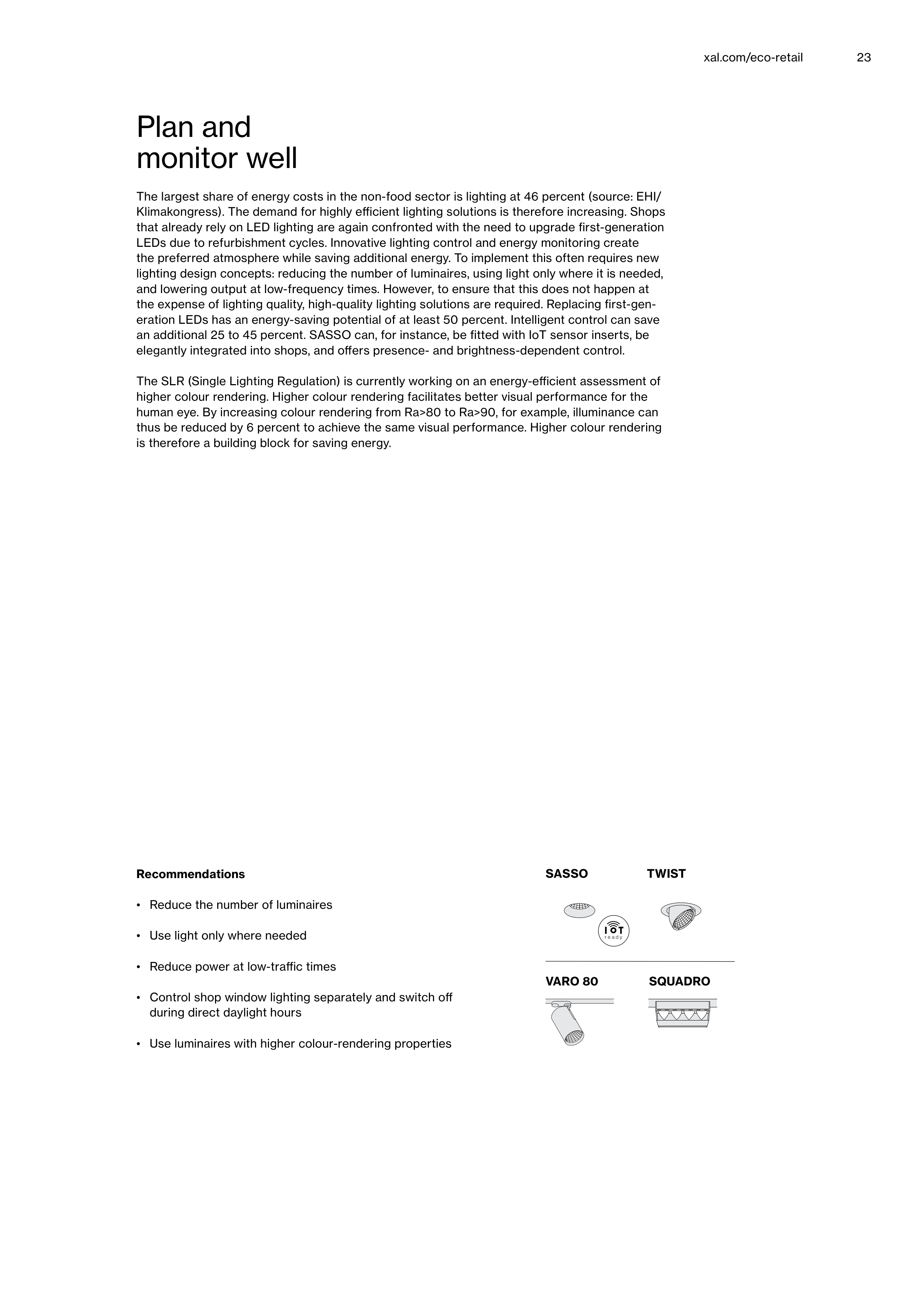
VARO 80
TWIST
SQUADRO
SASSO
Plan and
monitor well
Recommendations
• Reduce the number of luminaires
• Use light only where needed
• Reduce power at low-traffic times
• Control shop window lighting separately and switch off
during direct daylight hours
• Use luminaires with higher colour-rendering properties
The largest share of energy costs in the non-food sector is lighting at 46 percent (source: EHI/
Klimakongress). The demand for highly efficient lighting solutions is therefore increasing. Shops
that already rely on LED lighting are again confronted with the need to upgrade first-generation
LEDs due to refurbishment cycles. Innovative lighting control and energy monitoring create
the preferred atmosphere while saving additional energy. To implement this often requires new
lighting design concepts: reducing the number of luminaires, using light only where it is needed,
and lowering output at low-frequency times. However, to ensure that this does not happen at
the expense of lighting quality, high-quality lighting solutions are required. Replacing first-gen-
eration LEDs has an energy-saving potential of at least 50 percent. Intelligent control can save
an additional 25 to 45 percent. SASSO can, for instance, be fitted with IoT sensor inserts, be
elegantly integrated into shops, and offers presence- and brightness-dependent control.
The SLR (Single Lighting Regulation) is currently working on an energy-efficient assessment of
higher colour rendering. Higher colour rendering facilitates better visual performance for the
human eye. By increasing colour rendering from Ra>80 to Ra>90, for example, illuminance can
thus be reduced by 6 percent to achieve the same visual performance. Higher colour rendering
is therefore a building block for saving energy.
xal.com/eco-retail
23