21
‘As an architect I have always wanted to build a
low-energy home. So when I found this run-down
house in London, it was a great opportunity. My
idea was to show what can be done on a traditional
Edwardian building from 1907 to really lower the
energy consumption and make it comfortable and
sustainable. I tried to follow passive house principles:
super insulated airtight construction, triple glazing
and mechanical ventilation with heat recovery.
For the transformation I used natural materials like
timber and local stone rather than concrete and
steel. Stone really helps to keep houses cool on a hot
summer day. This proves that sustainability can be
an opportunity rather than a constraint.
Atmosphere is created with pure materials, with
carefully chosen finishes and daylight. A limited
material palette helps to create a calmer environment,
and that extends to the furniture. Over time materials
gain character through use, the accumulation of
marks and dents. Furniture made of natural materials
has a certain warmth to it.
At home I like things to be clean and minimal, like a
Zen space, a calm shelter to come back to after a busy
day. When I see Astrid, my cat, welcoming me, I feel
like I’m home. That is what I’m after: walk through
the front door and feel relaxed. Minimalism is not an
end in itself. It only comes to life through comfort.’
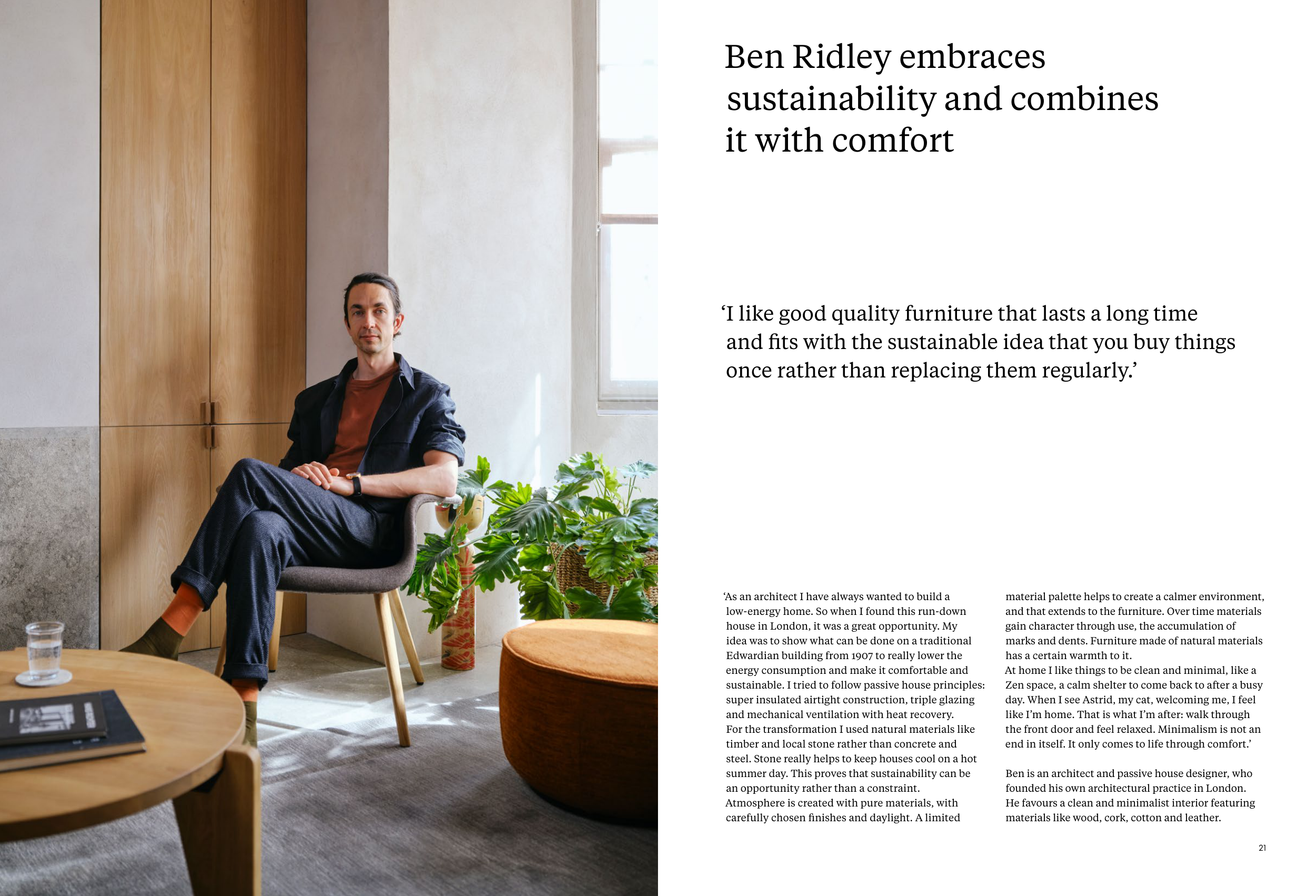
Ben is an architect and passive house designer, who
founded his own architectural practice in London.
He favours a clean and minimalist interior featuring
materials like wood, cork, cotton and leather.
Ben Ridley embraces
sustainability and combines
it with comfort
‘I like good quality furniture that lasts a long time
and fits with the sustainable idea that you buy things
once rather than replacing them regularly.’