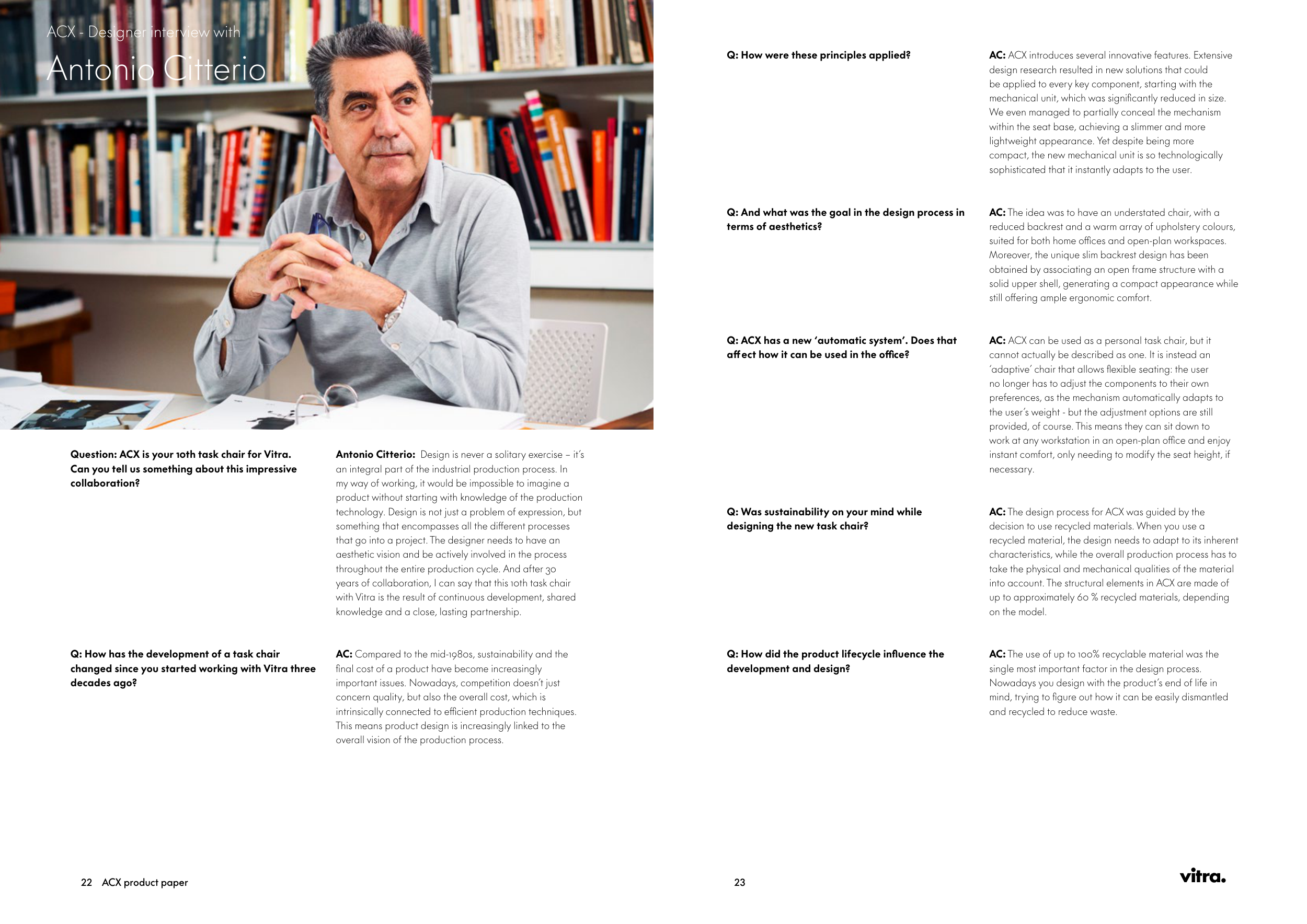
ACX - Designer interview with
Antonio Citterio
Antonio Citterio: Design is never a solitary exercise – it’s
an integral part of the industrial production process. In
my way of working, it would be impossible to imagine a
product without starting with knowledge of the production
technology. Design is not just a problem of expression, but
something that encompasses all the different processes
that go into a project. The designer needs to have an
aesthetic vision and be actively involved in the process
throughout the entire production cycle. And after 30
years of collaboration, I can say that this 10th task chair
with Vitra is the result of continuous development, shared
knowledge and a close, lasting partnership.
AC: Compared to the mid-1980s, sustainability and the
final cost of a product have become increasingly
important issues. Nowadays, competition doesn’t just
concern quality, but also the overall cost, which is
intrinsically connected to efficient production techniques.
This means product design is increasingly linked to the
overall vision of the production process.
AC: ACX introduces several innovative features. Extensive
design research resulted in new solutions that could
be applied to every key component, starting with the
mechanical unit, which was significantly reduced in size.
We even managed to partially conceal the mechanism
within the seat base, achieving a slimmer and more
lightweight appearance. Yet despite being more
compact, the new mechanical unit is so technologically
sophisticated that it instantly adapts to the user.
AC: The idea was to have an understated chair, with a
reduced backrest and a warm array of upholstery colours,
suited for both home offices and open-plan workspaces.
Moreover, the unique slim backrest design has been
obtained by associating an open frame structure with a
solid upper shell, generating a compact appearance while
still offering ample ergonomic comfort.
AC: ACX can be used as a personal task chair, but it
cannot actually be described as one. It is instead an
‘adaptive’ chair that allows flexible seating: the user
no longer has to adjust the components to their own
preferences, as the mechanism automatically adapts to
the user’s weight - but the adjustment options are still
provided, of course. This means they can sit down to
work at any workstation in an open-plan office and enjoy
instant comfort, only needing to modify the seat height, if
necessary.
AC: The design process for ACX was guided by the
decision to use recycled materials. When you use a
recycled material, the design needs to adapt to its inherent
characteristics, while the overall production process has to
take the physical and mechanical qualities of the material
into account. The structural elements in ACX are made of
up to approximately 60 % recycled materials, depending
on the model.
AC: The use of up to 100% recyclable material was the
single most important factor in the design process.
Nowadays you design with the product’s end of life in
mind, trying to figure out how it can be easily dismantled
and recycled to reduce waste.
Question: ACX is your 10th task chair for Vitra.
Can you tell us something about this impressive
collaboration?
Q: How has the development of a task chair
changed since you started working with Vitra three
decades ago?
Q: How were these principles applied?
Q: And what was the goal in the design process in
terms of aesthetics?
Q: ACX has a new ‘automatic system’. Does that
affect how it can be used in the office?
Q: Was sustainability on your mind while
designing the new task chair?
Q: How did the product lifecycle influence the
development and design?
v
22 ACX product paper
23