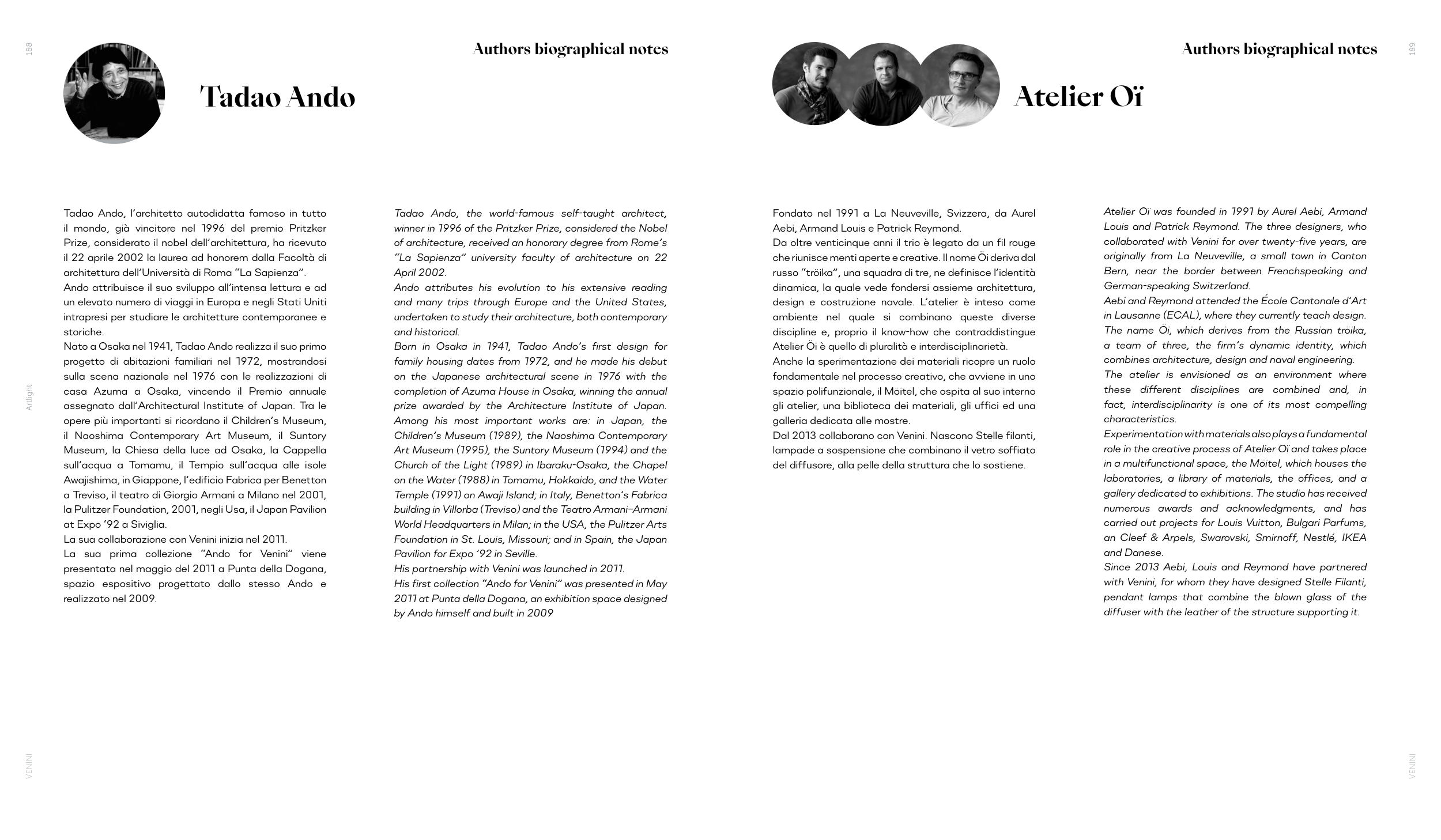
Tadao Ando
Tadao Ando, l’architetto autodidatta famoso in tutto
il mondo, già vincitore nel 1996 del premio Pritzker
Prize, considerato il nobel dell’architettura, ha ricevuto
il 22 aprile 2002 la laurea ad honorem dalla Facoltà di
architettura dell’Università di Roma “La Sapienza”.
Ando attribuisce il suo sviluppo all’intensa lettura e ad
un elevato numero di viaggi in Europa e negli Stati Uniti
intrapresi per studiare le architetture contemporanee e
storiche.
Nato a Osaka nel 1941, Tadao Ando realizza il suo primo
progetto di abitazioni familiari nel 1972, mostrandosi
sulla scena nazionale nel 1976 con le realizzazioni di
casa Azuma a Osaka, vincendo il Premio annuale
assegnato dall’Architectural Institute of Japan. Tra le
opere più importanti si ricordano il Children’s Museum,
il Naoshima Contemporary Art Museum, il Suntory
Museum, la Chiesa della luce ad Osaka, la Cappella
sull’acqua a Tomamu, il Tempio sull’acqua alle isole
Awajishima, in Giappone, l’edificio Fabrica per Benetton
a Treviso, il teatro di Giorgio Armani a Milano nel 2001,
la Pulitzer Foundation, 2001, negli Usa, il Japan Pavilion
at Expo ‘92 a Siviglia.
La sua collaborazione con Venini inizia nel 2011.
La sua prima collezione “Ando for Venini” viene
presentata nel maggio del 2011 a Punta della Dogana,
spazio espositivo progettato dallo stesso Ando e
realizzato nel 2009.
Tadao Ando, the world-famous self-taught architect,
winner in 1996 of the Pritzker Prize, considered the Nobel
of architecture, received an honorary degree from Rome’s
“La Sapienza” university faculty of architecture on 22
April 2002.
Ando attributes his evolution to his extensive reading
and many trips through Europe and the United States,
undertaken to study their architecture, both contemporary
and historical.
Born in Osaka in 1941, Tadao Ando’s first design for
family housing dates from 1972, and he made his debut
on the Japanese architectural scene in 1976 with the
completion of Azuma House in Osaka, winning the annual
prize awarded by the Architecture Institute of Japan.
Among his most important works are: in Japan, the
Children’s Museum (1989), the Naoshima Contemporary
Art Museum (1995), the Suntory Museum (1994) and the
Church of the Light (1989) in Ibaraku-Osaka, the Chapel
on the Water (1988) in Tomamu, Hokkaido, and the Water
Temple (1991) on Awaji Island; in Italy, Benetton’s Fabrica
building in Villorba (Treviso) and the Teatro Armani–Armani
World Headquarters in Milan; in the USA, the Pulitzer Arts
Foundation in St. Louis, Missouri; and in Spain, the Japan
Pavilion for Expo ’92 in Seville.
His partnership with Venini was launched in 2011.
His first collection “Ando for Venini” was presented in May
2011 at Punta della Dogana, an exhibition space designed
by Ando himself and built in 2009
Authors biographical notes
Artlight
188
VENINI
Atelier Oï
Fondato nel 1991 a La Neuveville, Svizzera, da Aurel
Aebi, Armand Louis e Patrick Reymond.
Da oltre venticinque anni il trio è legato da un fil rouge
che riunisce menti aperte e creative. Il nome Öi deriva dal
russo “tröika”, una squadra di tre, ne definisce l’identità
dinamica, la quale vede fondersi assieme architettura,
design e costruzione navale. L’atelier è inteso come
ambiente nel quale si combinano queste diverse
discipline e, proprio il know-how che contraddistingue
Atelier Öi è quello di pluralità e interdisciplinarietà.
Anche la sperimentazione dei materiali ricopre un ruolo
fondamentale nel processo creativo, che avviene in uno
spazio polifunzionale, il Möitel, che ospita al suo interno
gli atelier, una biblioteca dei materiali, gli uffici ed una
galleria dedicata alle mostre.
Dal 2013 collaborano con Venini. Nascono Stelle filanti,
lampade a sospensione che combinano il vetro soffiato
del diffusore, alla pelle della struttura che lo sostiene.
Atelier Oï was founded in 1991 by Aurel Aebi, Armand
Louis and Patrick Reymond. The three designers, who
collaborated with Venini for over twenty-five years, are
originally from La Neuveville, a small town in Canton
Bern, near the border between Frenchspeaking and
German-speaking Switzerland.
Aebi and Reymond attended the École Cantonale d’Art
in Lausanne (ECAL), where they currently teach design.
The name Öi, which derives from the Russian tröika,
a team of three, the firm’s dynamic identity, which
combines architecture, design and naval engineering.
The atelier is envisioned as an environment where
these different disciplines are combined and, in
fact, interdisciplinarity is one of its most compelling
characteristics.
Experimentation with materials also plays a fundamental
role in the creative process of Atelier Oï and takes place
in a multifunctional space, the Möitel, which houses the
laboratories, a library of materials, the offices, and a
gallery dedicated to exhibitions. The studio has received
numerous awards and acknowledgments, and has
carried out projects for Louis Vuitton, Bulgari Parfums,
an Cleef & Arpels, Swarovski, Smirnoff, Nestlé, IKEA
and Danese.
Since 2013 Aebi, Louis and Reymond have partnered
with Venini, for whom they have designed Stelle Filanti,
pendant lamps that combine the blown glass of the
diffuser with the leather of the structure supporting it.
Authors biographical notes
189
VENINI