22
23
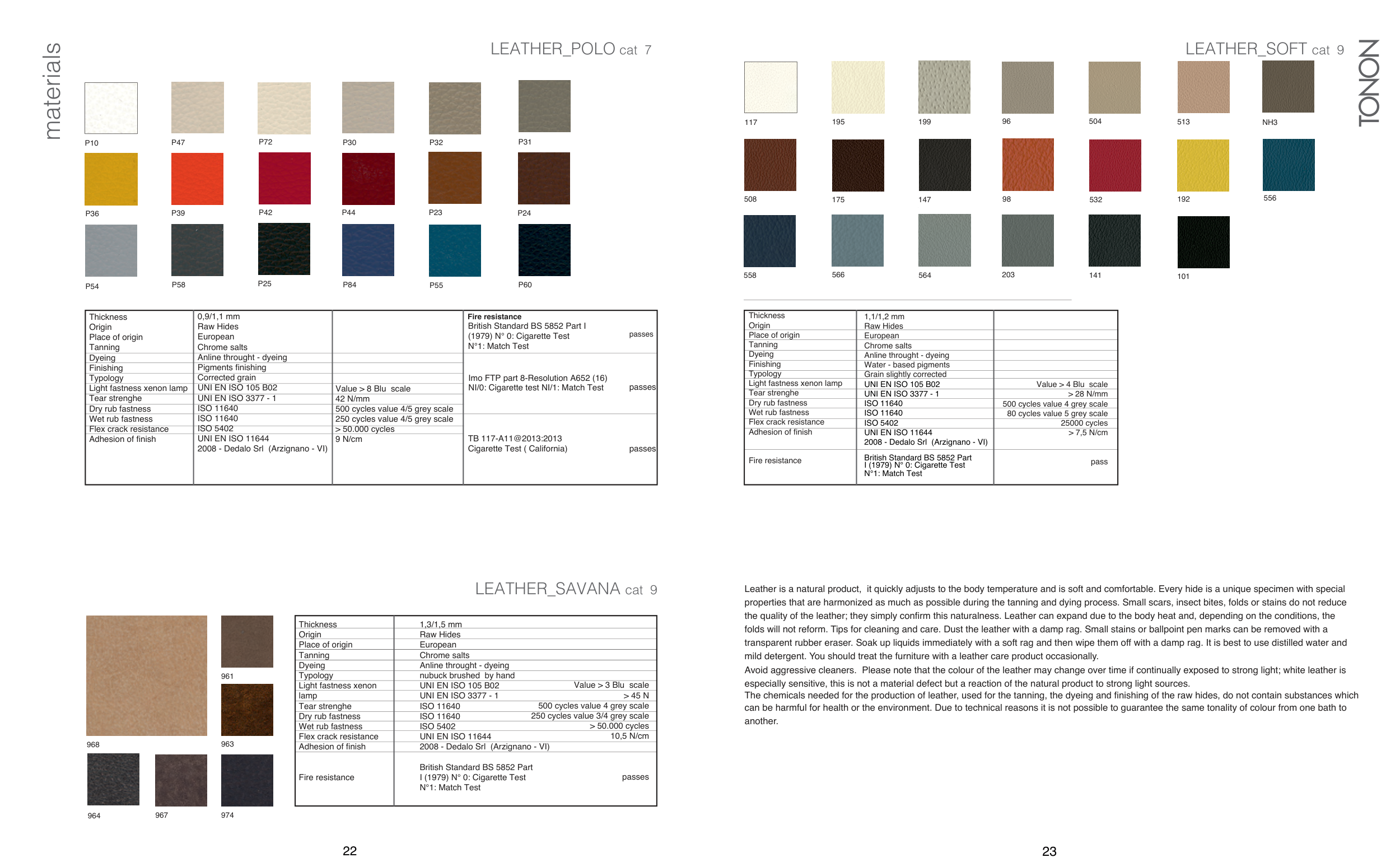
NH3
203
192
556
564
566
117
195
199
96
504
558
147
101
513
532
141
508
98
175
Thickness
Origin
Place of origin
Tanning
Dyeing
Finishing
Typology
Light fastness xenon lamp
Tear strenghe
Dry rub fastness
Wet rub fastness
Flex crack resistance
Adhesion of finish
Fire resistance
Value > 4 Blu scale
> 28 N/mm
500 cycles value 4 grey scale
80 cycles value 5 grey scale
25000 cycles
> 7,5 N/cm
pass
1,1/1,2 mm
Raw Hides
European
Chrome salts
Anline throught - dyeing
Water - based pigments
Grain slightly corrected
UNI EN ISO 105 B02
UNI EN ISO 3377 - 1
ISO 11640
ISO 11640
ISO 5402
UNI EN ISO 11644
2008 - Dedalo Srl (Arzignano - VI)
British Standard BS 5852 Part
I (1979) N° 0: Cigarette Test
N°1: Match Test
LEATHER_SOFT cat 9
materials
968
964
961
967
974
963
Thickness
Origin
Place of origin
Tanning
Dyeing
Typology
Light fastness xenon
lamp
Tear strenghe
Dry rub fastness
Wet rub fastness
Flex crack resistance
Adhesion of finish
Fire resistance
Value > 3 Blu scale
> 45 N
500 cycles value 4 grey scale
250 cycles value 3/4 grey scale
> 50.000 cycles
10,5 N/cm
passes
1,3/1,5 mm
Raw Hides
European
Chrome salts
Anline throught - dyeing
nubuck brushed by hand
UNI EN ISO 105 B02
UNI EN ISO 3377 - 1
ISO 11640
ISO 11640
ISO 5402
UNI EN ISO 11644
2008 - Dedalo Srl (Arzignano - VI)
British Standard BS 5852 Part
I (1979) N° 0: Cigarette Test
N°1: Match Test
LEATHER_SAVANA cat 9
LEATHER_POLO cat 7
P54
P42
P23
P32
P44
P10
P36
P72
P39
P58
P60
P30
P55
P84
P24
P25
P31
P47
Leather is a natural product, it quickly adjusts to the body temperature and is soft and comfortable. Every hide is a unique specimen with special
properties that are harmonized as much as possible during the tanning and dying process. Small scars, insect bites, folds or stains do not reduce
the quality of the leather; they simply confirm this naturalness. Leather can expand due to the body heat and, depending on the conditions, the
folds will not reform. Tips for cleaning and care. Dust the leather with a damp rag. Small stains or ballpoint pen marks can be removed with a
transparent rubber eraser. Soak up liquids immediately with a soft rag and then wipe them off with a damp rag. It is best to use distilled water and
mild detergent. You should treat the furniture with a leather care product occasionally.
Avoid aggressive cleaners. Please note that the colour of the leather may change over time if continually exposed to strong light; white leather is
especially sensitive, this is not a material defect but a reaction of the natural product to strong light sources.
The chemicals needed for the production of leather, used for the tanning, the dyeing and finishing of the raw hides, do not contain substances which
can be harmful for health or the environment. Due to technical reasons it is not possible to guarantee the same tonality of colour from one bath to
another.
Thickness
Origin
Place of origin
Tanning
Dyeing
Finishing
Typology
Light fastness xenon lamp
Tear strenghe
Dry rub fastness
Wet rub fastness
Flex crack resistance
Adhesion of finish
Fire resistance
Value > 8 Blu scale
42 N/mm
500 cycles value 4/5 grey scale
250 cycles value 4/5 grey scale
> 50.000 cycles
9 N/cm
passes
passes
passes
0,9/1,1 mm
Raw Hides
European
Chrome salts
Anline throught - dyeing
Pigments finishing
Corrected grain
UNI EN ISO 105 B02
UNI EN ISO 3377 - 1
ISO 11640
ISO 11640
ISO 5402
UNI EN ISO 11644
2008 - Dedalo Srl (Arzignano - VI)
TB 117-A11@2013:2013
Cigarette Test ( California)
Imo FTP part 8-Resolution A652 (16)
NI/0: Cigarette test NI/1: Match Test
British Standard BS 5852 Part I
(1979) N° 0: Cigarette Test
N°1: Match Test