viel tiefer in der DNA von Thonet. Denn noch bevor Michael
Thonet Mitte des 19. Jahrhunderts das Biegen von Massivholz
perfektionierte, experimentierte er mit verleimtem Holz, das
er in Formen presste. So entwickelte er in den 1830er Jahren
den kurvigen Bopparder Stuhl aus in Leim gekochten und
gebogenen Furnierbündeln. Ein erstaunlich modernes Möbel,
bei dem sich Gestaltung, Material und Konstruktion gegenseitig
bedingten – der Stuhl wäre in klassischer Tischlermanier aus
Massivholz nicht zu bauen gewesen. Doch die innovative
Konstruktion hatte auch ihre Tücken: Als Thonet eine Ladung
Bopparder Stühle nach Südamerika verschiffen ließ, hielt der
Leim dem feucht-warmen Klima nicht stand. Gebogenes Massiv-
holz erwies sich als widerstandsfähiger und schichtverleimte
Holzwerkstoffe waren für ein halbes Jahrhundert passé bei
Thonet – bis dauerhaftere Leime und optimierte Fertigungsver-
fahren entwickelt wurden.
Nach dem Zweiten Weltkrieg war Formholz das Material der
Stunde und zugleich ein Motor für Innovation. Die Freude am
organischen Design bestimmte die Welt der Gestaltung, Möbel
brachten Leichtigkeit und Schwung ins Interieur. Gebogene
Sitzschalen, abgerundete Kanten – mit Formholz kamen Stühle
und Sessel ins Schweben. Thonet legte unter dem Titel „Bent Ply“
sogar eine eigene Formholz-Kollektion auf. Bent Ply ist eine
kongeniale Synthese aus den englischen Begriffen „Bent Wood“
für Bugholz und „Ply Wood“ für Schichtholz – beides genuine
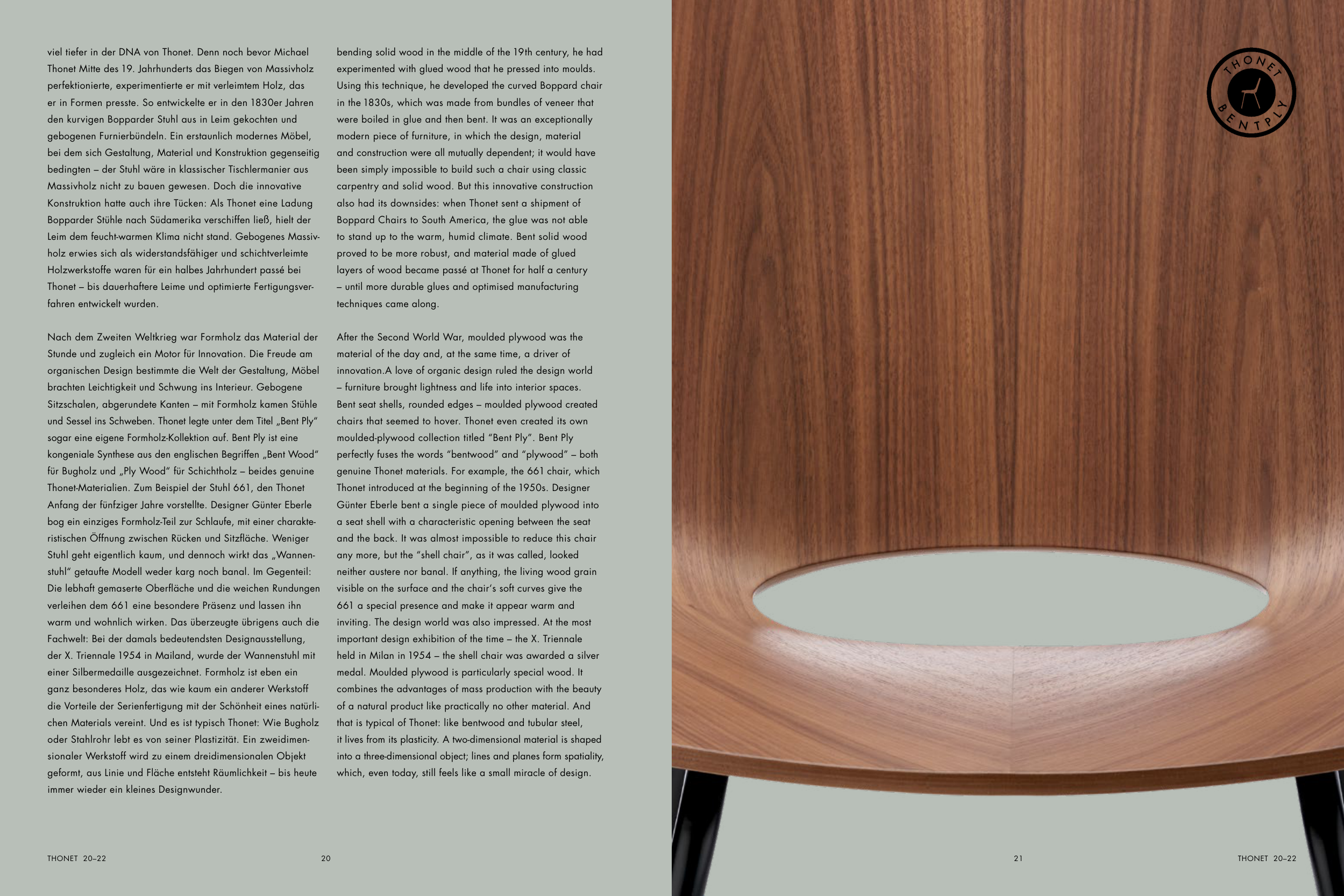
Thonet-Materialien. Zum Beispiel der Stuhl 661, den Thonet
Anfang der fünfziger Jahre vorstellte. Designer Günter Eberle
bog ein einziges Formholz-Teil zur Schlaufe, mit einer charakte-
ristischen Öffnung zwischen Rücken und Sitzfläche. Weniger
Stuhl geht eigentlich kaum, und dennoch wirkt das „Wannen-
stuhl“ getaufte Modell weder karg noch banal. Im Gegenteil:
Die lebhaft gemaserte Oberfläche und die weichen Rundungen
verleihen dem 661 eine besondere Präsenz und lassen ihn
warm und wohnlich wirken. Das überzeugte übrigens auch die
Fachwelt: Bei der damals bedeutendsten Designausstellung,
der X. Triennale 1954 in Mailand, wurde der Wannenstuhl mit
einer Silbermedaille ausgezeichnet. Formholz ist eben ein
ganz besonderes Holz, das wie kaum ein anderer Werkstoff
die Vorteile der Serienfertigung mit der Schönheit eines natürli-
chen Materials vereint. Und es ist typisch Thonet: Wie Bugholz
oder Stahlrohr lebt es von seiner Plastizität. Ein zweidimen-
sionaler Werkstoff wird zu einem dreidimensionalen Objekt
geformt, aus Linie und Fläche entsteht Räumlichkeit – bis heute
immer wieder ein kleines Designwunder.
bending solid wood in the middle of the 19th century, he had
experimented with glued wood that he pressed into moulds.
Using this technique, he developed the curved Boppard chair
in the 1830s, which was made from bundles of veneer that
were boiled in glue and then bent. It was an exceptionally
modern piece of furniture, in which the design, material
and construction were all mutually dependent; it would have
been simply impossible to build such a chair using classic
carpentry and solid wood. But this innovative construction
also had its downsides: when Thonet sent a shipment of
Boppard Chairs to South America, the glue was not able
to stand up to the warm, humid climate. Bent solid wood
proved to be more robust, and material made of glued
layers of wood became passé at Thonet for half a century
– until more durable glues and optimised manufacturing
techniques came along.
After the Second World War, moulded plywood was the
material of the day and, at the same time, a driver of
innovation.A love of organic design ruled the design world
– furniture brought lightness and life into interior spaces.
Bent seat shells, rounded edges – moulded plywood created
chairs that seemed to hover. Thonet even created its own
moulded-plywood collection titled “Bent Ply”. Bent Ply
perfectly fuses the words “bentwood” and “plywood” – both
genuine Thonet materials. For example, the 661 chair, which
Thonet introduced at the beginning of the 1950s. Designer
Günter Eberle bent a single piece of moulded plywood into
a seat shell with a characteristic opening between the seat
and the back. It was almost impossible to reduce this chair
any more, but the “shell chair”, as it was called, looked
neither austere nor banal. If anything, the living wood grain
visible on the surface and the chair‘s soft curves give the
661 a special presence and make it appear warm and
inviting. The design world was also impressed. At the most
important design exhibition of the time – the X. Triennale
held in Milan in 1954 – the shell chair was awarded a silver
medal. Moulded plywood is particularly special wood. It
combines the advantages of mass production with the beauty
of a natural product like practically no other material. And
that is typical of Thonet: like bentwood and tubular steel,
it lives from its plasticity. A two-dimensional material is shaped
into a three-dimensional object; lines and planes form spatiality,
which, even today, still feels like a small miracle of design.
21
20
THONET 20–22
THONET 20–22