THONET
BENTPLY
DE
Formholz ist ein ganz besonders Holz. So leicht,
stabil und formbar, wie es ist, hat es die Gestalterinnen und
Gestalter der Moderne zu kühnen Entwürfen beflügelt. Ent-
würfe, die in ihrer organischen Ästhetik bis heute Gültigkeit
haben und mit denen wir uns gern umgeben. Zwar kommt
Formholz genauso wie Massivholz ursprünglich aus dem Wald.
Doch sobald der Baum gefällt und entrindet ist, trennen sich
die Wege. Formholz ist ein durch und durch modernes Material,
das Produkt eines industriellen Herstellungsprozesses, bei dem
die natürlichen Eigenschaften verändert, ja verbessert werden.
Dafür wird der Baumstamm zunächst zu einem Endlos-Furnier
„abgeschält“. Dann wird das Furnier zugeschnitten und in
mehreren Lagen kreuzweise verleimt. So sind die Zuschnitte
in alle Richtungen belastbar. Anschließend werden sie unter
Druck und Hitze verpresst und lassen sich dabei zu zweidimen-
sionalen Platten oder komplexen dreidimensionalen Objekten
formen. Elegant gekurvte Sessel, rasante Boots- und Flugzeug-
rümpfe: Formholz verkörpert wie verchromtes Stahlrohr oder
Beton den Enthusiasmus der Moderne, den Aufbruch in eine
neue Zeit. Dünne Holzschichten miteinander zu verleimen ist
allerdings beileibe keine Erfindung der Moderne. Schon die
alten Ägypter kannten das Prinzip: Sie verwendeten Furniere
und Schichthölzer im Möbel- und Wagenbau. Auch für das
antike China und Rom lassen sich ähnliche Objekte nachweisen.
Doch erst in der Zeit der industriellen Revolution schufen
Erfindungen wie der rotierende Furnierschneider oder die
Heißpresse die Voraussetzung, das altbekannte Material
weiterzuentwickeln – zum modernen Formholz.
Thonet entdeckte das Formholz im Jahr 1876. Franz Thonet,
einer der Söhne von Firmengründer Michael Thonet, reiste
damals zur Weltausstellung nach Philadelphia. Unter den
Ausstellern: ein amerikanisches Unternehmen, das Stühle mit
Sitzen aus Formholz präsentierte. Offensichtlich machten
die Möbel Eindruck, denn ein Jahr später stellte Thonet seinen
Stuhl Nr. 18 vor, den ersten mit Sitz- und Rückenteilen aus
dem neuen Material. Weitere Modelle in dieser innovativen
Konstruktionsweise folgten und Formholz etablierte sich als
Alternative zum Wiener Geflecht. 1888 tauchte in einem
Thonet-Katalog erstmals der Begriff „thermoplastische Holz-
sitze“ auf. Auch als Gestalterinnen und Gestalter in den
1920er Jahren mit dem gebogenen Stahlrohr das Möbeldesign
revolutionierten, wurde das geschichtete und geformte Holz
nicht obsolet: Der Stuhl S 43 von Mart Stam etwa wird von
Thonet bis heute mit Rücken- und Sitzfläche aus gebogenem
Formholz produziert. Aber eigentlich steckt der Werkstoff noch
DE
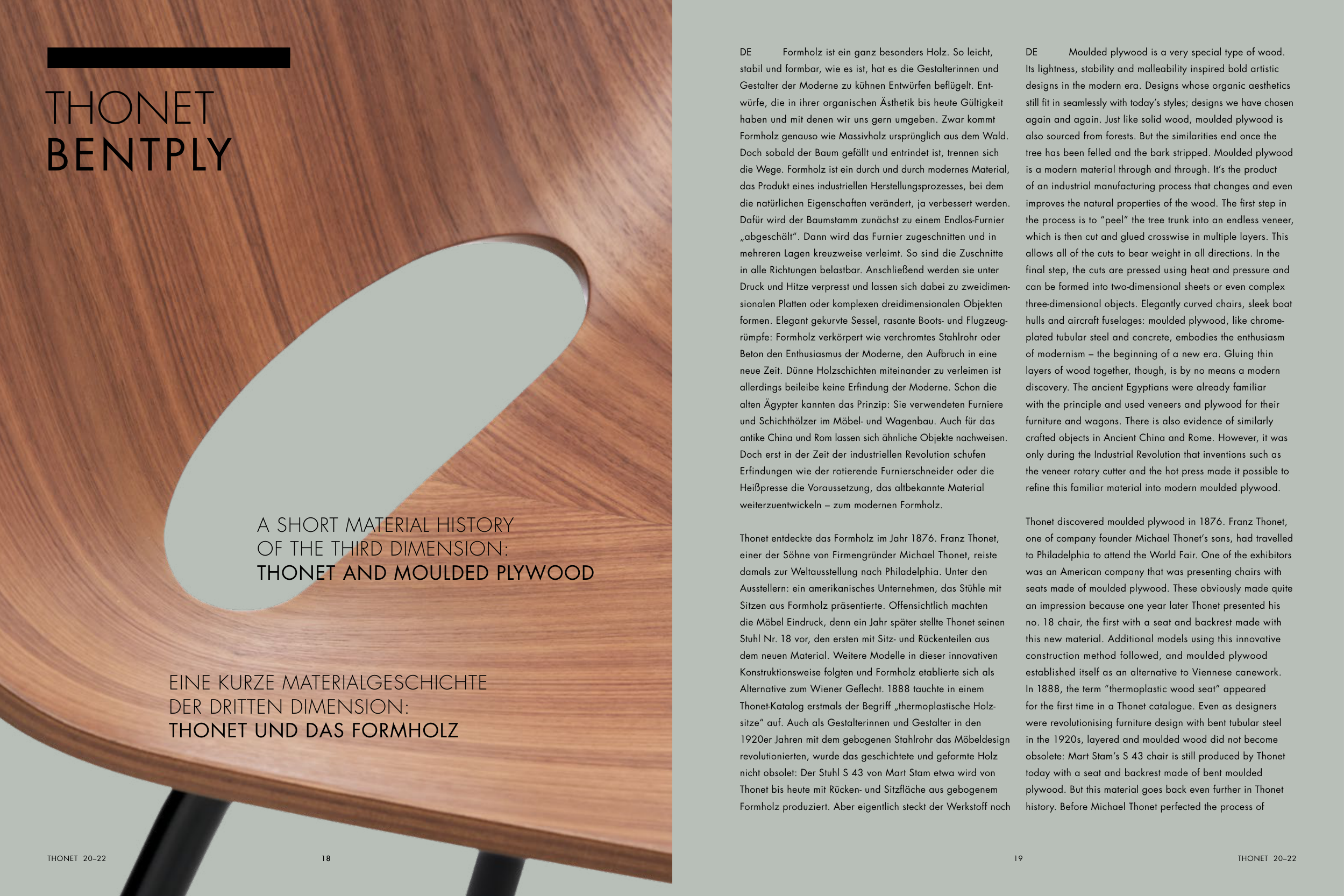
Moulded plywood is a very special type of wood.
Its lightness, stability and malleability inspired bold artistic
designs in the modern era. Designs whose organic aesthetics
still fit in seamlessly with today’s styles; designs we have chosen
again and again. Just like solid wood, moulded plywood is
also sourced from forests. But the similarities end once the
tree has been felled and the bark stripped. Moulded plywood
is a modern material through and through. It’s the product
of an industrial manufacturing process that changes and even
improves the natural properties of the wood. The first step in
the process is to “peel” the tree trunk into an endless veneer,
which is then cut and glued crosswise in multiple layers. This
allows all of the cuts to bear weight in all directions. In the
final step, the cuts are pressed using heat and pressure and
can be formed into two-dimensional sheets or even complex
three-dimensional objects. Elegantly curved chairs, sleek boat
hulls and aircraft fuselages: moulded plywood, like chrome-
plated tubular steel and concrete, embodies the enthusiasm
of modernism – the beginning of a new era. Gluing thin
layers of wood together, though, is by no means a modern
discovery. The ancient Egyptians were already familiar
with the principle and used veneers and plywood for their
furniture and wagons. There is also evidence of similarly
crafted objects in Ancient China and Rome. However, it was
only during the Industrial Revolution that inventions such as
the veneer rotary cutter and the hot press made it possible to
refine this familiar material into modern moulded plywood.
Thonet discovered moulded plywood in 1876. Franz Thonet,
one of company founder Michael Thonet’s sons, had travelled
to Philadelphia to attend the World Fair. One of the exhibitors
was an American company that was presenting chairs with
seats made of moulded plywood. These obviously made quite
an impression because one year later Thonet presented his
no. 18 chair, the first with a seat and backrest made with
this new material. Additional models using this innovative
construction method followed, and moulded plywood
established itself as an alternative to Viennese canework.
In 1888, the term “thermoplastic wood seat” appeared
for the first time in a Thonet catalogue. Even as designers
were revolutionising furniture design with bent tubular steel
in the 1920s, layered and moulded wood did not become
obsolete: Mart Stam’s S 43 chair is still produced by Thonet
today with a seat and backrest made of bent moulded
plywood. But this material goes back even further in Thonet
history. Before Michael Thonet perfected the process of
A SHORT MATERIAL HISTORY
OF THE THIRD DIMENSION:
THONET AND MOULDED PLYWOOD
EINE KURZE MATERIALGESCHICHTE
DER DRITTEN DIMENSION:
THONET UND DAS FORMHOLZ
19
18
18
THONET 20–22
THONET 20–22