30 THONET
THONET 31
MAGAZIN 2021
KULTUR / CULTURE
These individual offices were previously complemented by the board room, used for large-scale meetings. Long meetings were in keeping with a top-down style of management.
Today, conference rooms for the directors and supervisory board are geared more strongly towards communication and a changed style of leadership. The changes are even
tangible in the events sector. Large meeting rooms are no longer limited to seating in a traditional theatre layout but offer a mix of open spaces and versatile layout options.
The exciting thing about the new hybrid concepts is that spaces and activities are increasingly overlapping and merging. We have now learned what to do with these new
degrees of freedom, which also have an influence on architecture, interior design and organisational structures as well as directly impacting how employees behave.
Just because somebody moves about the room does not mean that they have stopped working or stopped thinking about the task in hand. Compliance with the process rule of
“sit at your desk” is less of a priority. More important is the result of the work, whenever and wherever that work is performed. Freedom of choice is an integral aspect of
freedom. Switching between quiet, focused work and interaction is easier if employees can choose between an appropriately configured chair or sofa arrangement, which,
in any case, is better than being tied to a desk.
WHAT WE REALLY, REALLY WANT
The German-American social philosopher Frithjof
Bergmann (1930-2021) considered autonomy, freedom
and participation in the community as the core values
of his New Work concept. Bergmann developed this
concept in the early 1980s to offer the US automotive
industry constructive alternatives to the mass lay-off of
workers. The idea was that these workers would
initially be employed as usual for a six-month period,
and then work in a self-determined capacity for the
same length of time. His hope was that New Work
would make wage labour superfluous in the long run or
reduce it to simply a partial aspect. In his view, wage
labour was a bit like a mild illness. And just like with
the flu, workers affected on a Wednesday would say:
“I can make it through to Friday.”
From the initial project, Bergmann developed the idea
of New Work together with a number of followers,
promoting a new understanding of work that involves
finding out what people really, really want. Bergmann
used surveys of car maker employees for this purpose.
The aim was to generate a form of self-empowerment
to try out other forms of meaningful activity and, with
them, new business models. Bergmann’s theories have
an enthusiastic following today, particularly in the
office furniture sector and start-up scene.
In 2006, Holm Friebe and Sascha Lobo published their
book “Wir nennen es Arbeit” (We call it work), in
which they paid homage to the “digital bohemian” or
“intelligent life beyond permanent full-time jobs”. They
presented projects that tried out new forms of work
using the latest technology. The Berlin-based digital
bohemian of the time was the equivalent of a free-
lancer equipped with a laptop who organised his
global entrepreneurial activities from a café via wifi.
Today, some cafés have evolved into coworking
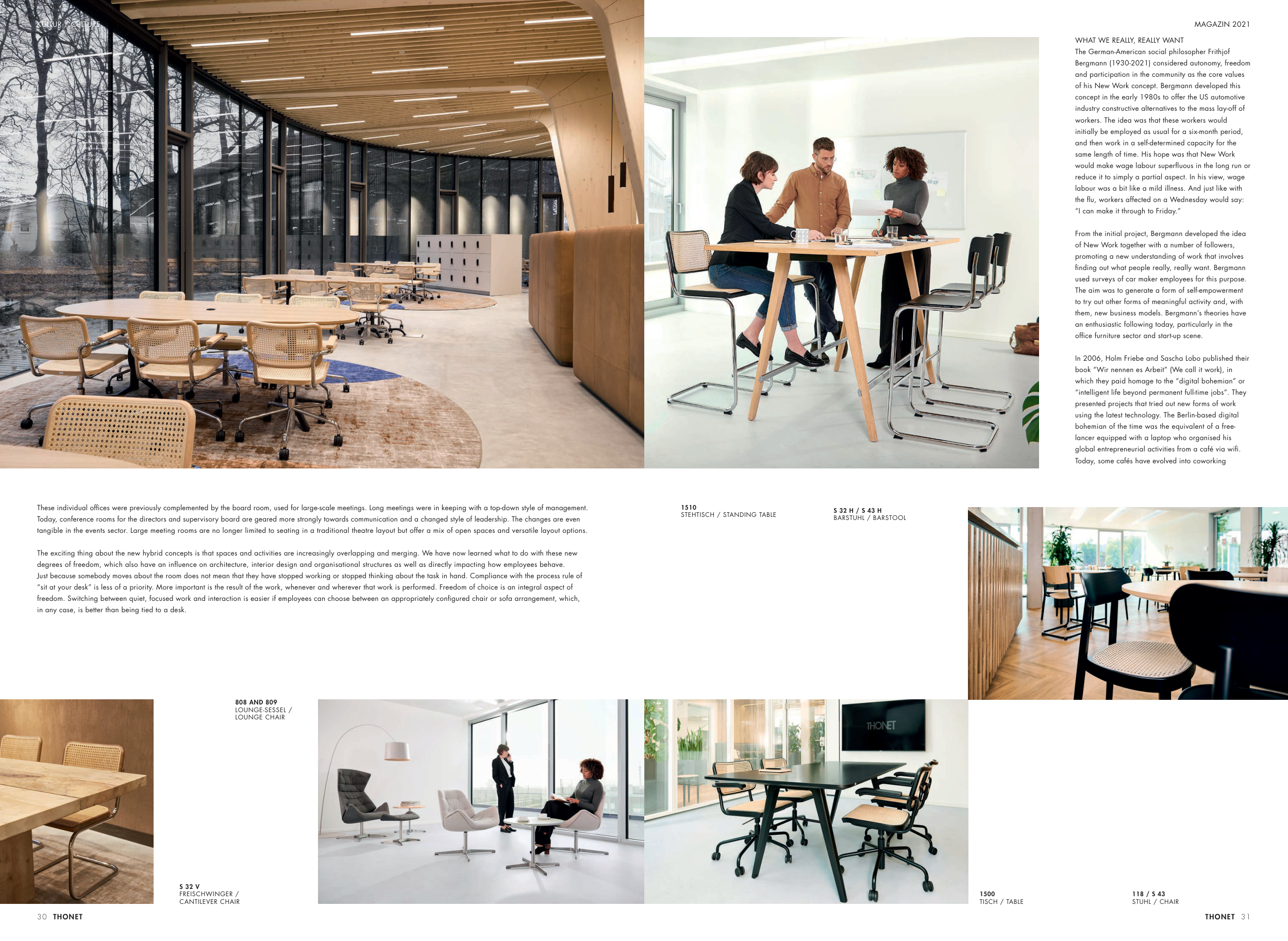
1500
TISCH / TABLE
118 / S 43
STUHL / CHAIR
1510
STEHTISCH / STANDING TABLE
S 32 H / S 43 H
BARSTUHL / BARSTOOL
S 32 V
FREISCHWINGER /
CANTILEVER CHAIR
808 AND 809
LOUNGE-SESSEL /
LOUNGE CHAIR