22 THONET
THONET 23
The table also became a part of the Thonet portfolio. How did that come to be?
We had had a friendly relationship with Thonet for many years. Early on in the
planning and conception stage of the Lyngby project, I got in touch with Norbert Ruf,
Creative Director and Managing Director at Thonet, to discuss whether we could
work together to create a table solution. Based on the design brief that we set
ourselves, the tables required for the Lyngby project were complex and, at the same
time, archetypal. We wanted:
a wooden table with four legs
an archetype, the epitome of a table
a sustainable wooden table
a table that was easy to transport, in other words one that could be disassembled
a table that could be manufactured in a variety of sizes
an extremely stable table
a table with longevity, in other words basic, simple, unobtrusive and timeless
These requirements from our design brief made it easy to find common ground with
Thonet. Thonet is synonymous with archetypical, simple, clean designs that are both
timeless and sustainable, and that incorporate smart engineering solutions.
Wie kam es parallel dazu, dass der Tisch Teil des Thonet-Programms wurde?
Der freundschaftliche Kontakt zu Thonet besteht schon seit vielen Jahren. Ich hatte
dann sehr früh in der Planungs- und Konzeptionsphase des Lyngby-Bauprojekts mit
Norbert Ruf, Creative Director und Geschäftsführer bei Thonet, Kontakt aufgenommen,
um zu diskutieren, ob wir hier eine gemeinsame Tischlösung erarbeiten könnten.
Denn die Tische, die in Lyngby benötigt wurden, waren in Bezug auf unser selbst
gestelltes Briefing komplex und gleichzeitig archetypisch. Was wir wollten:
einen Vierbeiner aus Holz
einen Archetyp, also der Inbegriff eines Tisches
einen nachhaltigen Holztisch
einen einfach zu transportierenden, also demontierbaren Tisch
einen in unterschiedlichsten Größen realisierbaren Tisch
einen super stabilen Tisch
einen Longrunner, also basic, einfach, unaufgeregt und zeitlos
Mit diesen selbst gebrieften Vorgaben war die Schnittmenge mit Thonet schnell
gefunden, denn Thonet steht für archetypische, unaufgeregte klare Entwürfe, die zeit-
los und nachhaltig sind und gleichzeitig schlaue Ingenieurslösungen inkorporieren.
Wie sind Sie an den Entwurf herangegangen? Man soll auf dem 1140 tanzen
können – woher kam dieses Briefing? Haben Sie sich in Ihre eigene Studentenzeit
versetzt?
Ich wollte einen Tisch kreieren, der nicht nur für Student:innen der Inbegriff eines
Tischs sein kann, sondern darüber hinaus eine komplette Allgemeingültigkeit für
alle Generationen und Nutzer:innen haben könnte. Also einen Archetyp, wie Kinder
einen Tisch zeichnen würden, wie Familien ihn als Esstisch benötigen, Studierende
einen „Studytable“ brauchen, der in Coworking-Bereichen oder Besprechungsräumen
genauso selbstverständlich steht wie in großzügigen Privathäusern als Tafel oder
gemütlichen Ferienhäusern als Community-Treffpunkt. Tische sollten im besten Fall
Stabilität, Solidität, Vertrauen und extreme Langlebigkeit ausstrahlen – ein statisch
stabiles, schwebendes Plateau, auf dem man bei einer wilden Hochzeit tanzen kann…
Tische sind wie Bühnen, auf denen das Leben über Generationen intensiv gelebt wird.
Was war für Sie die größte Herausforderung bei der Entwicklung des Tischs?
Die große Herausforderung war für uns alle, die ästhetisch dezente Anbindung der
Beine an die Platte. Es gibt in der Designgeschichte wenige Tische, die so große
Maße (z. B. 250 x 100 cm) ohne Zarge unter der Platte so stabil gewährleisten wie
der 1140. Der komplexe Eckverbinder, der nach vielen Ideen und Probeläufen final
fast unsichtbar zwischen Bein und Platte integriert ist, schafft es, die Kräfte so zu
verteilen, dass ein extrem stabiles Konstrukt entsteht, ohne den Holztisch mit seinen
vier Massivholzbeinen kompliziert und technisch wirken zu lassen.
EN
Solid, yet light; understated, yet impressive: designed by Werner Aisslinger
as a “community hub”, the Thonet table 1140 brings together functionality, versatility
and elegant simplicity. This new design features solid oak legs, rounded on the outer
edge in a quarter circle, as well as smart, unobtrusive connecting elements on the
corners of the tabletop. The tabletop appears almost as if it were floating. Thanks to the
smart design, even chairs with armrests fit nicely under this extremely sturdy, stable
piece of furniture. These features, together with its attractive price point, mean that the
1140 can be used almost anywhere: in the home as a dining table or desk as well as in
the contract sector – from New Work contexts to coworking spaces, from restaurants to
hotels, from libraries to seminar rooms.
The 1140 was created for a very specific project: the BaseCamp student apartment
project in Lyngby. How did this collaboration come about?
My design office, studio aisslinger, worked on the BaseCamp project, headed by
the American investor and owner Armon Bar-Tur, from day one. Starting in 2015,
we developed the concept for the Europe-wide student apartment buildings,
continuously worked to optimise the planning and interior design and, as part
of the corporate design identity of the project, we were able to keep adding more
new and surprising local stories and themes. That’s what makes BaseCamp so
exciting; it doesn’t simply use the same brand on repeat, it’s a living brand world
that is constantly evolving. Our office, which is part product design studio and part
spatial design architectural office, aims to create new design projects and products
from our contract work. For example, to design new furniture or lamps that we need
for projects like BaseCamp, but that could also easily be used in other projects
or settings. The project in Lyngby, located on the outskirts of Copenhagen, has
650 rooms and was the third and largest BaseCamp apartment project for students
that we designed in the Danish capital alone. It has spacious communal areas
with large areas for work and study. These spaces needed a study table without an
elaborate support system underneath, so that chairs could easily be pushed under
it. It was also important that the product we designed was very sustainable because
the “customers” who would be using it are young students, the Fridays for Future
generation, who care deeply about using sustainable products in their living and
working spaces.
How did you approach the design? Who came up with the requirement of being able
to dance on the 1140? Was that you, thinking back to your student days?
I wanted to create a table that was not just a typical table for students, but one that
could also be used universally by all generations. An archetype, a piece that looks
like a table children would sit at to draw, one that families could use as a dining
table, students could study on, a table that would look good in co-working spaces
or conference rooms, in luxurious private homes or in cosy vacation apartments as a
gathering space. Ideally, tables should emanate stability, solidarity, trust and extreme
longevity – a stable, suspended plateau that you can dance on at a wild wedding
reception. Tables are like stages on which the lives of generations are played out in
all their intensity.
What was your biggest challenge when developing the table?
The biggest challenge for all of us was connecting the legs to the tabletop in an
aesthetically pleasing manner. Throughout design history, there have been few tables
like the 1140 that can adequately support such large dimensions (e.g. 250 x 100 cm)
without a support system under the tabletop. The complex die-cast aluminium connectors
in the corners, which, after much trial and error, we were able to almost invisibly
integrate into the legs and tabletop, distribute the weight extremely well. The end
result was an exceptionally stable wooden table with solid-wood legs that doesn’t
look too complex or technical.
What do you personally feel the table is best suited for? As a dining table in
a private home? As part of a co-working space? Or as a table in a student apartment,
where it can be used for studying, eating, hanging out and maybe even for some of
that dancing we were talking about?
My hope is that the table will be a loyal companion that is used in all stages of life:
by students, as a dining table in the home, as a stand-alone desk and in co-working
spaces, and then again as a table around which multiple generations can gather and
celebrate as a family.
In welcher Situation gefällt Ihnen persönlich der Tisch am besten?
Als Esstisch im privaten Wohnbereich. Als Tischlandschaft in Coworking-Spaces.
Oder doch als Allrounder in einem Studierendenzimmer, wo er zum Lernen,
Essen, Beisammensein und vielleicht ja tatsächlich als Tanzfläche genutzt wird?
Wie gesagt, in allen Lebenslagen – der Tisch wird im besten Fall zum „Companion“,
also einem Begleiter für das gesamte Leben: vom Studententisch zum Familientreffpunkt,
zum Coworking- und Arbeitstisch und wieder zur Familientafel, an der mehrere
Generationen zusammen Feste feiern.
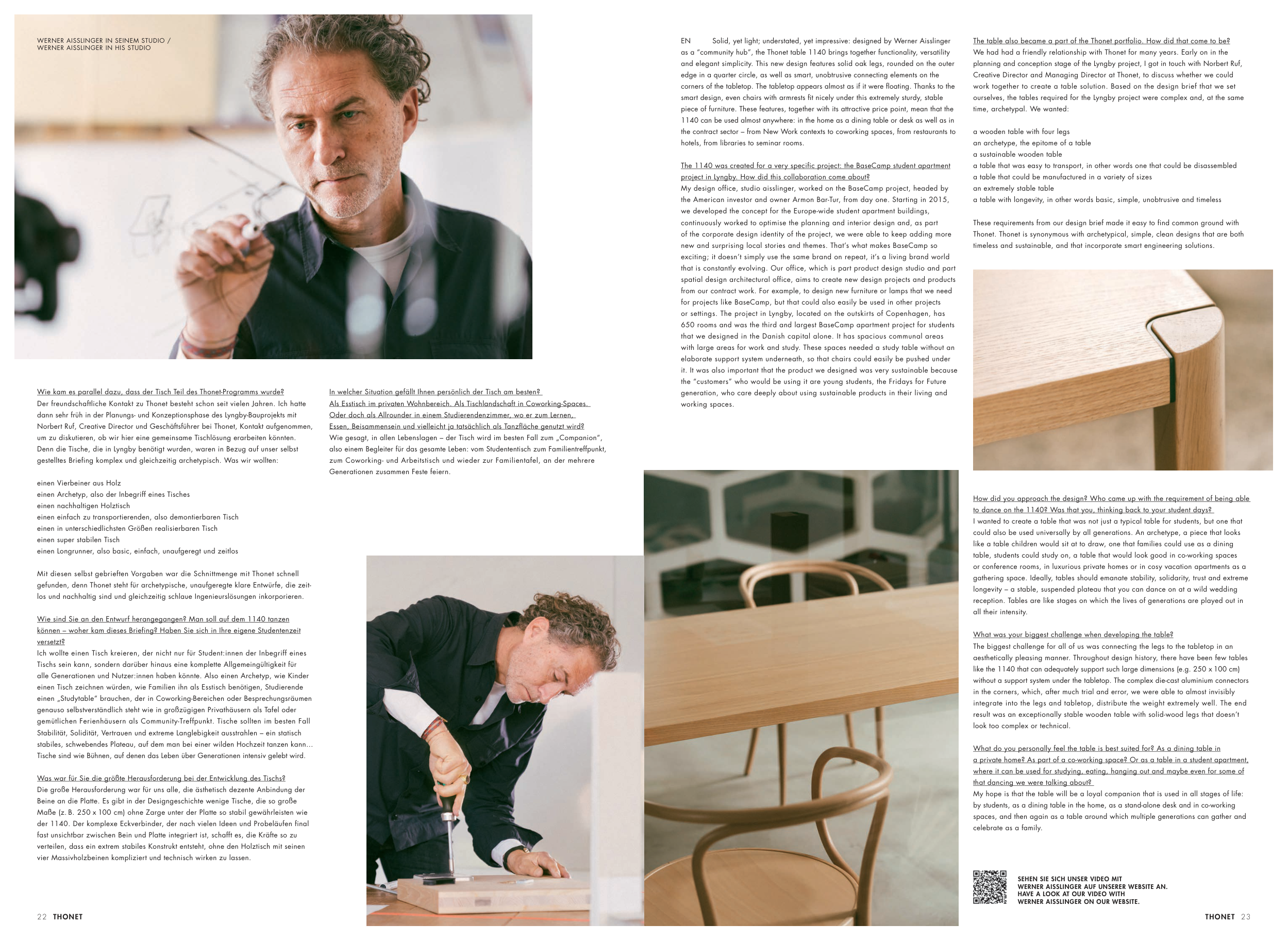
WERNER AISSLINGER IN SEINEM STUDIO /
WERNER AISSLINGER IN HIS STUDIO
SEHEN SIE SICH UNSER VIDEO MIT
WERNER AISSLINGER AUF UNSERER WEBSITE AN.
HAVE A LOOK AT OUR VIDEO WITH
WERNER AISSLINGER ON OUR WEBSITE.