7
6
Mit dem Wirken des Tischlermeisters Micha-
el Thonet (1796 bis 1871) begann unsere
traditionsreiche Unternehmensgeschichte.
In seinem Werk vollzog sich der Über-
gang von handwerklicher zu industrieller
Möbelfertigung. Der Durchbruch zur indus-
triellen Fertigung gelang Michael Thonet
1859 in Wien mit dem Stuhl Nr. 14, dem
später so genannten „Wiener Caféhaus-
Stuhl“, bei dem die neuartige Technologie
des Biegens von massivem Buchenholz
zum Einsatz kam. Die Arbeitsschritte waren
industriell standardisiert – erstmals in der
Möbelherstellung fand Arbeitsteilung statt.
Überdies war der Stuhl einfach zu zerlegen
und Platz sparend zu transportieren. Der
Stuhl ebnete uns den Weg zum Weltunter-
nehmen; zahlreiche erfolgreiche Bugholz-
Möbel folgten.
Die zweite Konstante im Thonet-Programm
bilden Stahlrohrmöbel. In den 1930er Jahren
war das Unternehmen der weltweit größte
Produzent dieser neuartigen Möbel, die
von berühmten Architekten wie Mart Stam,
Ludwig Mies van der Rohe oder Marcel
Breuer stammten. Heute gelten die frühen
Stahlrohrmöbel als Meilensteine in der
Designgeschichte. Ihre klare, offene und
schlichte Form war Ausdruck einer neuen
Haltung in Alltagskultur und Architektur,
die unter dem Stichwort „Neue Sachlich-
keit“ bekannt wurde. Auch aktuell sind
zahlreiche klassische Erfolgsmodelle in
unserem Programm, darunter der erste
Freischwinger S 33, für dessen Form und
Grundprinzip Mart Stam das künstlerische
Ur heberrecht zugesprochen bekam,
sowie die Modelle S 32 und S 64 von
Marcel Breuer.
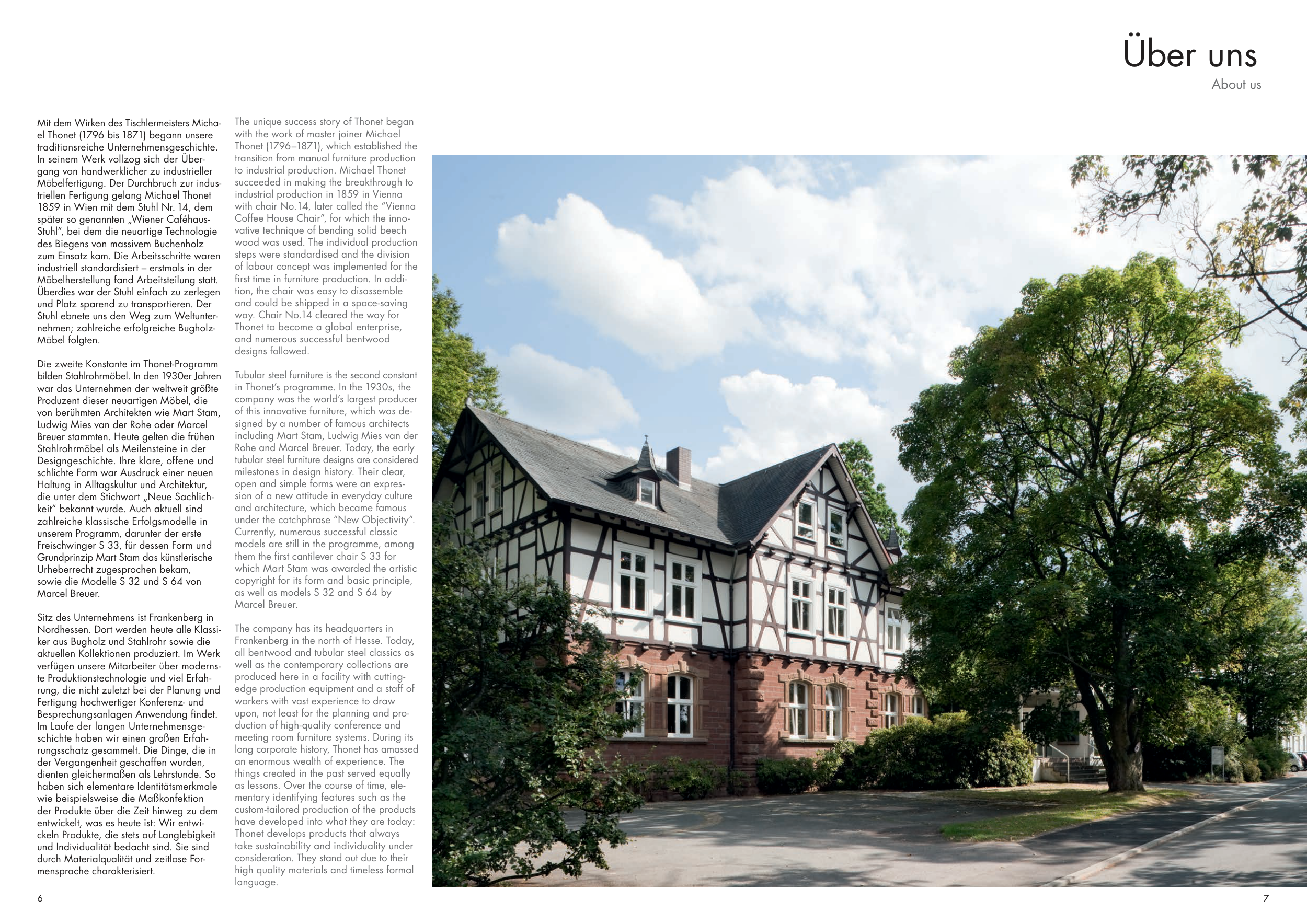
Sitz des Unternehmens ist Frankenberg in
Nordhessen. Dort werden heute alle Klassi-
ker aus Bugholz und Stahlrohr sowie die
aktuellen Kollektionen produziert. Im Werk
verfügen unsere Mitarbeiter über moderns-
te Produktionstechnologie und viel Erfah-
rung, die nicht zuletzt bei der Planung und
Fertigung hochwertiger Konferenz- und
Besprechungsanlagen Anwendung findet.
Im Laufe der langen Unternehmensge-
schichte haben wir einen großen Erfah-
rungsschatz gesammelt. Die Dinge, die in
der Vergangenheit geschaffen wurden,
dienten gleichermaßen als Lehrstunde. So
haben sich elementare Identitätsmerkmale
wie beispielsweise die Maßkonfektion
der Produkte über die Zeit hinweg zu dem
ent wickelt, was es heute ist: Wir entwi-
ckeln Produkte, die stets auf Langlebigkeit
und Individualität bedacht sind. Sie sind
durch Materialqualität und zeitlose For-
mensprache charakterisiert.
The unique success story of Thonet began
with the work of master joiner Michael
Thonet (1796–1871), which established the
transition from manual furniture production
to industrial production. Michael Thonet
succeeded in making the breakthrough to
industrial production in 1859 in Vienna
with chair No.14, later called the “Vienna
Coffee House Chair”, for which the inno-
vative technique of bending solid beech
wood was used. The individual production
steps were standardised and the division
of labour concept was implemented for the
first time in furniture production. In addi-
tion, the chair was easy to disassemble
and could be shipped in a space-saving
way. Chair No.14 cleared the way for
Thonet to become a global enterprise,
and numerous successful bentwood
designs followed.
Tubular steel furniture is the second constant
in Thonet’s programme. In the 1930s, the
company was the world’s largest producer
of this innovative furniture, which was de-
signed by a number of famous architects
including Mart Stam, Ludwig Mies van der
Rohe and Marcel Breuer. Today, the early
tubular steel furniture designs are considered
milestones in design history. Their clear,
open and simple forms were an expres-
sion of a new attitude in everyday culture
and architecture, which became famous
under the catchphrase “New Objectivity”.
Currently, numerous successful classic
models are still in the programme, among
them the first cantilever chair S 33 for
which Mart Stam was awarded the artistic
copyright for its form and basic principle,
as well as models S 32 and S 64 by
Marcel Breuer.
The company has its headquarters in
Frankenberg in the north of Hesse. Today,
all bentwood and tubular steel classics as
well as the contemporary collections are
produced here in a facility with cutting-
edge production equipment and a staff of
workers with vast experience to draw
upon, not least for the planning and pro-
duction of high-quality conference and
meeting room furniture systems. During its
long corporate history, Thonet has amassed
an enormous wealth of experience. The
things created in the past served equally
as lessons. Over the course of time, ele-
mentary identifying features such as the
custom-tailored production of the products
have developed into what they are today:
Thonet develops products that always
take sustainability and individuality under
consideration. They stand out due to their
high quality materials and timeless formal
language.
Über uns
About us